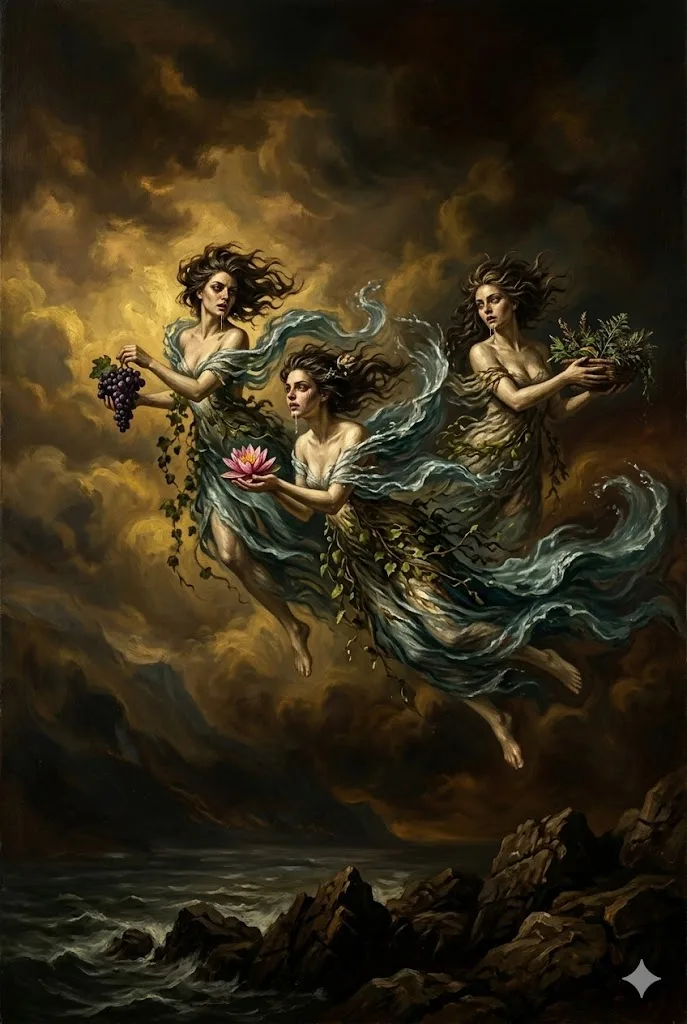
Everywhere in Nature
Nymphs were divine female nature spirits who inhabited virtually every feature of the natural landscape. They were not goddesses in the full Olympian sense but they were far more than mortal. They lived for thousands of years, possessed supernatural beauty, and could bless or curse those who encountered them. The Greeks believed that every river, spring, forest, mountain, meadow, and sea was alive with nymphs, making the entire natural world a sacred, inhabited space.
Types of Nymphs
Dryads were tree nymphs, each one bound to a specific tree. If the tree died, the Dryad died with it, which is why the Greeks considered cutting down an ancient tree a potentially fatal act of sacrilege. Hamadryads were a specific type of Dryad who were literally part of their tree. Naiads were freshwater nymphs of rivers, springs, streams, and fountains. They were considered the givers of fertility to the surrounding land and were worshipped at sacred springs across Greece.
Nereids were the fifty daughters of the sea god Nereus and inhabited the Mediterranean Sea. The most famous Nereid was Thetis, mother of Achilles. Oreads were mountain nymphs who lived on peaks and in caves. Echo, the nymph cursed by Hera to repeat others' words, was an Oread. Oceanids were daughters of Oceanus and Tethys, numbering three thousand, who presided over every body of water on earth.
Nymphs in Mythology
Nymphs appear throughout Greek mythology as love interests of gods, mothers of heroes, companions of Artemis and Dionysus, and guardians of sacred places. Calypso, who detained Odysseus for seven years on her island, was a nymph. The nurses who raised the infant Zeus on Crete were nymphs. Daphne, who was transformed into a laurel tree to escape Apollo, was a nymph. They are among the most frequently mentioned beings in Greek literature, yet because they are not major gods or heroes, they are often overlooked.
Why Nymphs Matter
The nymph tradition reveals something fundamental about how the ancient Greeks experienced the natural world. Every spring had a personality. Every ancient tree had a guardian spirit. Every mountain echo was the voice of a divine being. To harm nature was to harm the nymphs, and the nymphs could take revenge. In an age of environmental crisis, the Greek concept of nature as inhabited by divine spirits who demand respect feels remarkably prescient.
Classical Sources
- 📜 Homer, Iliad & Odyssey (c. 750 BC)
- 📜 Hesiod, Theogony (c. 700 BC)
- 📜 Apollodorus, Bibliotheca (c. 1st-2nd century AD)
- 📜 Ovid, Metamorphoses (8 AD)
Cross-referenced with multiple classical sources for accuracy.
Explore More
Artemis · Dionysus · Apollo · Pan · Apollo & Daphne · Echo & Narcissus · Home
Long-lived, but not immortal
Nymphs occupy an odd middle position, and the ancient sources are explicit about it. The Homeric Hymn to Aphrodite describes the mountain nymphs of Ida, who will nurse the infant Aeneas, as neither mortal nor immortal: they eat ambrosia and dance with the gods, but when they are born pines and oaks spring up with them, and when the trees wither and drop their bark, the nymphs' souls leave the light of the sun. A fragment of Hesiod, quoted by Plutarch, puts a figure on their lives through a riddle of multiplying lifespans: the crow lives nine generations of men, the stag four times the crow, the raven three times the stag, the phoenix nine times the raven, and the nymphs ten times the phoenix. Long, in other words, but finite.
Not every nymph fits the tidy categories either. The Meliae, nymphs of ash trees, were born from the drops of blood that fell on Gaia when Uranus was castrated, making them among the oldest beings in Hesiod's Theogony. The Hesperides who tend the golden apples, the Pleiades and the Hyades are all nymphs too, as are many local heroines who gave their names to springs and towns, such as Aegina, Salamis and Thebe.
Dangerous nymphs
The gentle, decorative nymph is mostly a modern image. Several myths turn on nymphs who seize, punish or trap mortals. The handsome Hylas, companion of Heracles on the Argo, went to draw water at a spring in Mysia and was pulled under by the water nymph, who had fallen for him; Apollonius of Rhodes and Theocritus both tell the story, and Heracles' frantic search for him cost the hero his place on the voyage. The Sicilian herdsman Daphnis, legendary inventor of pastoral song, was loved by a nymph who made him promise fidelity; when he was unfaithful, she blinded him.
Ovid adds the naiad Salmacis, who forced herself on the youth Hermaphroditus in her pool until the gods merged their two bodies into one. He also tells of Erysichthon, who cut down a sacred oak in Demeter's grove even as a dryad's voice cried out from inside it and blood ran from the trunk; the goddess punished him with insatiable hunger. Callimachus tells the same story in his Hymn to Demeter.
The Greeks had a word for being taken over by these spirits: nympholeptos, "seized by the nymphs". It could mean madness, but also inspiration. In Plato's Phaedrus, Socrates, sitting by a stream sacred to the nymphs and Achelous, jokes that he may be falling under their spell as he speaks.
Caves, springs and offerings
Nymph worship was everyday, local and cheap compared with the cults of the Olympians, and it has left good archaeological traces. The Odyssey describes a cave of the nymphs on Ithaca with stone mixing bowls, jars where bees store honey and looms of stone, where Odysseus hides the Phaeacians' gifts. Real caves served the same purpose. The Corycian Cave on Parnassus, above Delphi, was sacred to Pan and the nymphs and has yielded thousands of knucklebones, figurines and other small offerings. The Vari Cave in Attica carries inscriptions and carvings left by a man named Archedemus of Thera, who describes himself as nympholept and says he furnished the cave for the nymphs.
Nymphs were often worshipped together with Pan, Hermes and river gods, and votive reliefs from the fourth century BC regularly show three nymphs dancing in a line, led by Hermes, with Pan playing his pipes nearby. They were also closely bound to marriage. The Greek word nymphē simply means a bride or young marriageable woman, and brides in Athens bathed in water from the spring Callirrhoe before their wedding.
Famous individual nymphs
- Arethusa — a follower of Artemis who fled the river-god Alpheus; she was turned into a spring that runs under the sea from Elis to Syracuse in Sicily.
- Syrinx — an Arcadian naiad who escaped Pan by becoming reeds, from which he made the panpipes.
- Callisto — a companion of Artemis, seduced by Zeus and turned into a bear, later the Great Bear constellation.
- Thetis and Calypso — a Nereid and a daughter of Atlas, both powerful enough to bargain with Zeus.
The stories of Apollo and Daphne and Echo and Narcissus follow the same pattern of pursuit and transformation.
Ancient sources
- Homeric Hymn to Aphrodite 256–273 — the mountain nymphs of Ida, neither mortal nor immortal, whose lives are bound to their trees.
- Hesiod, Theogony 187 and 346–366 — the birth of the Meliae from Uranus's blood, and the long catalogue of Oceanid names.
- Homer, Odyssey 13.102–112 — the cave of the nymphs on Ithaca with its two entrances, one for mortals and one for gods.
- Apollonius of Rhodes, Argonautica 1.1207–1239 — the water nymph drags Hylas into her spring.
- Ovid, Metamorphoses — Salmacis and Hermaphroditus (Book 4), Arethusa (Book 5), Erysichthon and the dryad's oak (Book 8), Syrinx (Book 1).
- Pausanias, Description of Greece 10.32.7 — the Corycian Cave on Parnassus, sacred to the Corycian nymphs and Pan.
Frequently asked questions
Are nymphs immortal?
Not in the strict sense. Ancient sources describe them as extremely long-lived but able to die, especially tree nymphs whose lives depend on their trees.
What is the difference between a naiad, a dryad and a nereid?
Naiads live in fresh water such as springs and rivers, dryads in trees (especially oaks), and Nereids are the sea-dwelling daughters of Nereus.
Did the Greeks actually worship nymphs?
Yes. Caves and springs across Greece held shrines to them, and offerings, inscriptions and votive reliefs survive from many of these sites.
What does the word "nymph" mean?
Greek nymphē means a bride or young woman of marriageable age, and the same word was used for the nature spirits.
Books to read next
- Stephen Fry, Mythos
- Edith Hamilton, Mythology
- Apollodorus, The Library of Greek Mythology (Oxford World's Classics)
Links go to Bookshop.org, which supports independent bookstores. We earn a small commission if you buy, at no extra cost to you.