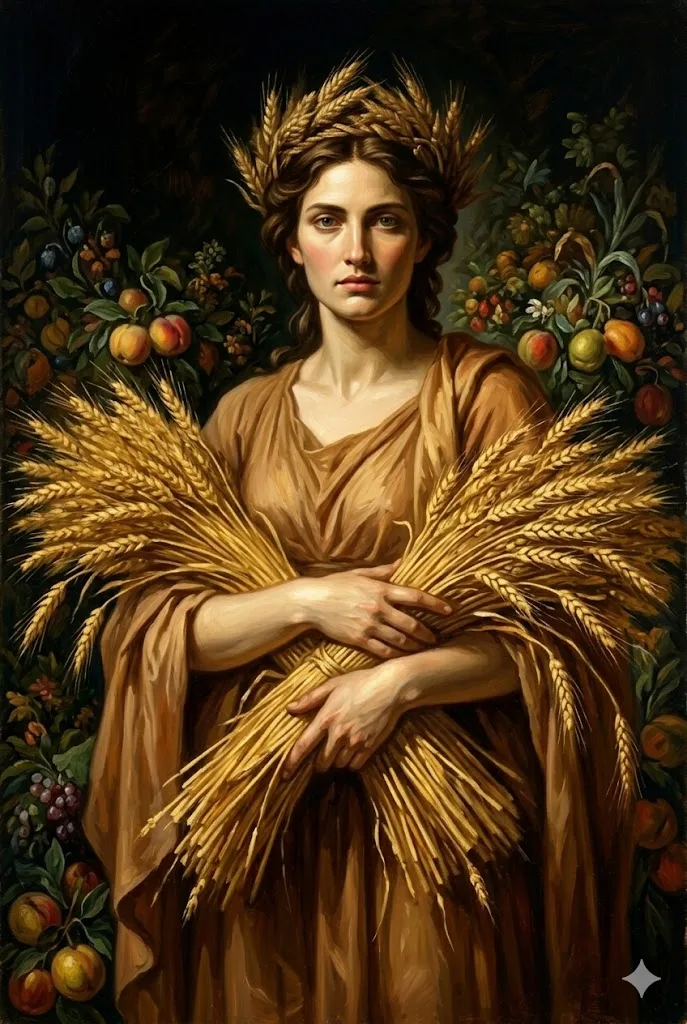
I. Who Was Demeter?
Demeter was the Olympian goddess of the harvest, agriculture, grain, fertility, and the sacred law that governed the cycle of life and death. She was one of the six children of the Titans Cronus and Rhea, making her a full sibling to Zeus, Poseidon, Hades, Hera, and Hestia. The Romans knew her as Ceres — from whose name we derive the word "cereal."
Demeter's most important myth is the story of her daughter Persephone's abduction by Hades. When Hades carried Persephone to the underworld, Demeter's grief was so overwhelming that she withdrew her blessings from the earth. Crops withered, fields turned barren, and humanity faced starvation. She wandered the earth for nine days and nights, torches in hand, searching for her daughter — a story of maternal love so powerful it threatened to destroy the world.
Only when Zeus intervened and ordered Hades to return Persephone was the crisis resolved — though because Persephone had eaten pomegranate seeds in the underworld, she was bound to return to Hades for a portion of each year. When Persephone is above ground with her mother, Demeter rejoices and the earth blooms (spring and summer). When Persephone descends to the underworld, Demeter mourns and the earth grows cold (autumn and winter). This is the Greek explanation for the changing of the seasons.
The Eleusinian Mysteries — the most sacred and secret rites in all of Greek religion, celebrated annually for nearly two thousand years — were held in Demeter's honor. Initiates were promised a blessed afterlife, making Demeter's cult one of the most personally meaningful spiritual traditions in the ancient world.
What happens at Eleusis in the Homeric Hymn
The oldest full account of Demeter's search, the Homeric Hymn to Demeter (probably sixth century BC), has much more in it than the abduction. Demeter learns the truth only on the tenth day. Hecate had heard Persephone's cries, and Helios, who sees everything, tells Demeter that Zeus gave the girl to Hades. Furious with Zeus, Demeter leaves Olympus and goes to Eleusis disguised as an old woman. She sits by the Maiden Well, where the daughters of King Celeus find her and bring her home to nurse their baby brother Demophon.
In the palace she will not sit or eat until a servant, Iambe, makes her laugh with crude jokes. She refuses wine and asks instead for kykeon, a drink of barley, water and pennyroyal, which later became part of the Mysteries. Each night she secretly lays Demophon in the fire to burn away his mortality. His mother Metaneira catches her and screams. Demeter angrily reveals her divinity, says the boy will now be mortal after all, and orders the Eleusinians to build her a temple. Only then does she bring the famine that forces Zeus to give in. Hades sends Persephone back, but first gives her a pomegranate seed to eat, and in the Hymn this binds her below for one third of every year. The poem closes with Demeter teaching her rites to the princes of Eleusis, including Triptolemus. Later tradition sends Triptolemus across the world in a winged, serpent-drawn chariot to teach agriculture.
Other myths of Demeter
Iasion. Hesiod says Demeter lay with the hero Iasion in a thrice-ploughed field in Crete and bore Plutus, "Wealth", meaning the wealth of the harvest. In the Odyssey Calypso mentions that Zeus killed Iasion with a thunderbolt for this.
Erysichthon. Callimachus' sixth hymn and Ovid's Metamorphoses (Book 8) tell how this Thessalian cut down a grove sacred to Demeter, including a great poplar (in Ovid an oak) that was home to nymphs. The goddess cursed him with a hunger nothing could satisfy. He ate through his household's wealth, and in Ovid's version he ends by devouring his own body.
Demeter Erinys and the horse. Pausanias records an Arcadian tradition from Thelpusa. To escape Poseidon during her search, Demeter turned herself into a mare. Poseidon became a stallion and caught her, and she bore the divine horse Areion and a daughter whose name could be told only to initiates, called Despoina, "the Mistress". Demeter's rage gave her the title Erinys. At Phigalia, Pausanias describes a cave of Black Demeter (Melaina), whose old image had a horse's head.
Pelops' shoulder. In the story of Tantalus serving his son to the gods, it was Demeter, distracted by grief, who ate the shoulder, and the gods replaced it with ivory. Pindar's first Olympian openly refuses to believe that any god would eat human flesh.
Festivals, epithets and images
The Eleusinian Mysteries were not her only rite. The Thesmophoria, held across the Greek world in autumn, was restricted to married women and honoured Demeter Thesmophoros, "bringer of law" or "of the established order". Piglets were thrown into pits, and their decayed remains were later brought up and mixed with seed grain. Other titles include Chloe ("green shoot"), Chthonia at Hermione, where Pausanias describes a festival in which cows were sacrificed, and Achaia. In art she often carries ears of grain, a sceptre or long torches. The best-known works are the seated Demeter of Knidos in the British Museum and the Great Eleusinian Relief in Athens, which shows her and Persephone with the young Triptolemus.
The story versions differ. Ovid sets the abduction near Henna in Sicily, adds the nymph Cyane who dissolves into a pool in grief, and says Persephone ate seven seeds. Ascalaphus informs on her and is turned into an owl. The neat division into "six months above, six below" is a modern simplification: the Hymn says one third of the year. For more, see Persephone and the seasons and the Eleusinian Mysteries.
Ancient sources
- Homeric Hymn 2 (To Demeter): the abduction, the stay at Eleusis, Demophon, the famine, the pomegranate seed and the founding of the Mysteries.
- Hesiod, Theogony 912–914 and 969–974: Zeus gives Persephone to Hades, and Demeter bears Plutus to Iasion in Crete.
- Callimachus, Hymn 6 (To Demeter): the punishment of Erysichthon.
- Ovid, Metamorphoses 5.341–661 and Fasti 4.417–620: Roman versions of the abduction set in Sicily, with Cyane, Ascalaphus and Triptolemus.
- Pausanias, Description of Greece, Book 8: Demeter Erinys at Thelpusa, Areion and Despoina, and the horse-headed Black Demeter of Phigalia.
- Pindar, Olympian 1: rejects the tale that the gods ate Pelops.
Frequently asked questions
How long does Persephone stay in the underworld?
The Homeric Hymn says one third of the year. Ovid divides the year evenly. The "six months" version common today follows the Roman tradition.
Did Demeter have children other than Persephone?
Yes. Hesiod gives her Plutus by Iasion. Arcadian tradition gives her the horse Areion and the goddess Despoina by Poseidon. Some sources also name Philomelus, brother of Plutus.
What was kykeon?
A drink of barley, water and pennyroyal that Demeter accepts at Eleusis in the Hymn. Initiates drank it during the Mysteries.
Is Demeter the same as Gaia?
No. Gaia is the primordial Earth itself. Demeter is an Olympian, daughter of Cronus and Rhea, whose domain is cultivated grain and farming. Some ancient writers did play on a supposed "Earth-Mother" etymology of her name.
Explore More Mythology
Get weekly deep dives into the gods, heroes, and myths of ancient Greece.