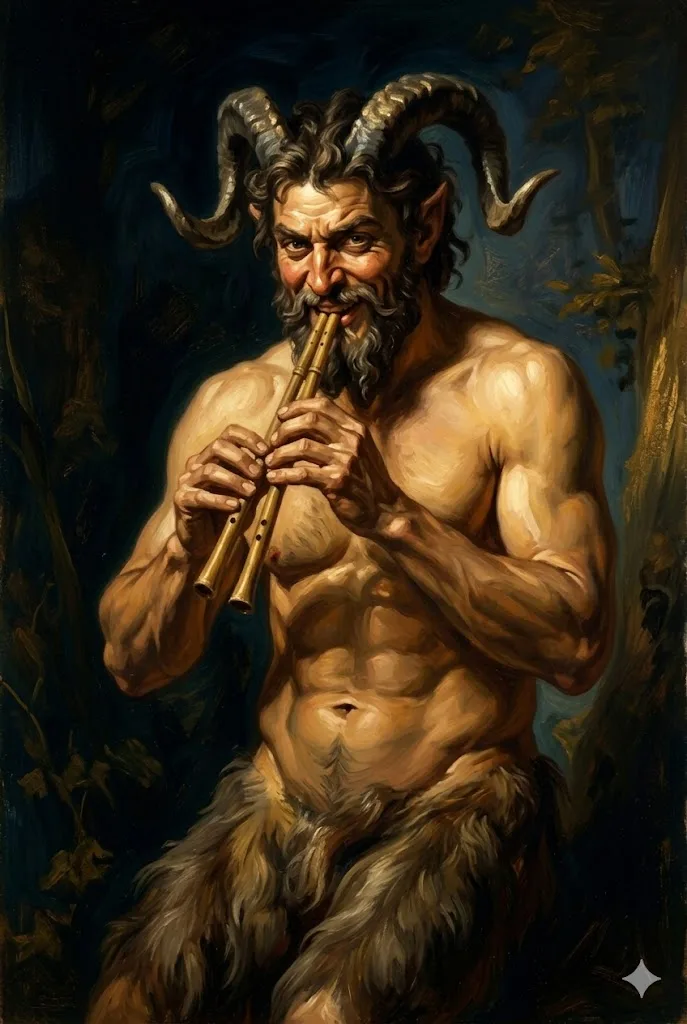
I. Who Was Pan?
Pan was the god of the wild, shepherds, flocks, rustic music, and mountain wilderness. He was one of the most distinctive gods in the Greek pantheon — depicted with the legs, horns, and beard of a goat from the waist down, and the torso and face of a man from the waist up. He lived not on Mount Olympus but in the caves and forests of Arcadia, where he spent his days playing his famous panpipes, chasing nymphs, and terrifying lone travelers in the wilderness.
Pan was the son of Hermes (in most traditions) and was born so strange-looking that his mother fled in horror at the sight of him. Hermes, however, was delighted by his son and carried him to Olympus wrapped in a rabbit skin. The gods, especially Dionysus, were charmed by the wild baby and named him "Pan" — meaning "all" — because he brought joy to all their hearts.
His most famous myth involves the nymph Syrinx, who fled from his amorous pursuit and was transformed into a bed of reeds by the river gods. When Pan sighed over the reeds, his breath created a haunting melody. He cut the reeds into graduated lengths and bound them together, creating the panpipes (syrinx) — the instrument that became his signature. His eerie music, played in lonely wilderness, was said to cause sudden, irrational fear in travelers — giving us the English word "panic" (from Pan).
Pan was the only Greek god said to have died. During the reign of Emperor Tiberius, a sailor named Thamus reportedly heard a divine voice crying out across the sea: "Great Pan is dead!" This proclamation was later interpreted by early Christians as marking the end of the pagan gods and the beginning of the Christian era.
Competing Stories of Pan's Birth
The Homeric Hymn to Pan gives the best-known version: Pan was the son of Hermes and the daughter of Dryops, born goat-footed, horned and noisy, so that his nurse ran away in fright. Hermes wrapped him in the skins of mountain hares and took him to Olympus, where the gods, Dionysus above all, were delighted, and the poet explains the name by saying he delighted "all" (pan) of them. The etymology is a pun; most scholars connect the name instead with a root meaning "to pasture," which suits a herdsman's god.
Other authors disagreed sharply about his parents. Herodotus says the Greeks made Pan the son of Hermes and Penelope, wife of Odysseus, and reckoned him one of the youngest gods. Later writers expanded this into a scandalous version in which Penelope bore him to all the suitors together, another bad pun on the name. Apollodorus records a tradition making Pan the son of Zeus and the nymph Hybris, and says it was Pan who taught Apollo the art of prophecy. Some sources give Zeus and Callisto, others Cronus and Rhea. No single genealogy ever won out, which fits a god who came into Greek religion from the Arcadian hills rather than from the Olympian family tree.
Lesser-Known Myths
Pan and Selene. Virgil, in the Georgics, says that Pan won the Moon goddess by offering her a gift of snow-white fleece, luring her into the deep woods. It is one of the few stories in which Pan's pursuit of a goddess succeeds. See Selene.
Echo and Pitys. In Longus' romance Daphnis and Chloe, Echo is a nymph who refused Pan; he drove the shepherds mad and they tore her apart, scattering her still-singing limbs across the earth. This is quite different from Ovid's better-known version with Narcissus. Pitys was another nymph who fled him and became a pine tree, which is why Pan wears a pine wreath.
The music contest. Ovid tells how Pan boasted that his pipes outdid Apollo's lyre. The mountain god Tmolus judged in Apollo's favour, but King Midas spoke up for Pan, and Apollo gave Midas the ears of an ass.
Pan and Typhon. When the monster Typhon attacked the gods, they fled into Egypt and took animal shapes. In the astronomical tradition preserved by Hyginus, Pan leapt into a river and became half goat, half fish, and Zeus later set this figure among the stars as Capricorn.
Cult: From Arcadia to the Acropolis
Pan's home was Arcadia, especially Mount Lykaion and Mount Maenalus, where Pausanias saw his sanctuaries and heard that the god could be heard piping on the mountain. Arcadian worship had a rough edge. Theocritus mentions that when hunting was poor, Arcadian boys whipped the image of Pan with squills to stir him to action.
His cult spread to Athens through a single famous episode. Herodotus says that before the battle of Marathon in 490 BC, the runner Pheidippides was sent to Sparta for help and met Pan on Mount Parthenion. The god asked why the Athenians paid him no attention, though he had been friendly to them and would be again. After the victory, which the Athenians partly credited to Pan's terror falling on the Persians, they founded a shrine to him in a cave on the north-west slope of the Acropolis, with yearly sacrifices and a torch race.
Caves were his natural temples. The Corycian Cave above Delphi was sacred to Pan and the nymphs, and thousands of dedications have been excavated there. Menander's comedy Dyskolos is set at Pan's cave at Phyle in Attica, and the god himself speaks the prologue.
Shepherds also feared him at midday, his resting hour. In Theocritus' first Idyll a goatherd refuses to play his pipe at noon because Pan, tired from hunting, would be angry if woken.
Pan in Art and Common Misconceptions
Early Arcadian bronzes show Pan as essentially a goat standing upright; the more human figure with only goat legs and horns developed in Athenian art of the fifth century. The vase painter known as the Pan Painter takes his name from a bell-krater in Boston showing Pan chasing a young goatherd. A well-known Hellenistic group from Delos shows Aphrodite threatening Pan with her sandal while Eros flutters between them.
Pan is often confused with the satyrs, but satyrs in Greek art are horse-tailed men, not goat-legged, and they serve Dionysus rather than ruling the wild. Nor is Pan strictly the only god said to have died: the Cretans claimed to show the tomb of Zeus. But Plutarch's story of Thamus and "Great Pan is dead" is the only ancient account of a god's death being announced, which explains its lasting fame.
Ancient sources
- Homeric Hymn 19, To Pan — his birth to Hermes and the daughter of Dryops, his nurse's flight, and the explanation of his name.
- Herodotus, Histories 2.145 and 6.105 — Pan as son of Hermes and Penelope, and his appearance to Pheidippides before Marathon.
- Ovid, Metamorphoses 1.689–712 and 11.146–193 — the story of Syrinx, and the contest with Apollo that cost Midas his ears.
- Plutarch, On the Obsolescence of Oracles 17 — the pilot Thamus and the cry that Great Pan is dead.
- Longus, Daphnis and Chloe — Pan's role in the pastoral world, including the Echo story and Syrinx.
- Theocritus, Idylls 1 and 7 — the danger of piping at noon and the Arcadian custom of beating Pan's image.
Frequently asked questions
Who were Pan's parents?
Most often Hermes and a nymph, usually the daughter of Dryops. Herodotus names Penelope as his mother, and Apollodorus makes him a son of Zeus and Hybris. Ancient writers never settled on one version.
Is Pan the same as a satyr or faun?
Not quite. Pan is a god; satyrs are a class of wild companions of Dionysus. The Romans identified Pan with Faunus, and the Roman fauns took on his goat features, which is how the images blended.
Where does the word "panic" come from?
From Greek panikon deima, "Pan's fear," the sudden groundless terror that could strike a lonely traveller or a whole army camp. The Athenians believed it struck the Persians at Marathon.
Why does Pan play the pipes?
Because of Syrinx, the nymph who became reeds as he chased her. He cut the reeds into the panpipes, which the Greeks still called a syrinx.
Explore More Mythology
Get weekly deep dives into the gods, heroes, and myths of ancient Greece.