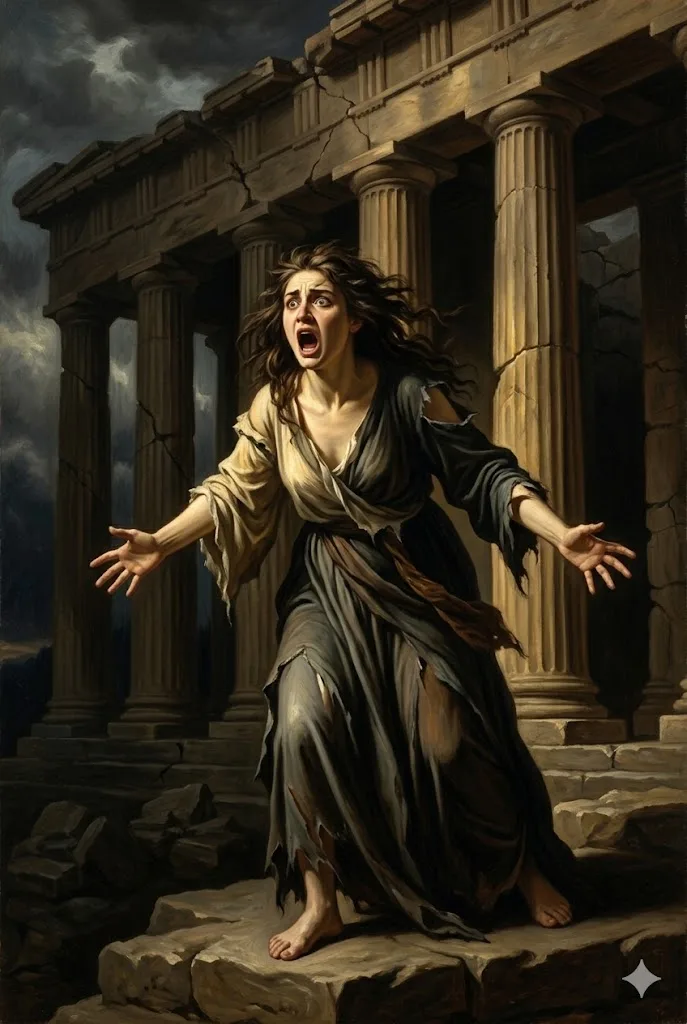
Apollo's Curse
Cassandra was a princess of Troy, daughter of King Priam and Queen Hecuba, and she was one of the most tragic figures in all of Greek mythology. Apollo fell in love with her and offered her the gift of prophecy in exchange for her affection. Cassandra accepted the gift but then rejected Apollo's advances. The god, unable to take back a divine gift once given, added a devastating twist: Cassandra would always see the future accurately, but no one would ever believe her.
The Fall of Troy
Cassandra foresaw everything. She warned the Trojans not to accept Paris back after he abducted Helen. She screamed that the Trojan Horse was a trap. She predicted the fall of Troy, the death of Hector, the murder of Priam. She saw it all, in perfect detail, and told everyone who would listen. No one listened. They thought she was mad. Her own family locked her away during the final siege. When the Greeks poured out of the Horse and Troy burned, Cassandra was proved right about every single prophecy she had ever made. By then it was too late.
After the War
During the sack of Troy, Ajax the Lesser found Cassandra clinging to a statue of Athena in the goddess's temple and dragged her away by force, assaulting her. This act of sacrilege in Athena's own temple enraged the goddess, who cursed the entire Greek fleet. Cassandra was taken as a war prize by Agamemnon and brought back to Mycenae. She immediately prophesied that both she and Agamemnon would be murdered by his wife Clytemnestra. Agamemnon laughed. Clytemnestra killed them both.
Why Cassandra Matters
The Cassandra myth resonates with a particular modern anguish: the experience of knowing the truth, speaking it clearly, and being dismissed. The term 'Cassandra complex' is used in psychology to describe the experience of someone whose valid warnings are consistently ignored. Climate scientists, financial analysts who predicted the 2008 crash, pandemic experts who warned about COVID before 2020, have all been compared to Cassandra. Her myth endures because it captures one of the most frustrating aspects of the human condition: that truth alone is not enough. Without the power to compel belief, knowledge is a form of torture.
Classical Sources
- 📜 Homer, Iliad & Odyssey (c. 750 BC)
- 📜 Hesiod, Theogony (c. 700 BC)
- 📜 Apollodorus, Bibliotheca (c. 1st-2nd century AD)
- 📜 Ovid, Metamorphoses (8 AD)
Cross-referenced with multiple classical sources for accuracy.
Explore More
Apollo · Trojan War · Achilles · Troy · Home
Cassandra in Homer: beauty without prophecy
Homer knows Cassandra, but not as a prophet. In Iliad 13 she is called the most beautiful of Priam's daughters, and a Trojan ally named Othryoneus is killed after promising to drive the Greeks from Troy in exchange for her hand. In Book 24 she is the first to see Priam returning across the plain with Hector's body, and her cry rouses the city to mourn. In the Odyssey, Agamemnon's ghost remembers hearing her scream as Clytemnestra killed her over his body. Her prophetic gift and Apollo's curse first appear clearly in later epic and, above all, in Aeschylus. Our page on the Trojan War sets out where these episodes fall.
How she received the gift: competing versions
In Aeschylus' Agamemnon, Cassandra tells the chorus that she promised herself to Apollo in return for prophecy and then broke the promise, so the god made sure no one would believe her. Hyginus offers a variant in which she fell asleep in Apollo's temple and the god tried to embrace her. A different tradition, reported by later scholars and commentators, makes the gift accidental: as children, Cassandra and her twin brother Helenus were left overnight in the temple of Thymbraean Apollo, and sacred serpents licked their ears, giving them the power to hear the future. In this version Helenus, a respected seer whom the Greeks later captured and forced to reveal how Troy could fall, keeps a believable gift while Cassandra's is cursed.
Her alternative name, Alexandra, was used at Amyclae in Laconia and is the title of the Hellenistic poet Lycophron's Alexandra, a dense poem of nearly 1,500 lines framed as a guard's report of Cassandra's ravings, prophesying the fates of Greeks and Trojans long after the war.
The sack of Troy and the Locrian maidens
Cassandra was dragged from the Palladium, the statue of Athena, by Ajax son of Oileus, the Lesser Ajax (not the Salamis hero of our Ajax page). Early sources such as the lost Sack of Ilion describe the sacrilege as dragging her and the statue together; the explicit claim that he raped her is later, appearing in Lycophron and Roman-era writers. The Greeks nearly stoned Ajax, but he clung to the same altar. Athena's anger fell on the fleet on its way home, and Ajax drowned after boasting he had escaped the gods. For centuries afterward the Locrians of central Greece sent two young women each year to serve in Athena's sanctuary at Ilion as atonement, a custom ancient historians describe as lasting into the Hellenistic period.
In Euripides' Trojan Women, Cassandra enters waving torches and sings a mock wedding hymn for her "marriage" to Agamemnon, prophesying that her arrival will bring ruin on his house. It is one of the most unsettling scenes in Greek tragedy: the audience knows she is right while the other women think she has lost her mind.
Pausanias says Cassandra bore Agamemnon twin sons, Teledamus and Pelops, whom Aegisthus murdered as infants. At Mycenae he was shown their graves alongside hers, though the people of Amyclae claimed her tomb too.
Cult and art
At Amyclae, a sanctuary of Alexandra and Agamemnon received offerings, with excavated votive reliefs dating from the Archaic period onward. Pausanias also mentions a temple and statue of Cassandra at Leuctra in Laconia. Lycophron claims that women of Daunia in southern Italy honoured her to avoid unwanted marriages.
The scene of Ajax tearing Cassandra from Athena's statue is among the commonest Trojan subjects in Greek vase painting. On the Vivenzio hydria by the Kleophrades Painter (Naples, about 480 BC), she is naked and reaching toward Ajax as he grips her hair, beside a crowded panorama of Troy's fall. In later European art, Evelyn De Morgan's Cassandra (1898) shows her tearing her hair before a burning city.
A frequent modern assumption is that Cassandra was simply mad. Ancient tragedy shows her as lucid and terrifyingly specific; the madness lies in the response of those around her. Another misconception is that she warned against the wooden horse in Homer. That warning belongs to later sources, especially Apollodorus and the Roman poets, while Virgil's Aeneid pairs her doomed warning with Laocoön's. Her end is entwined with the stories of Agamemnon and Clytemnestra.
Ancient sources
- Homer, Iliad 13 and 24; Odyssey 11 — Cassandra as Priam's loveliest daughter, the first to see Hector's body returning, and her death at Clytemnestra's hands.
- Aeschylus, Agamemnon — her long prophetic scene before the palace, revealing the bargain with Apollo and foreseeing both murders.
- Euripides, Trojan Women — the torch-lit wedding song and her prophecies about Agamemnon and Odysseus.
- Lycophron, Alexandra — a Hellenistic poem presented entirely as her prophecy.
- Virgil, Aeneid 2 — her warnings ignored as the horse enters Troy, and her capture from Minerva's temple.
- Pausanias, Description of Greece 2.16 and 3.19 — her tomb and twin sons at Mycenae, and her worship as Alexandra at Amyclae.
Frequently asked questions
Why was no one able to believe Cassandra?
In the most common version Apollo granted her prophecy in exchange for her love; when she refused him, he could not revoke the gift, so he cursed her never to be believed.
Who was Cassandra's twin?
Her twin brother was Helenus, also a seer. Unlike her, he was believed, and after his capture he told the Greeks the conditions for taking Troy.
How did Cassandra die?
She was taken to Mycenae as Agamemnon's captive and was killed with him by Clytemnestra, in Aeschylus and Homer alike.
Does Homer say Cassandra could see the future?
No. The Iliad and Odyssey mention her beauty and death but never her prophetic gift, which is developed in later poetry and tragedy.