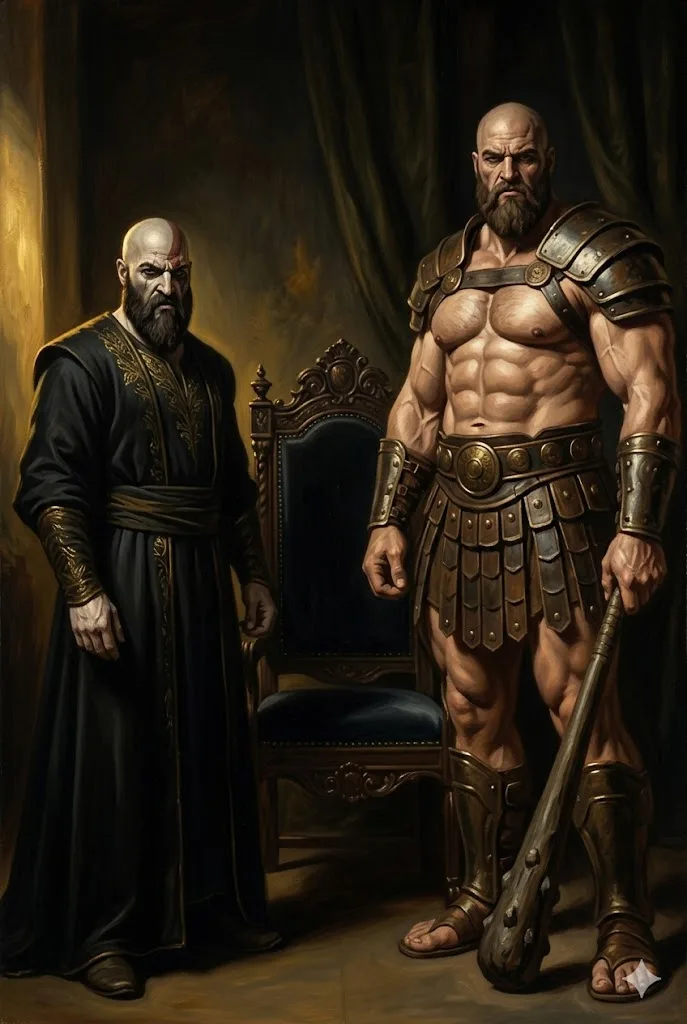
Zeus's Enforcers
Kratos (Strength) and Bia (Force) were among the most feared minor deities on Olympus — not for their own ambitions, but because they served as Zeus's personal enforcers. Where Zeus commanded, Kratos and Bia executed without question or mercy.
They were children of the Titan Pallas and the goddess Styx, who sided with Zeus during the Titanomachy. As reward for Styx's loyalty, Zeus made her children permanent attendants of his throne. Alongside their siblings Nike (Victory) and Zelus (Zeal), they formed the king of the gods' inner circle of power.
Binding Prometheus
Their most famous appearance comes in Aeschylus's tragedy Prometheus Bound. When Prometheus stole fire from the gods and gave it to humanity, Zeus ordered his punishment. It was Kratos and Bia who dragged Prometheus to the Caucasus Mountains and held him while Hephaestus — reluctantly — chained him to the rock.
In the play, Kratos speaks with cold authority, dismissing Hephaestus's sympathy as weakness. He represents the unyielding, impersonal nature of divine power — force without conscience, obedience without doubt. Bia, notably, never speaks in the play, embodying silent, brute force.
Strength vs. Force
The Greeks distinguished carefully between Kratos and Bia. Kratos represented legitimate strength — the power of authority, dominion, and sovereignty. His name is the root of words like 'democracy' (demos + kratos = people's power) and 'aristocracy.'
Bia, by contrast, represented raw physical force — violence, compulsion, and bodily might. Where Kratos was the iron fist of law, Bia was the sledgehammer that broke resistance.
Together they illustrated the Greek understanding that power requires both authority and the means to enforce it.
Modern Legacy
The video game series God of War borrows the name Kratos for its protagonist, though the game character bears little resemblance to the mythological figure. The real Kratos was not a warrior-rebel but the ultimate loyalist — the embodiment of obedience to power.
Their myth remains relevant as a meditation on what happens when strength serves power without moral questioning.
Quick Facts
Domain: Kratos = Strength/Sovereignty; Bia = Force/Violence
Parents: Pallas (Titan) and Styx
Siblings: Nike (Victory), Zelus (Zeal)
Role: Zeus's personal enforcers
Key Myth: Binding of Prometheus
Source: Aeschylus's Prometheus Bound
Why Styx's children never leave Zeus's side
The story behind the pair's position comes from Hesiod's Theogony. Styx, eldest of the daughters of Ocean, bore four children to Pallas, a son of the Titan Crius: Zelus (Rivalry or Zeal), Nike (Victory), and Kratos and Bia, whom Hesiod calls "glorious children." When Zeus summoned all the immortals to Olympus before the war with the Titans and promised that anyone who fought with him would keep or gain honours, Styx came first, bringing her children, on the advice of her father. Zeus rewarded her by making her the great oath of the gods and by keeping her children with him forever. Hesiod is precise about what that means: they have no house apart from Zeus, no seat, no path except where the god leads them, and they always sit beside him. They are not servants in the ordinary sense; they are qualities of Zeus's kingship given bodies.
That makes their parentage significant. Pallas is on the Titan side of the family tree, yet his children help secure the Olympian victory. Later handbooks repeat the genealogy: Apollodorus lists the same four children of Pallas and Styx, and Hyginus' Latin preface gives them as Potestas, Vis, Invidia and Victoria, adding some unexpected names, including Scylla, to the list. For the war that won them their place, see the Titanomachy.
Kratos in Prometheus Bound
The opening of Prometheus Bound, traditionally attributed to Aeschylus though its authorship is disputed, is the only place where Kratos has a real speaking part. What is worth noticing is how Kratos talks. He urges Hephaestus on with brutal practicality, telling him exactly where to drive the wedge through the prisoner's chest and how to fasten the ankles. When Hephaestus curses his own craft, Kratos answers that the craft is not to blame for the suffering. He mocks Prometheus's name, which means "forethought," saying the Titan will need a real Prometheus to get himself out of this. And he sums up the new order in a single line: everything is a burden except ruling over the gods, for no one is free except Zeus. Bia stands by without a word, which is perhaps the most eloquent piece of characterisation in the play. The scene also introduces the theme of the whole drama, the clash between Prometheus's defiance and a young tyrant's naked power; see also Prometheus and the theft of fire.
Plato seems to remember the same pair in the Protagoras. In the myth told there, Prometheus could steal fire from Hephaestus and Athena's workshop, but he could not enter Zeus's citadel to take political wisdom, because "the guards of Zeus were terrible." Scholars often take these guards to be Kratos and Bia.
Words before gods
Both names were ordinary Greek nouns long before they were figures in myth, and Homer uses them constantly in their plain sense. Kratos in the epic is the power to prevail, the supremacy Zeus grants to one side or the other in battle. Bia is physical force, and Homer has a striking idiom built on it: "the force of Heracles" (bie Herakleie) is a grand way of saying "mighty Heracles." So when Hesiod makes Kratos and Bia persons, he is turning the vocabulary of power into a family.
Their cult was almost nonexistent, with one notable exception. On the climb to Acrocorinth above Corinth, Pausanias passed a sanctuary of Necessity (Ananke) and Force (Bia), and noted that it was not the custom to go inside. Pairing Force with Necessity says something about how the Greeks thought of Bia: not a god to pray to for favours, but a compulsion one could only acknowledge.
Common mistakes
The English suffix "-cracy" does come from kratos, as do words like "autocrat" and "plutocracy"; see Greek words in English. Bia, however, has nothing to do with "bio-," which comes from the different word bios, "life." It is also worth knowing that Kratos is grammatically neuter in Greek and Bia feminine; the play treats Kratos as male and Bia as female, but no ancient source gives them adventures of their own. Securely identified images of the pair in ancient art are rare at best.
Ancient sources
- Hesiod, Theogony 383–403 — the birth of Zelus, Nike, Kratos and Bia to Styx and Pallas, and why they always remain beside Zeus.
- Aeschylus (attributed), Prometheus Bound 1–87 — Kratos supervises the binding of Prometheus while Bia stands silent.
- Apollodorus, Library 1.2.4 — repeats the four children of Pallas and Styx.
- Plato, Protagoras 321d — the "terrible guards" of Zeus's citadel, which kept Prometheus out.
- Pausanias, Description of Greece 2.4.6 — the sanctuary of Necessity and Force on the road up Acrocorinth.
Frequently asked questions
Is the Kratos of God of War based on a Greek god?
The game borrowed the name, but the character, a Spartan warrior who turns against the gods, has no connection to the mythological Kratos, who is a loyal personification of Zeus's power.
Who were the parents of Kratos and Bia?
Pallas, a son of the Titan Crius, and Styx, the goddess of the underworld river, according to Hesiod and Apollodorus.
Is Bia male or female?
Bia is female. Her name is a feminine noun meaning force or violence, and she is one of two daughters of Styx and Pallas, alongside Nike.
Does Bia speak in Prometheus Bound?
No. Bia appears on stage but has no lines; Kratos does all the talking for both of them.