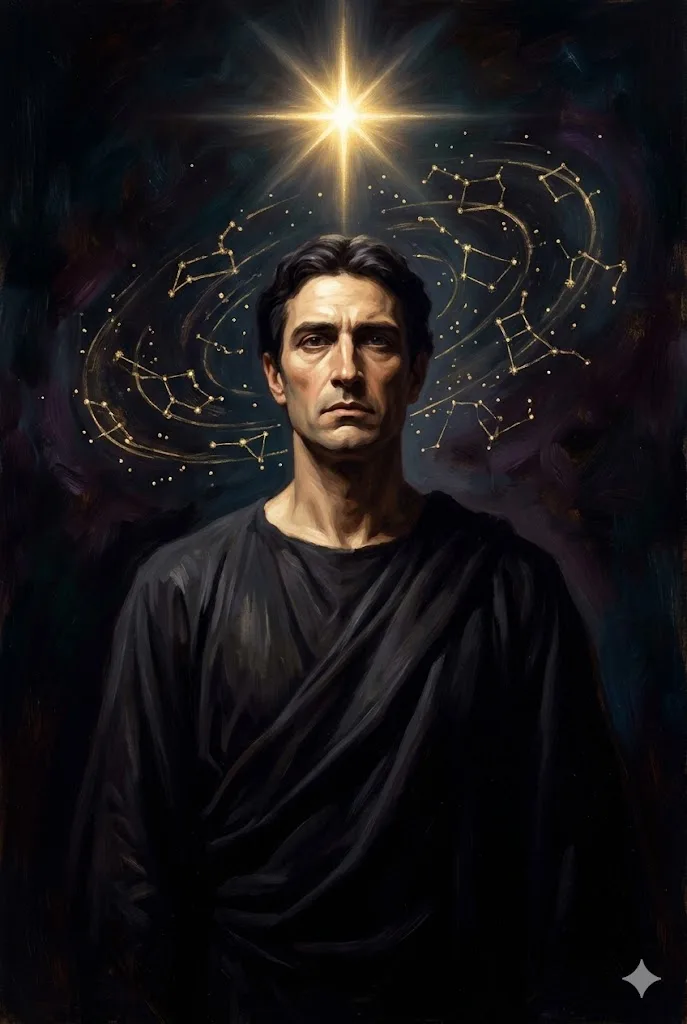
The Pillar of the North
Coeus (also spelled Koios) was one of the twelve original Titans, sons and daughters of Uranus and Gaia. He represented the axis of the celestial sphere — the pillar around which the heavens revolved — and was associated with the northern pole star and rational inquiry.
While less famous than his brothers Cronus and Oceanus, Coeus held a crucial cosmic role. As the Titan of intellect, he embodied the questioning mind — the desire to understand and organize the universe.
Father of Prophecy's Mother
Coeus married his sister Phoebe, the Titaness of the moon and prophetic wisdom. Together they had two daughters who would become enormously important: Leto, who would bear the twin gods Apollo and Artemis, and Asteria, who leapt into the sea to escape Zeus and became the island of Delos.
Through this lineage, Coeus was the grandfather of two of the most important Olympian gods. Apollo's gift of prophecy and rational truth can be traced directly back to Coeus's domain of intellect.
The Titanomachy and Tartarus
Like most of his Titan siblings, Coeus fought against the Olympians in the ten-year Titanomachy. When the Titans lost, Zeus cast them into Tartarus, the deepest pit beneath the underworld.
In a later tradition, Coeus attempted to escape Tartarus in a mad frenzy. He managed to pass through the first gate but was driven back by Cerberus, the three-headed guard dog. This rare escape attempt hints at the restless nature of pure intellect — the mind that cannot accept confinement.
Quick Facts
Domain: Intellect, Rational Mind, Northern Celestial Pole
Consort: Phoebe
Children: Leto, Asteria
Grandchildren: Apollo, Artemis, Hecate
Fate: Imprisoned in Tartarus
What the Ancient Texts Actually Say
Coeus is one of the most thinly documented of the original Titans, and it helps to be honest about how little survives. Hesiod's Theogony lists him among the twelve children of Uranus and Gaia, and a few lines later records his single essential act: Phoebe "came to the much-desired bed of Coeus" and bore dark-robed Leto, the gentlest of all the gods on Olympus, and Asteria of happy name. Apollodorus repeats this genealogy. Beyond that, no ancient author gives Coeus a myth of his own in the way Cronus, Prometheus or Atlas have.
The descriptions of Coeus as the Titan of intellect, inquiry or the celestial pole are modern interpretations. They rest partly on etymology (scholars have linked his name, Koios, with Greek words for perceiving or questioning, and some with the sky's axis) and partly on the later Roman habit of listing a Titan called Polus, "pole," whom some modern writers identify with Coeus. These ideas are reasonable guesses, but readers should know they are guesses rather than ancient doctrine.
A Grandfather of Gods: Leto, Asteria and Hecate
Coeus matters chiefly through his descendants. His daughter Leto bore Apollo and Artemis to Zeus. Poets often name her by her father, and Ovid gives a telling example: in book 6 of the Metamorphoses, the proud queen Niobe sneers at Latona as the daughter of "some Titan Coeus," using the obscurity of the name as an insult. Niobe's punishment, the killing of her children by Leto's twins, shows how badly that went.
His other daughter, Asteria, married the Titan Perses, and Hesiod makes their only child Hecate, to whom he devotes an unusually long and admiring passage. Later tradition says Asteria fled Zeus's advances by turning into a quail and plunging into the sea, becoming the floating island Ortygia, later identified with Delos, the one place that would receive her sister Leto in labour. The family thus links Coeus to two of the most important sanctuaries in the Greek world: Delos, birthplace of Apollo and Artemis, and, through Phoebe, Delphi.
At the opening of Aeschylus's Eumenides, the Pythia recites the succession of the Delphic oracle: first Gaia, then Themis, then Phoebe, who gave it as a birthday gift to Apollo, who took the name Phoebus from her. Coeus himself is not mentioned, but the household of Coeus and Phoebe is presented as the source of Apollo's prophetic inheritance on both sides.
Coeus Among the Rebels in Roman Poetry
Roman poets used Coeus as a byword for earth-born rebellion, sometimes blurring the line between the Titans and the Giants. Virgil, in the first book of the Georgics, warns that the fifth day of the month is unlucky because on it Earth bore Coeus, Iapetus and Typhoeus, and the brothers who conspired to pile Ossa on Pelion to storm heaven. In the Aeneid book 4, Rumour (Fama) is described as the youngest sister of Coeus and Enceladus, born of Earth in anger at the gods. Valerius Flaccus, in his Argonautica, compares a raging figure to Coeus straining against his chains in the underworld. The story of his attempted escape from Tartarus grows from Latin poetry of this kind rather than from Greek myth.
This Roman blending is one reason Coeus appears in some modern retellings as a warrior of the Gigantomachy. In Greek terms, he belongs to the earlier war, the Titanomachy, and to the generation imprisoned afterward.
Worship and Representation
No cult of Coeus is attested, and no securely identified ancient image of him survives. He is a genealogical figure, important for connecting the older cosmic generation to the Olympians, rather than a god people prayed to. Modern visual depictions, including those in games and illustrated guides, are inventions.
Ancient sources
- Hesiod, Theogony — lists Coeus among the twelve Titans and records his union with Phoebe, producing Leto and Asteria, and Asteria's daughter Hecate.
- Apollodorus, Library book 1 — repeats the genealogy of Coeus, Phoebe, Leto and Asteria, and the story of Asteria becoming a quail and then an island.
- Ovid, Metamorphoses book 6 — Niobe disparages Latona as the daughter of an obscure Titan, Coeus.
- Virgil, Georgics book 1 and Aeneid book 4 — Coeus named among the earth-born rebels and as brother of Rumour.
- Valerius Flaccus, Argonautica — a simile describing Coeus raging against his bonds below the earth.
Frequently asked questions
What is Coeus the Titan of?
No ancient text assigns him a clear domain. Modern sources call him the Titan of intellect or of the celestial axis, based on interpretations of his name and later Roman lists, but Hesiod gives no such role.
Who are Coeus's children and grandchildren?
With Phoebe he fathered Leto and Asteria. Through Leto he is grandfather of Apollo and Artemis; through Asteria, of Hecate.
Did Coeus fight in the Titanomachy?
Ancient sources imply that the Titans as a group fought Zeus and were imprisoned in Tartarus, but no surviving Greek account describes Coeus's role specifically.
How do you pronounce Coeus?
In English it is usually said "SEE-us"; the Greek form Koios is closer to "KOY-os."