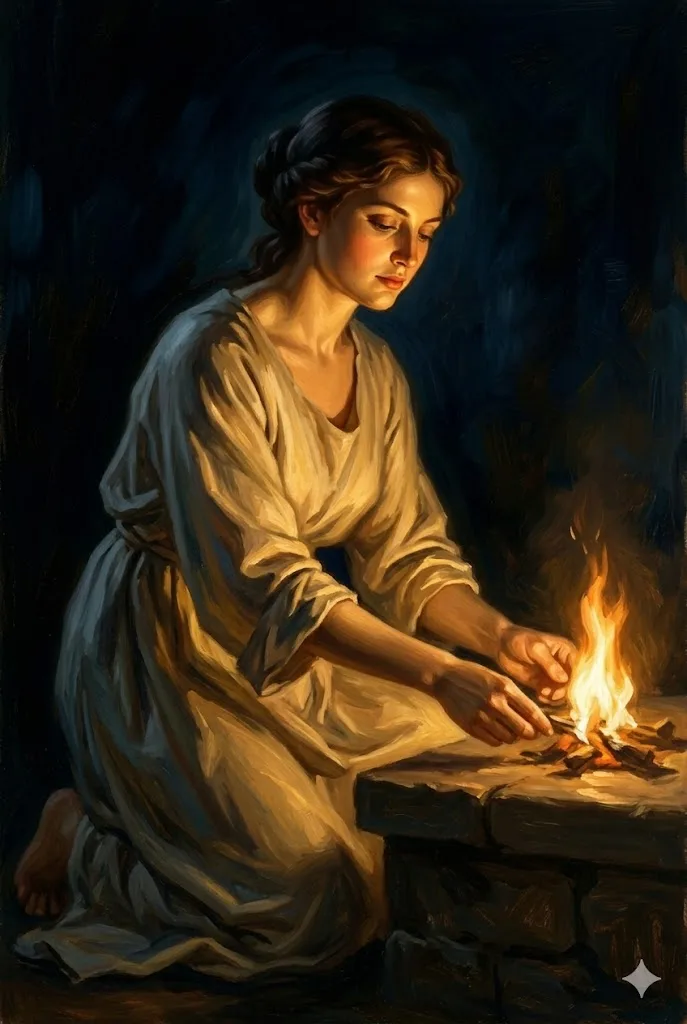
I. Who Was Hestia?
Hestia was the goddess of the hearth, home, and domestic life — the firstborn child of Cronus and Rhea, and therefore the eldest of the Olympian gods. She was the most gentle and least dramatic of the Twelve Olympians, with no myths of war, jealousy, or romance to her name. Yet she was arguably the most important goddess in the daily lives of ordinary Greeks, for her sacred flame burned at the center of every household, every temple, and every city hall in the Greek world.
Hestia was one of three virgin goddesses (along with Athena and Artemis). When both Poseidon and Apollo sought her hand in marriage, she swore an oath on Zeus's head to remain forever unmarried. Zeus, grateful for her decision (which prevented a potentially catastrophic rivalry between two powerful gods), granted her the honor of receiving the first and last offering at every sacrifice.
Her sacred flame was never allowed to go out. When Greeks founded a new colony, they carried fire from the mother city's hearth to light the new colony's civic flame — a ritual that symbolized the continuity of civilization itself. At the civic hearth (prytaneion), Hestia's flame represented the unity and identity of the community. To extinguish the flame was to symbolically destroy the city.
Her Roman equivalent Vesta was one of the most important goddesses in Rome, tended by the Vestal Virgins — priestesses who maintained her sacred flame and wielded extraordinary social and political power. The word "vestibule" derives from Vesta/Hestia, referring to the entrance of the home where her presence was felt.
Firstborn and lastborn
The Homeric Hymn to Aphrodite calls Hestia both the eldest and the youngest child of Cronus. She was the first child he swallowed, and so the last he vomited up, which in a sense made her born twice. The same hymn gives the fullest early account of her refusal to marry. When Poseidon and Apollo both courted her, she refused firmly and swore, with her hand on the head of Zeus, to stay a virgin forever. In return Zeus gave her a seat in the middle of every house and a share of the "fat", meaning the choicest portion of sacrifice. She was honoured in all the temples of the gods. Hestia is also named as one of the three goddesses on whom Aphrodite's power has no effect.
Two short Homeric Hymns are addressed to her. Hymn 24 invites her to a house at Delphi where she tends Apollo's sacred dwelling. Hymn 29 pairs her with Hermes, the god of the threshold and the road, as gods who look after the home together: one stays at the centre, the other keeps watch on comings and goings. The saying aph' Hestias archesthai, "to begin from Hestia", meant to start at the very beginning, because she received the first offering.
Hestia, Dionysus and the Twelve: a modern myth
Many websites and books say Hestia gave up her seat among the Twelve Olympians to Dionysus to avoid a quarrel. There is no ancient source for this. The story seems to have been popularised in the twentieth century, especially through Robert Graves' The Greek Myths. What the ancient evidence does show is that lists of the Twelve were not fixed. Some include Hestia, others include Dionysus, and Hestia often appears in groups of gods. The nearest ancient idea comes from Plato's Phaedrus. When the gods drive out in procession across the heavens, "Hestia alone stays at home in the house of the gods". This is not a story about losing status. It reflects her nature: the hearth does not travel.
Only one narrative episode about her survives in any detail, and it is Roman. In Ovid's Fasti, during a rustic party of the gods, Priapus tries to approach Vesta as she sleeps, and the braying of Silenus' donkey wakes her just in time. Ovid tells an almost identical story about the nymph Lotis in an earlier book. In Rome, donkeys were garlanded at the Vestalia festival in June in memory of this episode.
The hearth in Greek life and cult
Hestia's shrines were usually the hearths themselves, not temples. In the Athenian prytaneion, a fire burned perpetually. Foreign ambassadors and honoured citizens were entertained there, and colonists took fire from it to start their own civic hearths. Pausanias describes the prytaneion at Olympia, where the fire of Hestia burned day and night, and its ashes were added to Zeus' great ash altar. At Delphi the hearth inside Apollo's temple was treated as the common hearth of all Greece. Plutarch reports that after the Persians were defeated at Plataea in 479 BC, the oracle ordered the Greeks to put out every fire the invaders had polluted and relight them from Delphi. A runner named Euchidas made the round trip in a single day and died on arrival.
In the household, a newborn was formally welcomed in the amphidromia, a rite in which the baby was carried around the hearth a few days after birth. A new bride was welcomed at her husband's hearth, and a suppliant who sat at a family's hearth was under its protection. That is why Hestia appears in so few stories: she was present at nearly every domestic and civic act, but she rarely took action herself.
She was also seldom shown in art. She does appear, labelled by name, among the gods processing to the wedding of Peleus and Thetis on the Sophilos dinos (early sixth century BC) in the British Museum. A veiled, heavily draped Roman statue known as the "Hestia Giustiniani" is often reproduced as her image, though the identification is not certain. For her family, see Cronus, Rhea and the siblings of Zeus.
Ancient sources
- Homeric Hymn to Aphrodite 21–32: Hestia as eldest and youngest, her oath of virginity, and Zeus' grant of honours.
- Homeric Hymns 24 and 29: short hymns to Hestia, the second pairing her with Hermes.
- Hesiod, Theogony 453–454: Hestia listed first among the children Rhea bore to Cronus.
- Plato, Phaedrus 247a: Hestia alone remains in the house of the gods while the others ride out.
- Ovid, Fasti, Book 6: the Vestalia, the Roman cult of Vesta, and the story of Priapus and the donkey.
- Plutarch, Life of Aristides 20: Greek fires relit from the common hearth at Delphi after Plataea.
Frequently asked questions
Did Hestia give her throne to Dionysus?
No ancient source says so. The idea is modern. Ancient lists of the Twelve Olympians varied, and Plato describes Hestia staying at home on Olympus, not leaving it.
Why are there so few myths about Hestia?
She was the hearth itself, fixed at the centre of the house and the city. Greek myth is built on journeys, conflicts and love affairs, and she took part in none of these.
Was Hestia one of the Twelve Olympians?
In many lists, yes. The Twelve were never one fixed set, and some lists include Dionysus instead of her.
Did Hestia have temples?
Very few. She was worshipped mainly at household and civic hearths, especially in the prytaneion of each city, and at altars inside other gods' temples.
Explore More Mythology
Get weekly deep dives into the gods, heroes, and myths of ancient Greece.