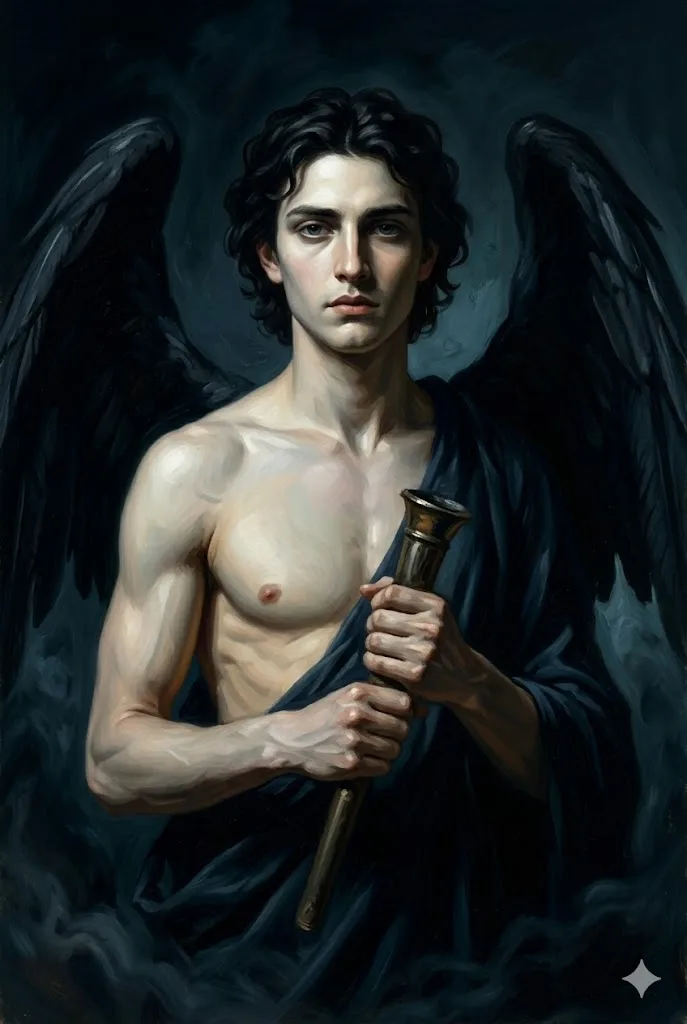
Who Was Thanatos?
Thanatos was the ancient Greek personification of death — not the violent, agonizing end brought by war or disease, but the gentle, peaceful passing that comes at the natural end of life. Where his counterpart, the Keres, represented violent and bloody death on the battlefield, Thanatos embodied the quiet release of the soul from the body when one's time had come.
Though often feared, Thanatos was not regarded as evil. The ancient Greeks understood death as a necessary and natural force — the inevitable counterpart to life itself. Thanatos performed his role with implacable calm, arriving to guide souls from the living world to the realm of the dead.
Origins and Family
According to the ancient poet Hesiod in his Theogony, Thanatos was born of Nyx (Night) alone, without a father — one of many dark primordial beings that emerged from Night's shadowy domain. His twin brother was Hypnos, the god of sleep. This pairing reveals the ancient Greek understanding that sleep and death were kindred states — both a surrender of consciousness, one temporary and the other eternal.
Among his many siblings were Moros (Doom), the Keres (Death Spirits), Nemesis (Retribution), Eris (Strife), the Moirai (Fates), and Charon, the ferryman of the dead. Together, these children of Night governed the darker aspects of existence that mortals could neither escape nor fully comprehend.
Thanatos vs. Hades
A common misconception is that Hades was the Greek god of death. In reality, Hades was the king of the Underworld — the ruler of the realm where the dead resided. Thanatos was the actual agent of death, the being who came to collect mortal souls at their appointed hour. Think of Hades as the warden and Thanatos as the one who brought new arrivals to his domain.
While Hades was one of the twelve great Olympians (or sometimes counted outside their number), Thanatos was a daemon — a spirit or lesser divine being. He operated under the authority of the Fates, who determined the length of every mortal's life by spinning, measuring, and cutting the threads of destiny.
The Myth of Sisyphus
One of the most famous myths involving Thanatos concerns the cunning king Sisyphus of Corinth. When Thanatos came to claim Sisyphus, the wily king managed to trick Death himself — either by binding Thanatos in chains or by deceiving him through clever conversation. With Death imprisoned, no mortal on earth could die. The natural order was thrown into chaos.
Eventually, Ares — the god of war — grew furious that his battles no longer produced casualties, robbing warfare of its consequences. Ares freed Thanatos, and Sisyphus was reclaimed. But Sisyphus had one more trick: he instructed his wife not to perform proper burial rites, then convinced Persephone in the Underworld to let him return to the living world to scold his wife for her negligence. Once back among the living, Sisyphus refused to return to the dead until he was finally dragged back by Hermes. His eternal punishment — rolling a boulder up a hill only for it to roll back down, forever — became one of mythology's most enduring images of futility.
Heracles and Thanatos
In the tragedy Alcestis by Euripides, the hero Heracles physically wrestled with Thanatos to save the life of Queen Alcestis, who had volunteered to die in place of her husband, King Admetus. When Thanatos arrived to claim her soul, Heracles ambushed him at the tomb, grappling with Death until Thanatos was forced to release his hold on the queen. This remarkable myth presents Thanatos as a being who could be physically overpowered — at least by a hero of Heracles' unmatched strength.
Depictions in Ancient Art
In the earliest Greek art, Thanatos was sometimes depicted as a dark, fearsome figure. However, by the classical period, his image had softened considerably. He was typically shown as a handsome, winged young man — often alongside his twin brother Hypnos. The two were frequently depicted carrying the body of a fallen hero from the battlefield, a scene that appeared on numerous vase paintings.
On the famous Euphronios Krater, one of the most celebrated surviving examples of ancient Greek pottery, Thanatos and Hypnos are shown carrying the body of the hero Sarpedon from the fields of Troy, guided by Hermes. This masterpiece captures the solemn dignity with which the Greeks imagined the transition from life to death.
Modern Legacy
Thanatos has experienced a remarkable revival in modern culture. Sigmund Freud borrowed the name for his concept of the "death drive" — the unconscious desire toward self-destruction that he believed existed alongside the life-affirming Eros. The critically acclaimed video game Hades (2020) features Thanatos as a major character, reimagining him as a complex, brooding figure with a compelling personal story.
The word "euthanasia" — literally "good death" in Greek — contains Thanatos' name, reflecting the ancient idea that a peaceful, painless death was a gift rather than a curse. This concept remains central to modern ethical debates about end-of-life care, demonstrating that the questions the ancient Greeks raised about the nature of death are still profoundly relevant.
Primary Classical Sources
The mythology of Thanatos is preserved in numerous ancient texts, including:
- 📜 Homer, Iliad & Odyssey (c. 750 BC) — The foundational texts of Greek literature, containing extensive references to the gods and their interventions in mortal affairs.
- 📜 Hesiod, Theogony (c. 700 BC) — The primary source for the genealogy and origins of the Greek gods, including the succession myths and the rise of the Olympians.
- 📜 Homeric Hymns (c. 7th–6th century BC) — A collection of hymns to individual deities providing detailed mythological narratives not found elsewhere.
- 📜 Apollodorus, Bibliotheca (c. 1st–2nd century AD) — The most comprehensive ancient handbook of Greek mythology, systematically cataloguing myths and genealogies.
- 📜 Ovid, Metamorphoses (8 AD) — The Roman poet's masterwork retelling Greek myths with a focus on transformation, preserving many stories that would otherwise be lost.
- 📜 Pausanias, Description of Greece (c. 150 AD) — A detailed travelogue recording temples, cult sites, and local mythological traditions across the Greek world.
All content on this page has been cross-referenced with multiple classical sources and modern scholarly works to ensure accuracy.
Join the Pantheon
Weekly mythology stories & deep dives delivered to your inbox.