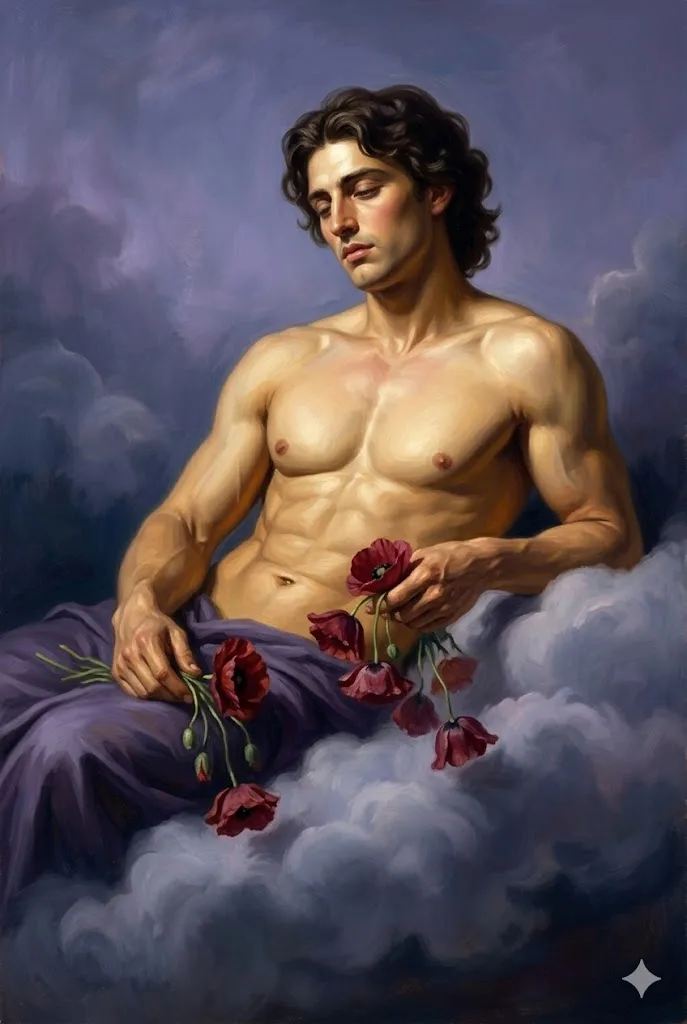
The Gentle God
Hypnos was the personification of sleep — the soft, irresistible force that claims every living creature each night. He was the twin brother of Thanatos (Death), and the two were often depicted together as young winged men, carrying the bodies of fallen warriors from the battlefield. While his brother's touch was final, Hypnos's embrace was temporary — a nightly rehearsal for death that offered rest, dreams, and renewal.
Son of Nyx (Night) and brother to a vast brood of dark spirits, Hypnos dwelled in a cave in the Underworld through which the River Lethe — the river of forgetfulness — flowed. No sunlight ever reached this cave, and its entrance was surrounded by fields of poppies and other sleep-inducing plants. The cave itself was so still and silent that even the river made no sound as it passed over the smooth stones.
Power Over Gods
Hypnos possessed a remarkable power: he could put anyone to sleep, including the gods themselves. In the Iliad, Hera recruited Hypnos to put Zeus to sleep so she could interfere in the Trojan War without her husband's knowledge. Hypnos was reluctant — the last time he had put Zeus to sleep, the king of the gods had awoken in a fury and nearly hurled him into the sea. But Hera promised him one of the Graces as a bride, and Hypnos agreed. He perched on a pine tree near Zeus in the form of a bird and cast his spell, allowing Hera to turn the tide of battle.
Symbols and Legacy
Hypnos was depicted as a gentle young man with small wings on his temples or shoulders, often carrying a horn of sleep-inducing opium or a branch dripping with Lethe water. In Hesiod the Oneiroi (Dreams) are his siblings, fellow children of Nyx; in Ovid's later Roman account, Sleep is instead the father of a thousand dream spirits, including Morpheus, who could take any human form in dreams. The word 'hypnosis' derives directly from his name, as does 'hypnotic.' In an age of sleep science and meditation apps, the ancient god of sleep has never been more relevant.
The full bargain in Iliad 14
The scene in which Sleep helps Hera deceive Zeus is richer than the usual summary. Hera finds Hypnos on Lemnos and first offers him a golden throne made by Hephaestus, with a footstool. He turns it down, and explains why. Once before, at Hera's request, he lulled Zeus while she sent storms against Heracles as the hero sailed home from sacking Troy, driving him off course to Cos. When Zeus woke he hurled the gods around his palace looking for the culprit, and would have flung Hypnos from the sky into the sea if Hypnos had not fled to Nyx, Night, "subduer of gods and men." Zeus stopped, because he was unwilling to do anything that displeased swift Night. It is one of the few places in Homer where Zeus himself backs down before another power.
Hera then raises her offer to Pasithea, one of the younger Graces, whom Hypnos says he has longed for all his days. Even so he makes Hera swear by the water of the Styx, with one hand on the earth and one on the sea, calling the Titans beneath Tartarus as witnesses. Only then does he go, settling in a fir tree on Mount Ida in the shape of a bird that the gods call chalkis and men call kymindis. After Zeus falls asleep, Hypnos goes on to tell Poseidon that the way is clear to help the Greeks.
Sleep and Death carry Sarpedon home
Hypnos' other great Homeric moment is quieter. When Sarpedon, the Lycian son of Zeus, is killed by Patroclus in Iliad 16, Zeus orders Apollo to take the body from the battlefield, wash it in the river, anoint it with ambrosia, and hand it to the twin brothers Sleep and Death, who carry it to Lycia for burial. This image became famous through the Euphronios krater, painted around 515 BC, which shows the two winged brothers lifting the bleeding hero while Hermes looks on. Looted and sold to the Metropolitan Museum in 1972, it was returned to Italy in 2008. Later the scene became a model for carrying the dead on Athenian white-ground lekythoi, the oil flasks used in funerals.
Genealogy, home and a few lesser stories
Hesiod's Theogony lists Hypnos and Thanatos among the children Night bore without a partner, together with "the tribe of Dreams." In Hesiod, then, the Dreams are Sleep's siblings, not his sons. Hesiod also locates the brothers' home at the edge of Tartarus, where Helios never looks on them; Sleep roams the earth and sea, "quiet and kindly," while Death has a heart of iron and holds fast whomever he catches. The cave among the Cimmerians, with its poppies and the silent stream of Lethe, is Ovid's later elaboration in Metamorphoses Book 11, where Somnus, the Roman Sleep, is roused by Iris and sends Morpheus to Alcyone.
A fragment of the lyric poet Licymnius, quoted by Athenaeus, has Hypnos falling in love with the beautiful shepherd Endymion and lulling him to sleep with his eyes open, so that he could go on gazing at them. It is a variant of the better-known story that ties Endymion's endless sleep to Selene.
Worship and images
Hypnos had no major temples, but he was not ignored. Pausanias saw several images of him. At Troezen the people sacrificed to the Muses and to Sleep at the same altar, saying Sleep was the god dearest to the Muses. In the sanctuary of Asclepius at Sicyon stood a figure of Dream and one of Sleep, the latter called Epidotes, "the giver," shown lulling a lion. Sparta had statues of Sleep and Death. On the Chest of Cypselus at Olympia, Night was shown holding two children, a white one asleep and a black one who seemed asleep, with crooked feet: Sleep and Death.
The best-known surviving image is a bronze head in the British Museum, found in central Italy, with a single wing sprouting from the temple; a matching full-length type survives in a marble statue in Madrid. Both reflect a Hellenistic model of a youthful god walking softly forward, pouring sleep from a horn.
Ancient sources
- Homer, Iliad 14.231–291 — Hera's bargain with Hypnos on Lemnos, the earlier episode with Heracles and Nyx, the promise of Pasithea, and the oath by the Styx.
- Homer, Iliad 16.666–683 — Sleep and Death carry Sarpedon's body home to Lycia.
- Hesiod, Theogony 211–212 and 758–766 — Hypnos as son of Night, and the home of Sleep and Death beside Tartarus.
- Ovid, Metamorphoses 11.592–649 — the house of Somnus among the Cimmerians, visited by Iris.
- Pausanias, Description of Greece 2.10.2, 2.31.3, 3.18.1 and 5.18.1 — images and altars of Sleep at Sicyon, Troezen, Sparta and on the Chest of Cypselus.
Frequently asked questions
Who was Hypnos married to?
Pasithea, one of the Graces, promised to him by Hera in the Iliad. Later poets, such as Nonnus, keep her as his wife.
Is Hypnos the father of Morpheus?
In Ovid, yes: Somnus has a thousand sons, and Morpheus is the one who imitates human beings. In Hesiod, however, the Dreams are children of Night and so brothers of Sleep.
What is Hypnos called in Roman mythology?
Somnus. His brother Death is Mors, and their mother Night is Nox.
Are Hypnos and Thanatos twins?
Homer calls them twin brothers in the Sarpedon episode, and Hesiod makes both children of Night. The pairing was so strong that artists often showed them as near-identical winged youths, sometimes one fair and one dark.
Books to read next
- Stephen Fry, Mythos
- Edith Hamilton, Mythology
- Hesiod, Theogony and Works and Days (Oxford World's Classics)
Links go to Bookshop.org, which supports independent bookstores. We earn a small commission if you buy, at no extra cost to you.
Explore More
Thanatos · Nyx · Underworld · Home