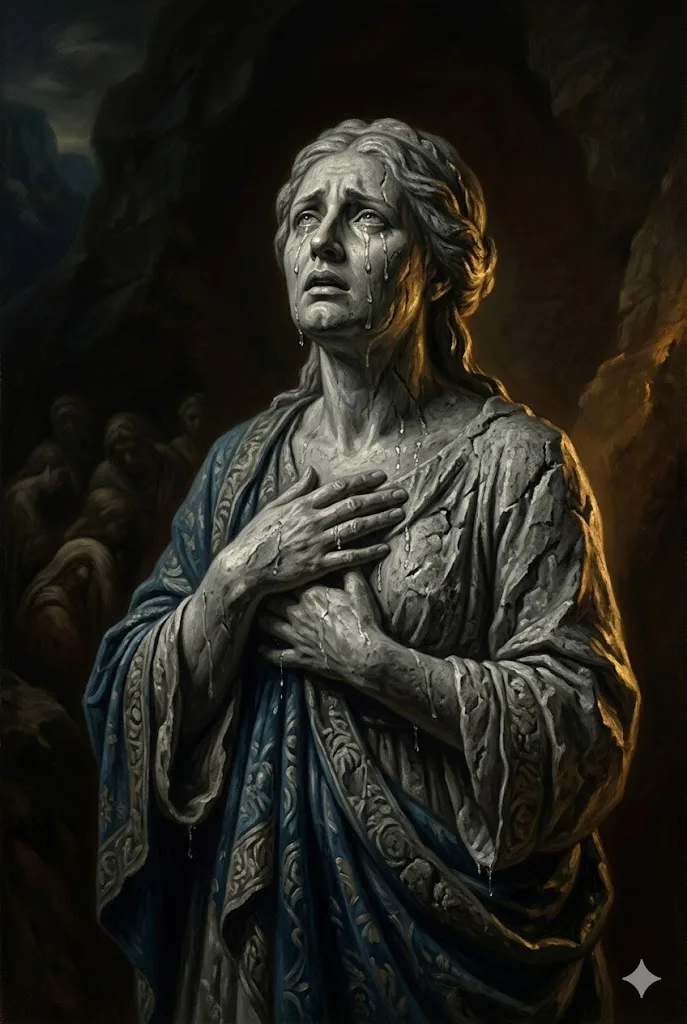
A Mother's Fatal Pride
Niobe was the daughter of Tantalus and queen of Thebes, married to King Amphion. She had fourteen beautiful children — seven sons and seven daughters — and in this abundance she found the seed of her destruction.
Niobe publicly declared herself superior to the Titaness Leto, who had only two children. 'I have seven times as many,' Niobe boasted. 'Worship me instead.' She even ordered the people of Thebes to stop making offerings at Leto's temples.
Apollo and Artemis Strike
Leto's two children were Apollo and Artemis — and they would not let their mother's honor go unavenged. Apollo descended from Olympus with his silver bow and killed all seven of Niobe's sons, one by one. Artemis then slew all seven daughters with her unerring arrows.
In some versions, one son and one daughter were spared because they prayed to Leto. But the destruction was essentially total — fourteen children dead in a single day because their mother dared to compare herself to a goddess.
Turned to Stone
Niobe's husband Amphion killed himself in grief (or was slain by Apollo). Niobe herself, destroyed by sorrow, fled to Mount Sipylus in Lydia. There, the gods took pity on her endless weeping and transformed her into a rock — but even as stone, she continued to weep. Ancient travelers reported a rock formation on the mountain that appeared to have water streaming down its face, which they identified as the still-weeping Niobe.
The geological formation still exists today on Mount Sipylus in modern Turkey.
The Lesson of Niobe
Niobe's story is the quintessential Greek lesson about hubris. She didn't merely feel pride — she publicly challenged a goddess and demanded worship that belonged to the immortals. The severity of her punishment reflects how seriously the Greeks took the boundary between mortal and divine.
Homer uses Niobe as an example in the Iliad when Achilles urges Priam to eat despite his grief, reminding him that even Niobe eventually ate after losing all her children.
Quick Facts
Father: Tantalus
Husband: Amphion, King of Thebes
Children: 14 (7 sons, 7 daughters) — the Niobids
Crime: Boasted superiority over Leto
Punishment: All children slain; turned to weeping stone
Location: Mount Sipylus, Lydia (modern Turkey)
How many children? The ancient argument
The fourteen Niobids are the most familiar number, but they are only one tradition. Homer, in the speech of Achilles in Iliad 24, gives Niobe six sons and six daughters. Aulus Gellius, collecting the variants in his Attic Nights (20.7), notes that Euripides made it fourteen, Sappho eighteen, and Bacchylides and Pindar twenty. Apollodorus reports that Hesiod gave her ten sons and ten daughters, and that the historian Herodorus reduced the family to two sons and three daughters. The number mattered: it measured the size of the boast, and later authors liked to inflate it.
Homer's version also contains details later retellings drop. After the killings the bodies lay unburied for nine days, because Zeus had turned the people of the city to stone, and on the tenth day the gods themselves buried them. Niobe, now stone on Sipylus "among the lonely mountains," still broods on the sorrows the gods sent her.
The survivors vary as well. Apollodorus names Amyclas and Chloris as the two spared children. Pausanias, who saw a statue of Chloris at Argos, says her original name was Meliboea and that she became so pale from terror during the massacre that she was renamed Chloris, "the pale one." She later married Neleus of Pylos, which in some genealogies makes Niobe the grandmother of Nestor.
Family and setting
Niobe came from a family famous for overstepping divine limits. Her father was Tantalus, punished in the underworld for testing or abusing the gods' hospitality (see the story of Tantalus), and her brother was Pelops, ancestor of Agamemnon and the whole house of Atreus. She married Amphion, the musician who, with his twin Zethus, built the walls of Thebes by charming the stones into place with his lyre.
Ovid's account in Metamorphoses 6 is the fullest narrative. The seer Manto, daughter of Tiresias, goes through the streets urging Theban women to honour Leto and her twins; Niobe sweeps in, dressed in gold-woven Phrygian robes, and scorns a goddess who could find nowhere on earth to give birth until the floating island of Delos took pity on her. Apollo kills the sons as they exercise on horseback outside the walls; Amphion stabs himself; and Niobe, still defiant, boasts that even bereaved she has more children than Leto. Then Artemis shoots the daughters, the last of them while Niobe begs to keep just one. Turned to stone, she is carried by a whirlwind to her homeland in Lydia, where the marble still weeps.
This Niobe should not be confused with an earlier namesake, Niobe the daughter of Phoroneus of Argos, whom Apollodorus calls the first mortal woman Zeus slept with.
Tragedy, art and a chemical element
Aeschylus wrote a Niobe, now lost, that was famous for its silence: Aristophanes' Frogs mocks the playwright for keeping a veiled Niobe seated on her children's tomb for most of the play without uttering a word. A papyrus fragment preserves part of a speech from it. Sophocles also wrote a Niobe, of which very little survives.
The massacre was a favoured subject in sculpture and vase painting. The name vase of the Niobid Painter, a calyx-krater in the Louvre from about 460–450 BC, shows Apollo and Artemis shooting down the children on a hillside. Pausanias saw the Niobids among the decorations of Pheidias' throne of Zeus at Olympia. A group of Roman statues of Niobe and her children, discovered in Rome in 1583, now fills the Niobe Room of the Uffizi in Florence, and the striking "Dying Niobid," a daughter reaching for the arrow in her back, is in the Ny Carlsberg Glyptotek in Copenhagen.
Pausanias says he climbed Mount Sipylus to see the Niobe rock himself: close up it was just a crag and a precipice, with nothing like a woman, but from a distance it looked like a weeping woman bowed in grief. The formation near Manisa in western Turkey is still pointed out as the "Weeping Rock." In 1844 the chemist Heinrich Rose named the element niobium after her, because it occurs alongside tantalum, named for her father.
Ancient sources
- Homer, Iliad 24.602–617 — Achilles tells Priam the story: twelve children, nine days unburied, Niobe turned to stone on Sipylus.
- Ovid, Metamorphoses 6.146–312 — the most detailed narrative, with Manto, Niobe's speech, Amphion's suicide and the death of the last daughter.
- Apollodorus, Library 3.5.6 — the variant numbers of children and the survivors Amyclas and Chloris.
- Pausanias, Description of Greece 1.21.3, 2.21.9, 5.11.2 — his visit to the rock on Sipylus, the statue of Chloris at Argos, and the Niobids on the throne of Zeus.
- Aulus Gellius, Attic Nights 20.7 — collects the differing numbers given by Homer, Euripides, Sappho, Bacchylides and Pindar.
Frequently asked questions
How many children did Niobe have?
Fourteen in the most common version, seven sons and seven daughters, but Homer gives twelve, Sappho eighteen, and Hesiod, Pindar and Bacchylides twenty.
Can you still see Niobe's rock?
Yes. A rock formation on Mount Sipylus (Spil Dağı) near Manisa in Turkey is traditionally identified as the weeping Niobe, as Pausanias described in the second century AD.
Did any of Niobe's children survive?
In several versions one son and one daughter were spared, usually named Amyclas and Chloris. Homer and Ovid have all of them die.
What is Niobe a symbol of?
She became the classic image of a mother's grief and of punished pride. Shakespeare's Hamlet describes his mother at his father's funeral as "like Niobe, all tears."