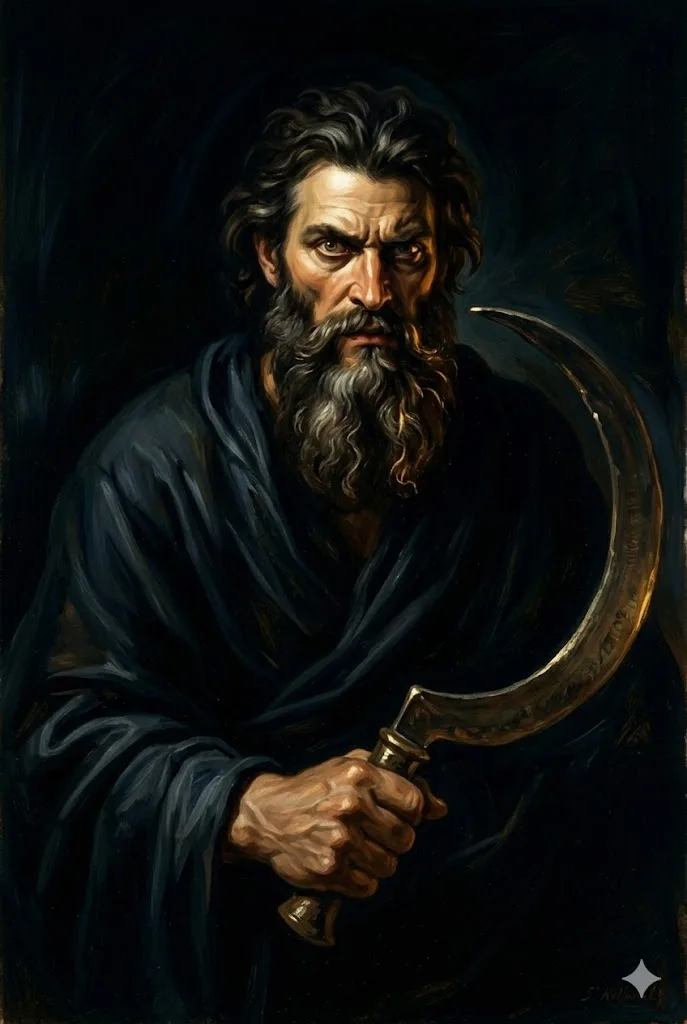
I. Who Was Cronus?
Cronus was the youngest and most ambitious of the twelve original Titans, and for an age he was the supreme ruler of the cosmos. His reign was known as the Golden Age — a mythical era of peace and abundance when mortals lived without toil, sorrow, or old age. Yet beneath this idyllic surface, Cronus was haunted by a prophecy: just as he had overthrown his father Uranus, one of his own children would one day overthrow him.
Driven by this fear, Cronus devoured each of his children — Hestia, Demeter, Hera, Hades, and Poseidon — the moment they were born. His wife Rhea, desperate to save her last child, hid the infant Zeus on the island of Crete and substituted a stone wrapped in swaddling clothes. Cronus swallowed the stone without noticing the deception.
II. The Fall of the Titans
When Zeus reached maturity, he returned and forced Cronus to regurgitate his siblings. The freed gods, led by Zeus, declared war on Cronus and the Titans in the cataclysmic Titanomachy — a ten-year conflict that shook the foundations of the earth. With the help of the Cyclopes and the Hundred-Handed Ones, Zeus and the Olympians prevailed. Cronus and the Titans were cast into the abyss of Tartarus, imprisoned forever in the deepest pit beneath the underworld.
His Roman counterpart Saturn gave his name to Saturday (Saturn's Day) and the planet Saturn. The festival of Saturnalia — the most popular holiday in the Roman calendar — commemorated the Golden Age of Cronus/Saturn with feasting, gift-giving, and temporary social equality. Many of its customs were later absorbed into Christmas celebrations.
Classical Sources
The mythology of Cronus is preserved in:
- 📜 Hesiod, Theogony (c. 700 BC) — The primary source for Titan mythology, genealogy, and the Titanomachy.
- 📜 Apollodorus, Bibliotheca (c. 1st–2nd century AD) — Comprehensive handbook of Titan genealogies and myths.
- 📜 Aeschylus, Prometheus Bound (c. 5th century BC) — Dramatic portrayal of Titan defiance against Olympian authority.
- 📜 Ovid, Metamorphoses (8 AD) — Roman accounts of Titan mythology and transformations.
Cross-referenced with multiple classical sources for accuracy.
Explore More Mythology
Get weekly deep dives into the gods, heroes, and myths of ancient Greece.