Echidna — The Mother of Monsters — Half Woman, Hal
⚡ Quick Facts
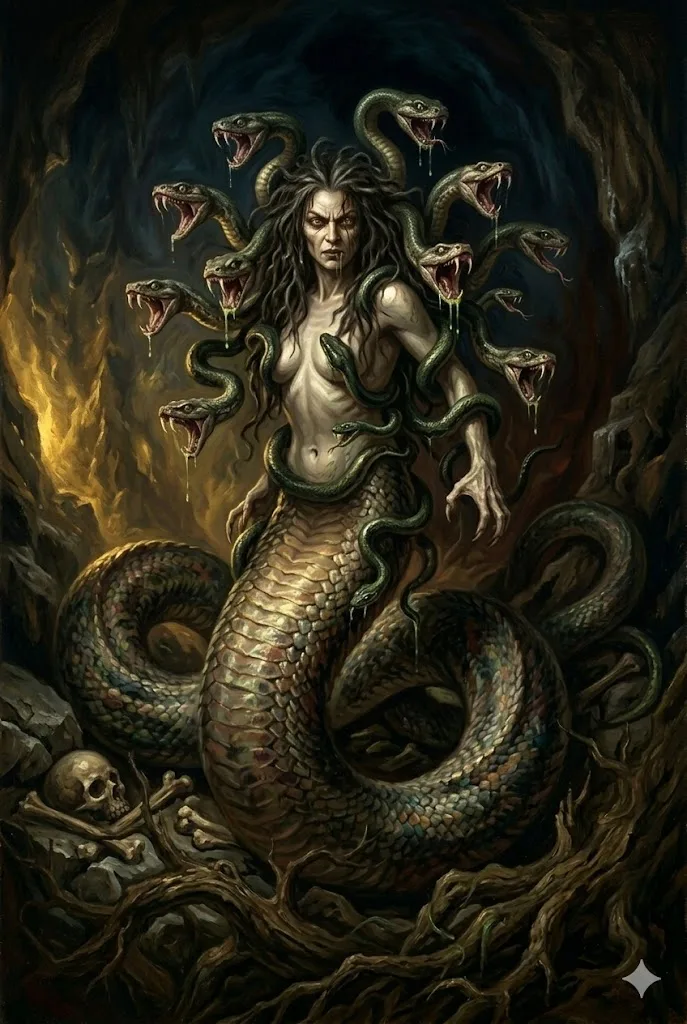
The She-Viper
Echidna was described as a terrifying hybrid: from the waist up, she was a beautiful, dark-eyed woman. From the waist down, she was a massive, speckled serpent. She lived in a cave deep beneath the earth, far from both gods and mortals, emerging only to hunt and feed.
Her mate was Typhon, the most terrible monster in Greek mythology — the creature who challenged Zeus himself for supremacy. Together, Echidna and Typhon produced nearly every famous monster in Greek myth.
Her Monstrous Children
Echidna's offspring reads like a catalogue of Greek mythology's greatest threats. With Typhon, she bore the Lernaean Hydra (the multi-headed serpent killed by Heracles), the Chimera (lion-goat-serpent hybrid), Cerberus (the three-headed guardian of the Underworld), the Colchian Dragon (guardian of the Golden Fleece), the Sphinx of Thebes, the Nemean Lion, and the eagle that tormented Prometheus.
Some accounts also credit her with the Gorgons, Scylla, and the Crommyonian Sow. Nearly every hero's greatest challenge traces back to Echidna's bloodline — she was the ultimate source of the monsters that defined heroic myth.
Death and Legacy
In Hesiod, Echidna was immortal and ageless, dwelling in her cave. In Apollodorus, the hundred-eyed giant Argus Panoptes killed her while she slept. A modern retelling, not found in any major ancient author, adds that Zeus allowed her and her children to survive the defeat of Typhon so that future heroes would have worthy opponents.
Hesiod's Portrait and the Puzzle of Her Parents
The fullest early description is in Hesiod's Theogony. Echidna is "divine and fierce-hearted," half a quick-eyed, fair-cheeked nymph and half a huge, terrible snake, speckled and eating raw flesh "beneath the hollows of the holy earth." She lives in a cave far from gods and men, "among the Arimoi," and Hesiod stresses that she is immortal and ageless for all her days. That line conflicts with the later story of her death.
Her parentage is uncertain because of Hesiod's grammar. The passage follows the children of Phorcys and Ceto, but the pronoun "she" that introduces Echidna's mother could also point back to Callirhoe, the Oceanid just mentioned as the mother of Geryon. Ancient readers took it both ways. Apollodorus offers a third option, making the Echidna killed by Argus a daughter of Tartarus and Gaia. Pausanias records a fourth: the Cretan poet Epimenides made her the daughter of Styx and an otherwise obscure figure named Peiras. The quick facts above list two of these, but there were at least four different family trees in antiquity.
Where "the Arimoi" were was argued over just as much. Homer mentions Typhon's bed "among the Arimoi" in the Iliad, and later geographers looked for the place in Cilicia, in Syria, in Lydia, or on the volcanic island of Pithekoussai (Ischia) off Italy. The location follows Typhon, and wherever he was thought to lie under the earth, Echidna's cave was placed nearby.
The Family Tree in Detail
Hesiod lists her children by Typhon as Orthus, the two-headed dog of Geryon later killed by Heracles; Cerberus; and the Lernaean Hydra. Then come two ambiguous passages. The Chimaera's mother is either Echidna or the Hydra, and the mother of the Sphinx and the Nemean Lion, fathered by Orthus, is either Echidna or the Chimaera. On the second reading, Echidna's own son fathered her grandchildren, which shows how closely Greek imagination bred its monsters.
Later writers added to the list freely. Apollodorus makes Echidna and Typhon the parents of the eagle that ate Prometheus' liver, the Colchian dragon, the Chimaera and the Sphinx, and he names Ladon, the serpent of the Hesperides, as their child. Hesiod had made Ladon the youngest child of Ceto and Phorcys. Some ancient writers also called the Crommyonian Sow her offspring. Hyginus, in the preface to his Fabulae, adds names such as the Gorgon and Scylla. These expanded lists show a tendency to trace every monster back to one mother, but they are not consistent with each other.
The Scythian Snake-Woman
A completely different story is in Herodotus, who reports a version told by the Greeks of the Black Sea. While Heracles slept in the Scythian region of Hylaea, his mares disappeared. He found them in a cave with a creature who was a woman above the buttocks and a serpent below. Herodotus calls her a two-formed viper-maiden. She agreed to return the horses only if Heracles stayed with her, and she bore him three sons: Agathyrsus, Gelonus and Scythes. Heracles left her a bow and a belt and told her that whichever son could draw the bow should rule the land. Only Scythes could, and he became the ancestor of the Scythian kings. Herodotus does not call her Hesiod's Echidna, but later readers often identified the two, and the story shows the snake-woman as an ancestral mother rather than a monster for heroes to slay.
Echidna Today
Ancient art has very few images that can be securely identified as Echidna. Modern illustrations are mostly inventions based on Hesiod's description. Her name, Greek for "viper," passed into zoology. The spiny egg-laying mammal of Australia and New Guinea is called the echidna, reportedly because it seemed to combine mammal and reptile features, like the half-woman, half-snake of myth. The idea, repeated online, that Zeus spared Echidna and her children on purpose to challenge future heroes is not stated by any major ancient author. It is a modern reading of the fact that her offspring outlived Typhon's defeat.
Ancient sources
- Hesiod, Theogony 295–332: Echidna's half-nymph, half-serpent form, her cave among the Arimoi, her immortality, and her children by Typhon.
- Homer, Iliad 2.781–783: Typhon's bed "among the Arimoi," the location later linked with Echidna's cave.
- Herodotus, Histories 4.8–10: the serpent-maiden of Hylaea who bore Heracles three sons, including Scythes.
- Apollodorus, Library 2.1.2: Argus Panoptes kills Echidna, daughter of Tartarus and Gaia, as she sleeps. Other passages assign her many monstrous children.
- Pausanias, Description of Greece 8.18.2: Epimenides' genealogy making Echidna a daughter of Styx and Peiras.
Frequently asked questions
Who killed Echidna?
According to Apollodorus, Argus Panoptes, the hundred-eyed giant, killed her while she slept because she seized passers-by. Hesiod, however, calls her immortal and ageless.
What does the name Echidna mean?
It is the ordinary Greek word for a viper or she-snake, appropriate for a woman whose lower half was a serpent.
Is Echidna the mother of Medusa?
Not in Hesiod, where the Gorgons are daughters of Phorcys and Ceto. Some late lists such as Hyginus' add a Gorgon to Echidna's children, but this is a minority version.
Why is the Australian animal called an echidna?
Naturalists borrowed the name of the half-woman, half-snake of myth, reportedly because the animal seemed to combine mammal and reptile features, such as laying eggs.