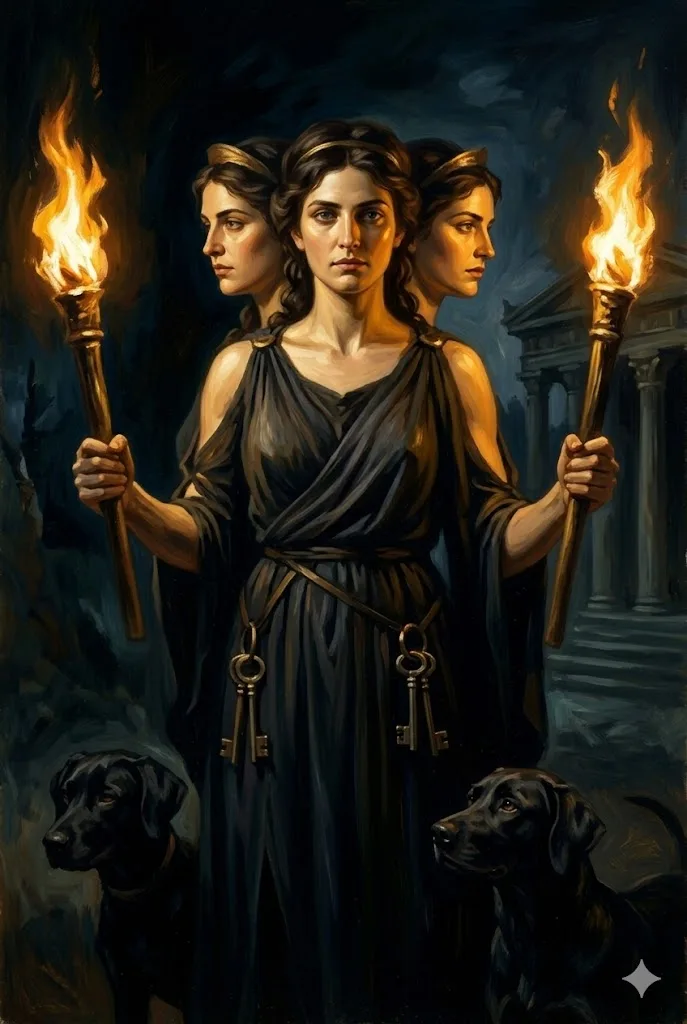
Who Was Hecate?
Hecate was one of the most enigmatic and powerful deities in the Greek pantheon — a goddess who held dominion over magic, sorcery, the night, the moon, ghosts, necromancy, and crossroads. She occupied a unique position among the gods: though she predated the Olympians as a Titan-era deity, Zeus honoured her above all others and allowed her to retain her ancient powers and privileges after his rise to supremacy.
Unlike the bright, public gods of Olympus, Hecate operated in the shadows and liminal spaces of the world. She was encountered at crossroads at midnight, in graveyards under the new moon, and at the thresholds between the living world and the realm of the dead. She was both feared and revered — a protector of households and a guide through darkness, but also a fearsome mistress of ghosts and dark magic.
Origins and Powers
Hecate was the daughter of the Titans Perses and Asteria, making her a cousin of Apollo and Artemis. According to Hesiod's Theogony, Zeus granted Hecate a share of the earth, sea, and sky — an extraordinary privilege that made her one of the most widely powerful deities in existence. She could bestow wealth, victory, wisdom, and good fortune on those who prayed to her, or withhold these blessings at will.
Her triple nature was her most distinctive attribute. Hecate was frequently depicted as a triple-formed goddess — three female bodies joined back-to-back, each facing a different direction at a crossroads. This form represented her dominion over the three realms (earth, sea, and sky), and, in later interpretations, the three phases of the moon. At three-way crossroads, the Greeks placed offerings of food known as 'Hecate's suppers' on the night of the new moon.
Hecate and Persephone
Hecate played a crucial role in one of Greek mythology's most important stories — the abduction of Persephone. When Hades seized Persephone and dragged her to the Underworld, it was Hecate who heard the girl's screams from her cave. Carrying her twin torches, Hecate helped Demeter search for her missing daughter, eventually guiding the grieving mother to the truth. After Persephone's partial return, Hecate became her companion and attendant in the Underworld, serving as a psychopomp — a guide of souls between the worlds of the living and the dead.
Worship and Rituals
Hecate's worship was deeply personal and often conducted in private or at night. Her devotees left offerings at crossroads — typically honey cakes, garlic, eggs, and fish — on the night of the new moon. These 'Hecate's suppers' were intended to appease the goddess and the restless spirits that accompanied her. Dogs were sacred to Hecate, and the howling of dogs at night was believed to signal her approach. Black dogs and black lambs were sacrificed in her honour.
Despite her association with darkness, Hecate was also considered a protective goddess. She guarded doorways and entrances — small shrines to Hecate were placed outside homes to ward off evil spirits. She was a patron of those who worked at night, of travellers navigating dangerous roads, and of women during childbirth. Her dual nature as both terrifying and protective made her one of the most complex deities in Greek religion.
Legacy in Modern Culture
Hecate's influence on Western culture has been enormous. She became the archetypal figure of the witch in European folklore, and Shakespeare included her in Macbeth as the goddess who presides over the three witches, a separate figure from the witches themselves. The modern Wiccan and neo-pagan movements have adopted Hecate as a central deity, often honouring her as the triple goddess of maiden, mother, and crone, a modern idea popularized by Robert Graves rather than an ancient Greek one. Her image as the torchbearing goddess of the crossroads continues to captivate artists, writers, and spiritual practitioners around the world.
Hesiod's Hecate: a goddess of blessings, not spells
The long passage on Hecate in Hesiod's Theogony is one of the strangest in the poem, because it reads almost like a hymn inserted into the genealogy. What it praises is not witchcraft. Hesiod's Hecate sits beside kings in judgement, makes men stand out in the assembly, gives victory in war and in athletic contests, helps horsemen, and grants fishermen a good catch or takes it away. She can multiply herds of cattle and flocks of sheep, or shrink them. Hesiod also calls her kourotrophos, "nurse of the young," a role Zeus gave her over every child born after her. Nothing in the passage mentions ghosts, the moon or magic. That darker side developed later, mostly through tragedy and Hellenistic poetry, and readers who meet Hecate first as the queen of witches are often surprised by how practical and generous the earliest description is.
Her parentage also varies. Hesiod makes her the only child of Perses and Asteria. Bacchylides calls her a daughter of Nyx, other writers attached her to Zeus or to Demeter, and she was often identified with Artemis, a link helped by their shared torches and their care for women in childbirth. In Thessaly a goddess called Enodia, "she of the road," worshipped at Pherae, was regularly equated with her.
How Hecate became the goddess of witches
By the fifth century BC tragedy had tied Hecate to sorcery. In Euripides' Medea, Medea swears by Hecate, "whom I revere above all and have chosen as my helper, who dwells in the inmost part of my hearth." Apollonius of Rhodes went further in the Argonautica: Medea is Hecate's priestess in Colchis, and before the trial of the fire-breathing bulls Jason bathes in a river at midnight, digs a pit, sacrifices a ewe and pours honey, and calls on the goddess. Hecate rises wreathed in serpents and oak boughs, surrounded by torches and the barking of hellhounds, and Jason flees without looking back. Theocritus' second Idyll shows a lovesick woman, Simaetha, invoking Hecate during a binding spell, and Roman poets such as Ovid, Seneca and Lucan pushed the image toward the gothic. The Greek Magical Papyri from Roman Egypt preserve real spells addressed to her alongside Selene and Persephone.
Hecate also had her moment in the war against the Giants. Apollodorus says she killed the Giant Clytius with her torches, and the east frieze of the Pergamon Altar shows her in triple form, several arms wielding torch, sword and spear, fighting a Giant, often identified as Clytius. More on that conflict is in our account of the Gigantomachy.
Sanctuaries, images and epithets
Her most important temple stood at Lagina in Caria, in southwest Asia Minor, attached to the city of Stratonicea. Its festival, the Hekatesia, included a procession in which a key was carried, matching her title Kleidouchos, "key-holder," the keeper of the gates. On the island of Aegina, Pausanias says, Hecate was the most honoured of the gods, with annual mystery rites the islanders said Orpheus had founded, and a wooden image by Myron with one face and one body. He adds that the Athenian sculptor Alcamenes was, in his opinion, the first to show her as three figures joined together, in the statue the Athenians called Hecate Epipyrgidia, "on the tower," which stood beside the temple of Athena Nike on the Acropolis.
In daily life Athenians set small images of Hecate, hekataia, at the doors of their houses, and she was worshipped as Propylaia, "before the gate." Other common titles include Enodia and Trioditis (of the roads and the three-way crossing, the Latin Trivia), Phosphoros (light-bringer) and Chthonia (of the earth below). The "suppers" left at crossroads were not always eaten by spirits: in Aristophanes' Wealth, a character jokes that the poor snatched them before they reached the goddess.
In late antiquity the Chaldean Oracles and the Neoplatonists raised her to cosmic rank, as a world soul and mediator between the highest god and the material world. That philosophical Hecate is very different from both Hesiod's provider and Medea's patron.
What people get wrong
The popular "maiden, mother, crone" triple goddess is a modern idea, given its widest currency by Robert Graves's The White Goddess (1948). Ancient images of the triple Hecate show three identical young women, not three ages; the three faces look down the three roads of a crossing. In Macbeth, Hecate appears in person as queen of the witches, but her scenes (3.5 and part of 4.1) are widely thought to have been added by Thomas Middleton, and she is distinct from the three Weird Sisters.
Ancient sources
- Hesiod, Theogony 411–452 — the "hymn to Hecate": her parentage, her share of earth, sea and sky, and the many kinds of people she helps.
- Homeric Hymn to Demeter — Hecate hears Persephone's cry from her cave, meets Demeter with a torch, and becomes Persephone's attendant.
- Euripides, Medea — Medea names Hecate as her chosen patron who dwells at her hearth.
- Apollonius of Rhodes, Argonautica 3 — Medea as Hecate's priestess, and Jason's midnight sacrifice that summons the goddess.
- Apollodorus, Library 1.6.2 — Hecate kills the Giant Clytius in the Gigantomachy.
- Pausanias, Description of Greece 2.30.2 — her mysteries on Aegina, Myron's single-bodied image, and Alcamenes' triple Hecate Epipyrgidia in Athens.
Frequently asked questions
Is Hecate a Titan?
Not strictly. She is the daughter of the Titan-generation figures Perses and Asteria, so she belongs to the line of the Titans, but she sided with Zeus and kept her privileges under the Olympians.
What animals are sacred to Hecate?
Dogs above all, which were sacrificed to her and whose barking announced her. Snakes accompany her in Apollonius, and in the story told by Antoninus Liberalis the girl Galinthias, turned into a weasel, became Hecate's sacred attendant.
What is the difference between Hecate and Persephone?
Persephone is queen of the underworld and wife of Hades. Hecate is her companion and helper, a goddess of thresholds and crossings who moves between worlds rather than ruling one.
Why does Hecate carry torches?
In the Homeric Hymn to Demeter she carries a torch when she joins the search for Persephone, and torches became her constant attribute as a goddess who lights the way at night, at crossroads and on the road to the dead.
Explore More
Persephone · Demeter · Artemis · Hades · Home
Join the Pantheon
Weekly mythology stories & deep dives delivered to your inbox.