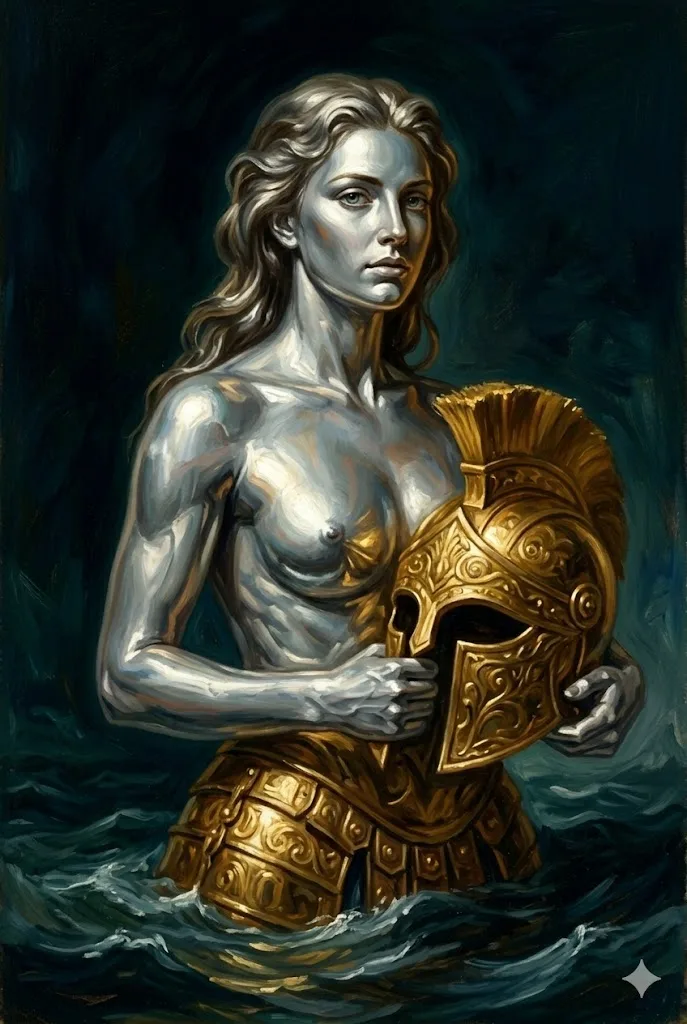
The Nereid Who Terrified Zeus
Thetis was a Nereid, one of the fifty daughters of the old sea god Nereus, and she was so beautiful that both Zeus and Poseidon pursued her. But the Titan Prometheus revealed a prophecy that changed everything: Thetis was destined to bear a son greater than his father. If Zeus fathered her child, that child would be powerful enough to overthrow him, just as Zeus had overthrown Cronus. Terrified, Zeus immediately abandoned his pursuit and arranged for Thetis to marry a mortal, the hero Peleus, ensuring her son would be merely human in status even if extraordinary in ability.
The Wedding
The wedding of Peleus and Thetis was one of the most important events in Greek mythology. Every god and goddess attended except Eris (Discord), whose uninvited appearance and the golden apple she threw would eventually trigger the Trojan War. The gods brought magnificent gifts. It was the last great gathering of gods and mortals before the age of heroes gave way to the age of wars.
The River Styx
When Thetis bore her son Achilles, she was determined to make him immortal. Older Greek accounts say she anointed him with ambrosia and placed him in fire, until Peleus interrupted her. In a later version, first found in the Roman poet Statius, she held the infant by his heel and dipped him in the River Styx, whose waters conferred invulnerability. Every part of his body that the water touched became impervious to harm. But the heel where she gripped him remained dry and vulnerable. This single unprotected spot would eventually kill the greatest warrior who ever lived.
A Mother's Grief
Thetis knew from prophecy that Achilles would die young if he went to Troy. She disguised him as a girl and hid him on the island of Skyros, but Odysseus tricked him into revealing himself. Throughout the Iliad, Thetis appears as a grieving mother who uses her influence with Zeus to help her son but knows she cannot save him. When Patroclus is killed and Achilles needs new armour, Thetis goes to Hephaestus and commissions the most magnificent armour ever created. She does everything a divine mother can do, and it is never enough.
Classical Sources
- 📜 Homer, Iliad & Odyssey (c. 750 BC)
- 📜 Hesiod, Theogony (c. 700 BC)
- 📜 Apollodorus, Bibliotheca (c. 1st-2nd century AD)
- 📜 Ovid, Metamorphoses (8 AD)
Cross-referenced with multiple classical sources for accuracy.
Explore More
Achilles · Zeus · Poseidon · Hephaestus · Home
Who Revealed the Prophecy, and Why Zeus Let Her Go
The ancient sources disagree about why Thetis married a mortal. In Pindar's eighth Isthmian Ode it is Themis who warns the assembled gods that Thetis's son will be mightier than his father, and advises that she be given to the pious Peleus. In Prometheus Bound, attributed to Aeschylus, the secret belongs to Prometheus, who uses it as leverage against Zeus. Apollodorus records another version: some said Thetis refused Zeus's advances out of loyalty to Hera, who had raised her, and Zeus in anger condemned her to marry a mortal. The Iliad hints at the bitterness of the match when Thetis complains that she alone of the sea goddesses was forced into a mortal's bed against her will.
The Wrestling Match and the Failed Immortality
Thetis did not agree to the marriage. On the advice of the centaur Chiron (in Apollodorus) or the sea god Proteus (in Ovid), Peleus ambushed her on the shore and held on while she changed into fire, water, a lion, a serpent and other forms. Pindar, Apollodorus and Ovid all tell this wrestling scene, and it was one of the most popular subjects on Athenian black- and red-figure vases, where small lions or snakes on Thetis's body or at her shoulders mark the transformations.
Before the Styx story became standard, Greek authors gave a different account of her attempt to make Achilles immortal. In Apollonius of Rhodes and Apollodorus, she burned away the boy's mortal nature in the fire by night and anointed him with ambrosia by day. Peleus woke, saw his son in the flames and cried out. Thetis, insulted, left the house and went back to the Nereids under the sea. The marriage effectively ended there, and Peleus handed Achilles to Chiron to raise. The dipping in the Styx is first attested in full in Statius' Achilleid, a Latin poem of the late first century AD (see Styx).
Thetis as a Rescuer of Gods
Homer presents Thetis as having real power over the gods, and that background explains why Zeus listens to her in Iliad Book 1. In that book Achilles reminds his mother that she once saved Zeus himself. When Hera, Poseidon and Athena plotted to bind him, Thetis summoned the hundred-handed Briareus to Olympus, and the conspirators backed down at the sight of him. In Book 6 she takes in the young Dionysus when the Thracian king Lycurgus drives him into the sea. In Book 18 Hephaestus welcomes her warmly because she and Eurynome took him in after Hera threw him from Olympus, and he worked for them for nine years in a cave by the sea. He makes Achilles' armour partly to repay that debt.
In the Argonautica she guides the Argo through the Wandering Rocks at Hera's request. After Achilles' death, the lost epic Aethiopis (known from a summary by Proclus) told how she snatched his body from the pyre and carried him to the White Island (Leuke) in the Black Sea, where a hero cult of Achilles later flourished. The Odyssey describes her rising from the sea with the Nereids to mourn at his funeral while the nine Muses sang the dirge.
Cult, Art and a Common Mix-Up
Thetis had real worship, especially in Thessaly, Peleus's homeland, where a Thetideion near Pharsalus took its name from her. Pausanias mentions a temple of Thetis at Sparta. Herodotus reports that after a storm wrecked Xerxes' fleet off Cape Sepias, the Persian Magi sacrificed to Thetis and the Nereids because locals said Peleus had seized her at that spot.
The best-known artwork is the François Vase in Florence (c. 570 BC), whose main frieze shows the gods arriving in procession at the house of Peleus for the wedding. The wedding feast was also where the dispute leading to the Judgement of Paris began.
Thetis is often confused with Tethys, the Titaness wife of Oceanus. In Greek the names differ by one letter and they are separate figures. Thetis is a Nereid, granddaughter of Pontus and Gaia; Tethys is a Titan and mother of the Oceanids, including Styx.
Ancient sources
- Homer, Iliad Books 1, 6, 18 and 24: Thetis pleads with Zeus, recalls freeing him with Briareus, sheltered Dionysus and Hephaestus, commissions the armour, and brings Zeus's order that Achilles return Hector's body.
- Pindar, Isthmian 8 and Nemean 4: Themis reveals the prophecy; Peleus wins Thetis despite her shape-changing.
- Apollonius of Rhodes, Argonautica Book 4: the fire-and-ambrosia attempt on the infant Achilles, her departure from Peleus, and her help steering the Argo.
- Apollodorus, Bibliotheca 3.13: the competing reasons for the marriage, the wrestling, the wedding, and the burning of Achilles.
- Ovid, Metamorphoses Book 11: Proteus advises Peleus and the capture in a sea cave.
- Statius, Achilleid: the Styx immersion and the hiding of Achilles on Skyros.
Frequently asked questions
Was Thetis a goddess or a nymph?
She was a Nereid, a sea nymph and daughter of Nereus and Doris. She was immortal and had more power and status than an ordinary nymph, as her influence over Zeus in the Iliad shows.
Why did Thetis leave Peleus?
Apollonius and Apollodorus say Peleus interrupted her while she was putting baby Achilles in the fire to make him immortal. She took offence and went back to the sea.
Did Thetis really dip Achilles in the River Styx?
Not in the earliest sources. The Styx immersion first appears in full in Statius' Roman epic. Older Greek versions use fire and ambrosia, and Homer's Achilles has no invulnerability at all.
What is the difference between Thetis and Tethys?
Thetis is a Nereid and the mother of Achilles. Tethys is a Titaness, wife of Oceanus and mother of the river gods and Oceanids.
Books to read next
Links go to Bookshop.org, which supports independent bookstores. We earn a small commission if you buy, at no extra cost to you.