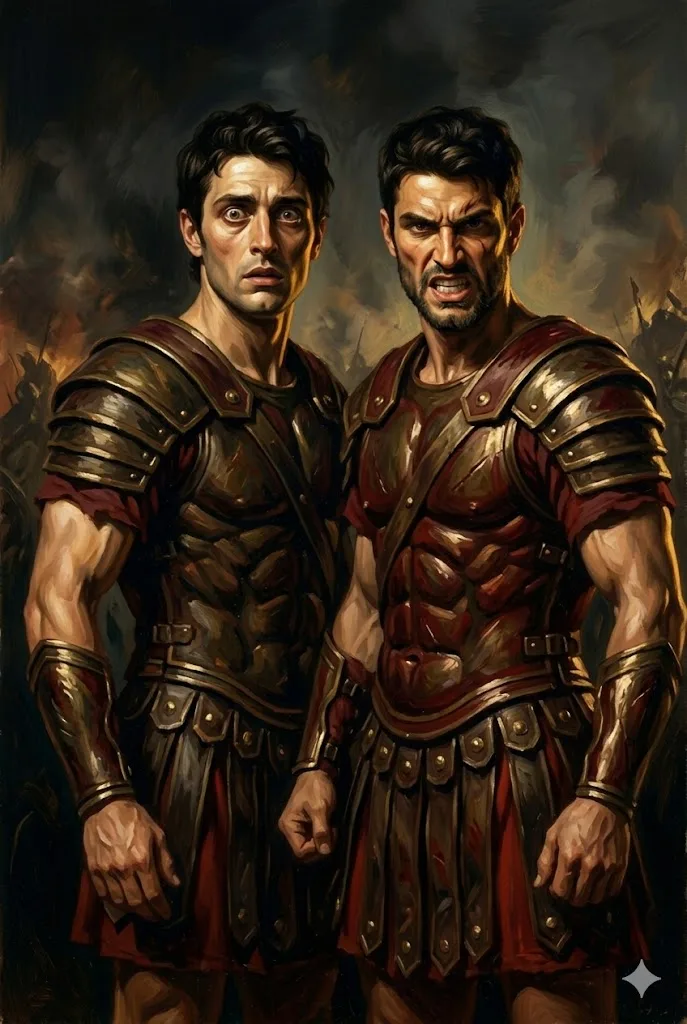
Sons of War and Love
Phobos (Fear) and Deimos (Terror) were the twin sons of Ares, god of war, and Aphrodite, goddess of love. They accompanied their father into every battle, driving his chariot and spreading panic through enemy ranks. Phobos represented the fear that grips you before a fight, the dread that makes your hands shake and your legs feel weak. Deimos was the terror of the battle itself, the screaming chaos and confusion that overwhelms rational thought.
The pairing of their parents is significant. That Fear and Terror are born from the union of War and Love tells us something the Greeks understood deeply: the things we love most are the things we are most afraid to lose. The soldier on the battlefield is not afraid of death in the abstract. He is afraid because he loves his life, his family, his home. Fear and love are not opposites. They are twins.
In the Iliad
Homer describes Phobos and Deimos preparing Ares's chariot for war. They are not characters with their own storylines but rather extensions of their father's power, the emotional weapons he deploys alongside the physical ones. When Ares enters the battlefield, Fear and Terror clear the path before him. Enemy warriors break and flee not because they are physically overpowered but because Phobos and Deimos have already destroyed their will to fight.
The Moons of Mars
When two small, irregularly shaped moons were discovered orbiting Mars in 1877, they were named Phobos and Deimos. The naming was perfect: Mars is the Roman name for Ares, and his two tiny attendants orbit him forever, just as they did in Homer. Phobos is slowly spiraling inward and will eventually either crash into Mars or break apart to form a ring, a fate that feels appropriately mythological.
Classical Sources
- 📜 Homer, Iliad & Odyssey (c. 750 BC)
- 📜 Hesiod, Theogony (c. 700 BC)
- 📜 Apollodorus, Bibliotheca (c. 1st-2nd century AD)
- 📜 Ovid, Metamorphoses (8 AD)
Cross-referenced with multiple classical sources for accuracy.
Explore More
Ares · Aphrodite · Trojan War · Home
What Homer and Hesiod Actually Say
The brothers appear only in brief, vivid glimpses, and it helps to look at exactly where. Hesiod's Theogony gives their parentage: Aphrodite bore to Ares "Phobos and Deimos, terrible ones, who rout the close-packed ranks of men in chilling war, together with city-sacking Ares," and also a daughter, Harmonia, whom Cadmus married. Hesiod never calls the sons twins; that label is modern, though they always appear as a pair.
Homer uses them in several different ways in the Iliad:
- In Book 4, as the armies clash, Ares drives on the Trojans and Athena the Greeks, and with them come Deimos, Phobos and Eris, Strife, who "rages without ceasing."
- In Book 13, Homer compares two Greek heroes to Ares going to war with "his dear son Phobos, strong and fearless, who terrifies even a steadfast warrior."
- In Book 15, when Ares learns that his son Ascalaphus has been killed, he orders Deimos and Phobos to yoke his horses so he can avenge him, until Athena stops him.
- In Book 11, the shield of Agamemnon bears a Gorgon's face, and around it Deimos and Phobos.
That last use is important. To Homer, Phobos meant not "fear" in general but panic flight, the moment a line of warriors breaks and runs. Placing his image on a shield or on Athena's aegis was a way of turning that force against the enemy.
Fear on Shields, Altars and Battlefields
The pseudo-Hesiodic Shield of Heracles puts Phobos at the centre of the hero's shield, staring backward with eyes glowing like fire, his mouth full of teeth. Pausanias saw a similar image on the archaic Chest of Cypselus at Olympia: on Agamemnon's shield Phobos was shown with a lion's head. These are among the only physical descriptions of either brother that survive.
Fear also received sacrifices, especially before battle. In Aeschylus' Seven Against Thebes, the seven champions slaughter a bull over a black shield and swear by Ares, Enyo and blood-loving Phobos. Plutarch reports that Alexander the Great, on the night before the battle of Gaugamela, performed secret sacrifices to Phobos. Most striking of all, Plutarch says the Spartans kept sanctuaries not only of Phobos but also of Death and Laughter, explaining that they honoured fear not as something harmful but as the force that holds a state together, the healthy fear of shame and of the law.
The Romans had their own versions. Livy tells how King Tullus Hostilius, when his army wavered during a war with the Veientes, vowed shrines to Pallor and Pavor, Paleness and Panic, and the pair were later understood as Latin equivalents of Deimos and Phobos.
Family and Relationships
As children of Ares and Aphrodite, the brothers belong to a larger family. Their full siblings are usually Harmonia, and in later writers Eros and Anteros, though Eros has other parentages as well. Their companions on the battlefield are Eris and Enyo, sometimes said to be Ares' sister or mother. Unlike Harmonia, who has a full mythology through her marriage to Cadmus and the cursed necklace, Phobos and Deimos never marry, have children or appear in a story where they speak. They are personifications kept almost entirely within the language of battle. For the rest of this family, see the children of Ares and the children of Aphrodite.
More on the Moons of Mars
The moons were discovered by Asaph Hall at the US Naval Observatory in August 1877. The names were proposed by Henry Madan, a science master at Eton, who took them from the passage in Book 15 of the Iliad where Ares calls the two to his chariot. Phobos, the larger and inner moon, orbits Mars in under eight hours, faster than the planet rotates, so from the Martian surface it rises in the west. Deimos is smaller and takes about thirty hours. Phobos' largest crater is named Stickney, after Hall's wife Angeline Stickney, who encouraged him to keep searching. More planetary names drawn from myth are collected in Greek mythology planet names.
Ancient sources
- Hesiod, Theogony 933–937 — Phobos and Deimos as children of Ares and Aphrodite, routing ranks of men alongside their father; Harmonia as their sister.
- Homer, Iliad 4.439–445, 11.36–37, 13.298–300 and 15.119–120 — the brothers with Eris in battle, on Agamemnon's shield, beside Ares, and yoking his horses.
- Shield of Heracles — the fearsome image of Phobos on Heracles' shield.
- Aeschylus, Seven Against Thebes 42–48 — the champions' oath by Ares, Enyo and Phobos.
- Plutarch, Life of Cleomenes 9 and Life of Alexander 31 — the Spartan sanctuary of Phobos and Alexander's sacrifice to Fear before Gaugamela.
- Pausanias, Description of Greece 5.19 — lion-headed Phobos on the Chest of Cypselus.
Frequently asked questions
Are Phobos and Deimos twins?
No ancient source says so. They are always named together as sons of Ares and Aphrodite, so they are often called twins today, but the term is a modern convenience.
What is the difference between Phobos and Deimos?
Phobos is panic and flight, the fear that makes soldiers run. Deimos is dread or terror, the fear felt before and during the danger. The Greek words overlap, and the brothers have no separate stories to sharpen the distinction.
Did anyone worship Phobos?
Yes, in limited ways. The Spartans had a sanctuary of Phobos, warriors swore oaths and sacrificed to him before battle, and Alexander the Great offered sacrifice to him before Gaugamela.
Why are the moons of Mars called Phobos and Deimos?
Because Mars is the Roman Ares, and in the Iliad these two attend him. Henry Madan suggested the names soon after Asaph Hall discovered the moons in 1877.
Books to read next
- Stephen Fry, Mythos
- Edith Hamilton, Mythology
- Hesiod, Theogony and Works and Days (Oxford World's Classics)
Links go to Bookshop.org, which supports independent bookstores. We earn a small commission if you buy, at no extra cost to you.