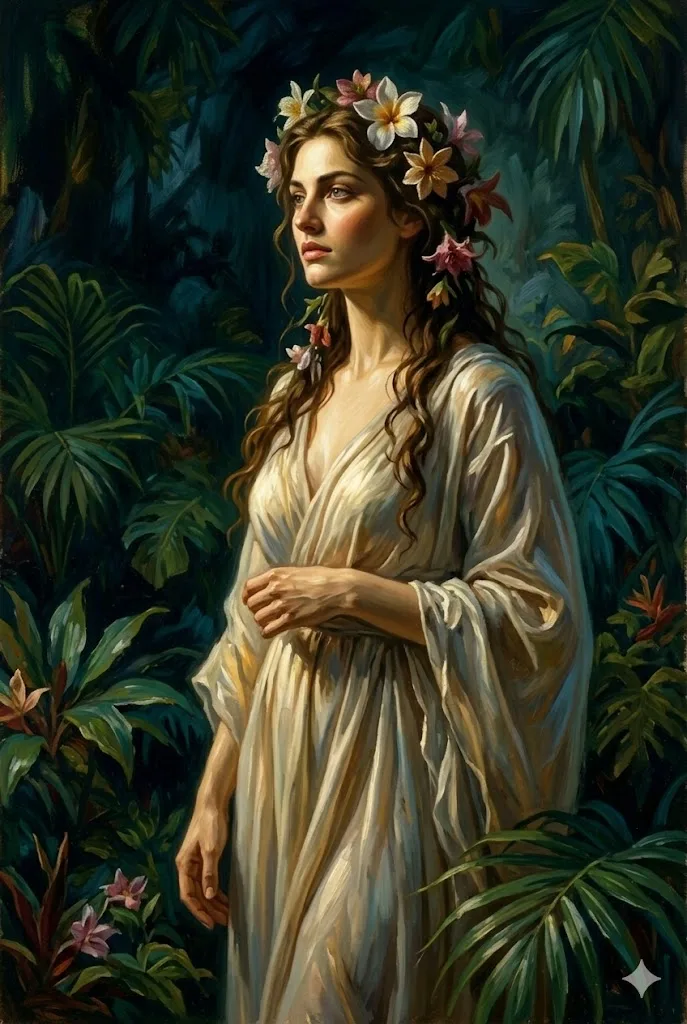
The Hidden Goddess
Calypso was a goddess (or nymph, depending on the source) who lived alone on the island of Ogygia, described by Homer as the navel of the sea, a paradise of lush meadows, singing birds, and cascading vines. Her name comes from the Greek kalyptein, meaning 'to conceal' or 'to hide,' and her island was so remote that no ship could find it unless the gods willed it. She was a daughter of the Titan Atlas in most accounts.
Seven Years
When Odysseus washed ashore on Ogygia after losing his entire crew, Calypso took him in, healed him, and fell in love with him. She kept him on her island for seven years, offering him everything a mortal could dream of: comfort, luxury, her own bed, and the ultimate gift, immortality and eternal youth. If Odysseus stayed, he would never grow old and never die. He would live forever in paradise with a goddess.
He Said No
Odysseus refused. Every day he sat on the shore staring at the sea, weeping for his home, his wife Penelope, and his son Telemachus. He chose mortality and a rocky island kingdom over godhood and eternal paradise. This is one of the most defining moments in all of mythology. It tells us what Homer valued most: home, family, and the authenticity of a mortal life, even with all its suffering, over an immortal existence that feels like a cage.
The Release
After seven years, Athena convinced Zeus to order Calypso to release Odysseus. Hermes delivered the message. Calypso obeyed but not without bitterness. She pointed out the hypocrisy of the male gods: they took mortal lovers freely, but when a goddess loved a mortal man, they intervened. Her protest is one of the earliest critiques of divine double standards in Western literature. She helped Odysseus build a raft, gave him provisions, and sent him on his way with fair winds, knowing she would be alone again.
Classical Sources
- 📜 Homer, Iliad & Odyssey (c. 750 BC)
- 📜 Hesiod, Theogony (c. 700 BC)
- 📜 Apollodorus, Bibliotheca (c. 1st-2nd century AD)
- 📜 Ovid, Metamorphoses (8 AD)
Cross-referenced with multiple classical sources for accuracy.
Explore More
Odysseus · The Odyssey · Athena · Ithaca · Home
Ogygia in Homer's own words
Homer describes Calypso's home in some detail when Hermes arrives with Zeus's order in Odyssey Book 5. A wood of alder, poplar and fragrant cypress grows around her cave. Horned owls, falcons and long-tongued sea-crows nest there. A vine heavy with grapes trails over the entrance, four springs run in different directions, and soft meadows of violet and parsley spread out around it. Inside, a fire of cedar and citron-wood fills the island with scent. Calypso walks back and forth at her loom with a golden shuttle, singing. Even Hermes, Homer says, stopped and stared before he went in.
The details of Odysseus' arrival come out in two places. In Book 12 he tells the Phaeacians that after Charybdis he drifted on the wreckage for nine days and reached Ogygia on the tenth night. In Book 7 he says the stay lasted seven years, and that all that time he soaked the immortal clothing Calypso had given him with his tears. Homer adds a telling line in Book 5: by the end, "the nymph no longer pleased him". That suggests the relationship had not always been a captivity he resented. Every night he slept beside her in the cave, unwilling with a willing goddess.
Calypso's speech and the oath by the Styx
Calypso's angry reply to Hermes is more pointed than a general complaint about double standards. She names precedents. When Eos took Orion as her lover, Artemis killed him on Ortygia. When Demeter lay with Iasion in a thrice-ploughed field, Zeus struck him down with a thunderbolt. Calypso also reminds Hermes that she was the one who rescued Odysseus when he came ashore clinging to his keel.
After she tells Odysseus he may leave, he does not trust her. He demands that she swear the great oath of the gods. She swears by Earth, by the sky, and by the water of the Styx that she is not planning any further harm to him. She then gives him a bronze axe and an adze, shows him where the tallest trees grow, and brings him cloth for a sail. He builds the raft in four days and leaves on the fifth. That night she makes a last attempt: she asks whether Penelope could really be lovelier than a goddess. Odysseus diplomatically agrees that Penelope is not, and says he still longs to go home.
Parentage, children and later traditions
Homer calls Calypso a daughter of Atlas, "who knows the depths of every sea and holds the tall pillars that keep earth and sky apart". Hesiod's Theogony, however, includes a Calypso in its list of Oceanids, the daughters of Oceanus and Tethys. Scholars debate whether this is the same figure. The closing section of the Theogony, generally regarded as a later addition, says that Calypso bore Odysseus two sons, Nausithous and Nausinous. Homer mentions no children at all. The mythographic Epitome attributed to Apollodorus names a son, Latinus, though other sources make Latinus a son of Circe. That source also gives a shorter stay on the island than Homer's seven years.
Ancient readers tried to locate Ogygia. Strabo reports that the poet Callimachus identified it with Gaudos, the island now called Gozo near Malta, where a "Calypso's Cave" is still shown to visitors. Plutarch, in his dialogue On the Face in the Moon, placed an Ogygia far to the west of Britain. Homer himself gives no usable geography beyond calling it the "navel of the sea".
A common mix-up is to merge Calypso with Circe. Circe lives on Aiaia, is a daughter of Helios, uses drugs and a wand to turn men into animals, and keeps Odysseus for one year by his own choice before helping him on his way. Calypso uses no magic on him. What she offers is immortality, and she holds him through the gods' indifference until Athena raises his case. For the full episode, see Calypso and Odysseus.
Ancient sources
- Homer, Odyssey 1.48–59: Athena tells Zeus about Odysseus held by the daughter of Atlas on the sea-girt island.
- Homer, Odyssey 5.28–268: Hermes' visit, Calypso's protest, her oath, and the building of the raft.
- Homer, Odyssey 7.244–266 and 12.447–450: Odysseus' own account of reaching Ogygia and of his seven years there.
- Hesiod, Theogony: lists a Calypso among the Oceanids, and in its late ending names her sons by Odysseus.
- Apollodorus, Epitome 7: a condensed mythographic version of the stay on Ogygia, with a son named Latinus.
- Strabo, Geography 1.2: reports Callimachus' identification of Ogygia with Gaudos.
Frequently asked questions
Did Calypso and Odysseus have children?
Homer mentions none. A late passage of Hesiod's Theogony names two sons, Nausithous and Nausinous, and the Apollodoran Epitome names Latinus. The traditions do not agree.
Was Calypso a goddess or a nymph?
Homer uses both words for her, nymphe and thea. She is immortal and can offer immortality, but she has to obey Zeus's commands passed on by Hermes.
Where was Ogygia?
It is a mythical island. In antiquity Callimachus placed it at Gozo, near Malta, and Plutarch placed it in the far Atlantic. Neither identification is supported by Homer.
Why did Odysseus stay seven years if he wanted to leave?
He had no ship and no crew, and Ogygia was unreachable. Only a divine order could free him. Homer also suggests that he was not unwilling at first.
Books to read next
- Homer, The Odyssey (trans. Emily Wilson)
- Homer, The Odyssey (trans. Robert Fagles)
- Madeline Miller, Circe
Links go to Bookshop.org, which supports independent bookstores. We earn a small commission if you buy, at no extra cost to you.