The Moon Made Divine
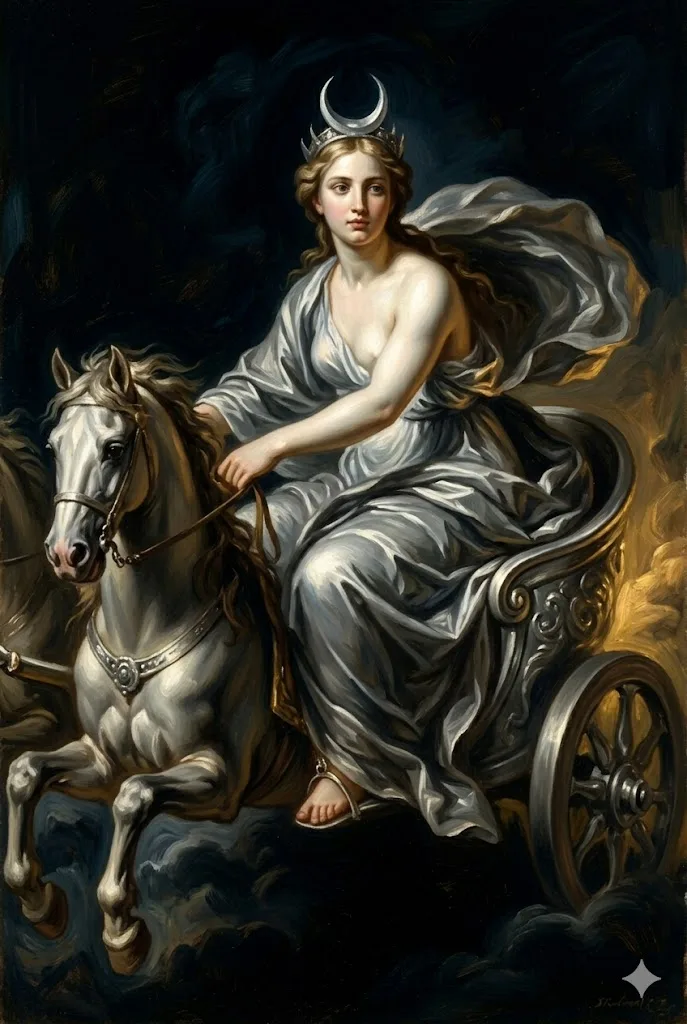
Selene was the Titan goddess who personified the moon itself. Each night, she drove her silver chariot across the dark sky, drawn by a pair of magnificent white horses or oxen, casting her pale light across the sleeping world. She was the moon in its fullest, most radiant aspect — the luminous disk that turned night into silver and inspired poets, lovers, and dreamers across the ancient world.
Selene was the daughter of the Titans Hyperion and Theia, making her sister to Helios (the Sun) and Eos (the Dawn). Together, these three siblings governed the celestial cycle that measured the passage of every day: Eos opened the gates of morning, Helios blazed across the daytime sky, and Selene illuminated the hours of darkness. It was a divine relay that never ceased, marking the eternal rhythm of the cosmos.
Selene and Endymion
The most celebrated myth of Selene concerns her passionate love for Endymion, a breathtakingly handsome mortal shepherd — or, in some versions, a king or hunter. As Selene drove her chariot over the hills of Caria, she gazed down and saw Endymion sleeping in a cave on Mount Latmus. She was struck with an overwhelming love for him and descended from the sky to be with him.
Unable to bear the thought of Endymion growing old and dying, Selene asked Zeus to grant him eternal sleep — a state of perpetual youth and beauty from which he would never age or awaken. Zeus agreed. Endymion slept forever in his cave, eternally beautiful, and each night Selene descended to lie beside him. According to some traditions, she bore him fifty daughters during these visits — a number some ancient scholars connected to the roughly fifty lunar months in an Olympiad, the four-year cycle between Olympic Games.
Selene, Artemis, and Hecate
In later Greek religion, Selene became closely associated with two other goddesses connected to the moon: Artemis and Hecate. Artemis, the virgin huntress, was linked to the crescent moon — the new and waxing phases associated with youth and independence. Selene represented the full moon — maturity, illumination, and fulfillment. Hecate was connected to the dark moon — mystery, magic, and the unseen. Together, these three formed a triple moon goddess that profoundly influenced later religious traditions.
By the Hellenistic and Roman periods, the boundaries between these three goddesses had blurred considerably. Artemis was frequently called 'Selene' by poets, and the Romans merged Selene with their moon goddess Luna. Despite this syncretism, Selene retained her distinct identity in myth as the Titan who literally was the moon — not merely associated with it, but its living embodiment.
Symbols and Worship
Selene was depicted wearing a crescent moon upon her head or as a diadem, and she was often shown riding her chariot or mounted on a horse or bull. Her robes were typically white or silver, and she was surrounded by a luminous aura. The full moon was her most sacred symbol, and rituals honoring her were conducted under its light. Offerings included white cakes, milk, and cheese — foods associated with the moon's pale colour.
Primary Classical Sources
The mythology of Selene is preserved in numerous ancient texts, including:
- 📜 Homer, Iliad & Odyssey (c. 750 BC) — The foundational texts of Greek literature, containing extensive references to the gods and their interventions in mortal affairs.
- 📜 Hesiod, Theogony (c. 700 BC) — The primary source for the genealogy and origins of the Greek gods, including the succession myths and the rise of the Olympians.
- 📜 Homeric Hymns (c. 7th–6th century BC) — A collection of hymns to individual deities providing detailed mythological narratives not found elsewhere.
- 📜 Apollodorus, Bibliotheca (c. 1st–2nd century AD) — The most comprehensive ancient handbook of Greek mythology, systematically cataloguing myths and genealogies.
- 📜 Ovid, Metamorphoses (8 AD) — The Roman poet's masterwork retelling Greek myths with a focus on transformation, preserving many stories that would otherwise be lost.
- 📜 Pausanias, Description of Greece (c. 150 AD) — A detailed travelogue recording temples, cult sites, and local mythological traditions across the Greek world.
All content on this page has been cross-referenced with multiple classical sources and modern scholarly works to ensure accuracy.
Join the Pantheon
Weekly mythology stories & deep dives delivered to your inbox.