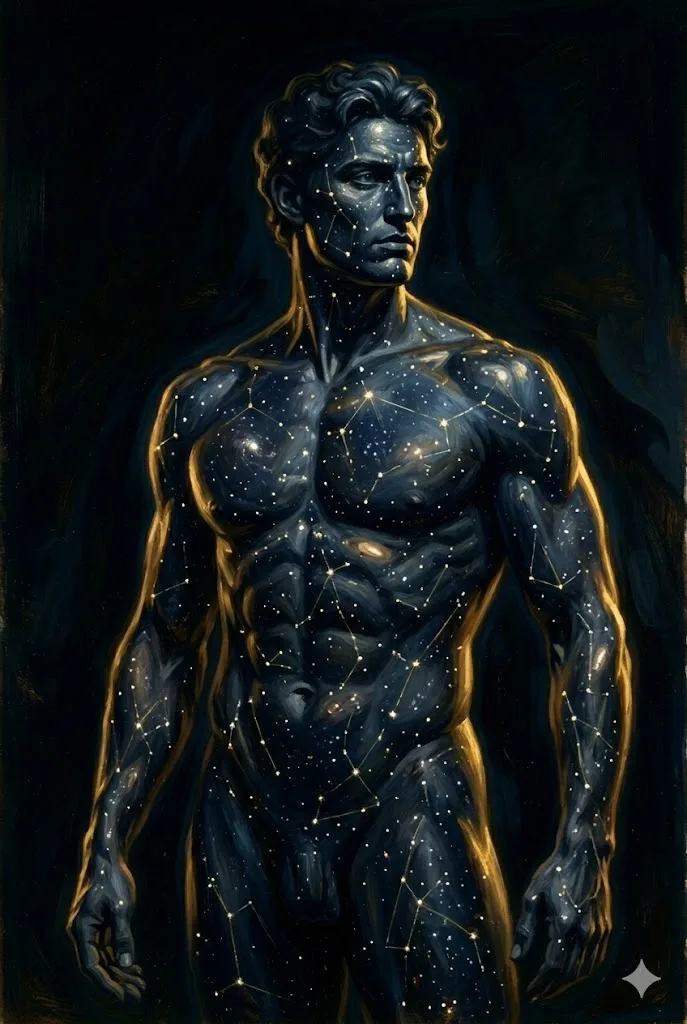
Son and Husband of Gaia
Uranus (Ouranos in Greek) was the primordial god of the sky, born from Gaia (Earth) without a father. He then became Gaia's consort, and together they produced the first generation of divine beings: the twelve Titans, the three Cyclopes (Brontes, Steropes, and Arges), and the three Hecatoncheires (Hundred-Handed Ones). Uranus was the first ruler of the cosmos, a sky that literally lay upon the earth, covering Gaia completely.
The Tyrant
Uranus feared and despised several of his own children, particularly the Cyclopes and Hecatoncheires, whose monstrous forms offended him. He imprisoned them inside Gaia's body, deep within the earth, causing her terrible pain. This act of cruelty against his own children and his consort set in motion the first great revolution in cosmic history.
The Castration
Gaia, wracked with pain from the children imprisoned inside her, fashioned a great sickle of grey adamantine and asked her Titan sons to punish their father. Only the youngest, Cronus, had the courage to act. Gaia hid him in ambush, and when Uranus descended to lie with Gaia that night, Cronus reached out and castrated his father with the sickle, hurling the severed parts into the sea. From the blood that fell on the earth sprang the Erinyes (Furies), the Giants, and the Meliae (ash-tree nymphs). From the severed parts floating in the sea foam, Aphrodite was born.
Uranus retreated permanently to the heights of the sky, never again descending to lie upon the earth. His role as cosmic ruler passed to Cronus, who would in turn be overthrown by his own son Zeus, establishing the pattern of generational conflict that defines the Greek succession myth.
Legacy
The planet Uranus, discovered in 1781, was named after the primordial sky god, continuing the tradition of naming planets after mythological figures. He is also the source of the word 'uranium' for the radioactive element. Despite being overthrown in the first generation of the cosmic story, Uranus's act of fathering the Titans made him the ultimate ancestor of every Olympian god. Without him, the entire Greek pantheon would not exist.
Classical Sources
- 📜 Homer, Iliad & Odyssey (c. 750 BC)
- 📜 Hesiod, Theogony (c. 700 BC)
- 📜 Apollodorus, Bibliotheca (c. 1st-2nd century AD)
- 📜 Ovid, Metamorphoses (8 AD)
Cross-referenced with multiple classical sources for accuracy.
Explore More
Gaia · Cronus · Aphrodite · The Furies · Home