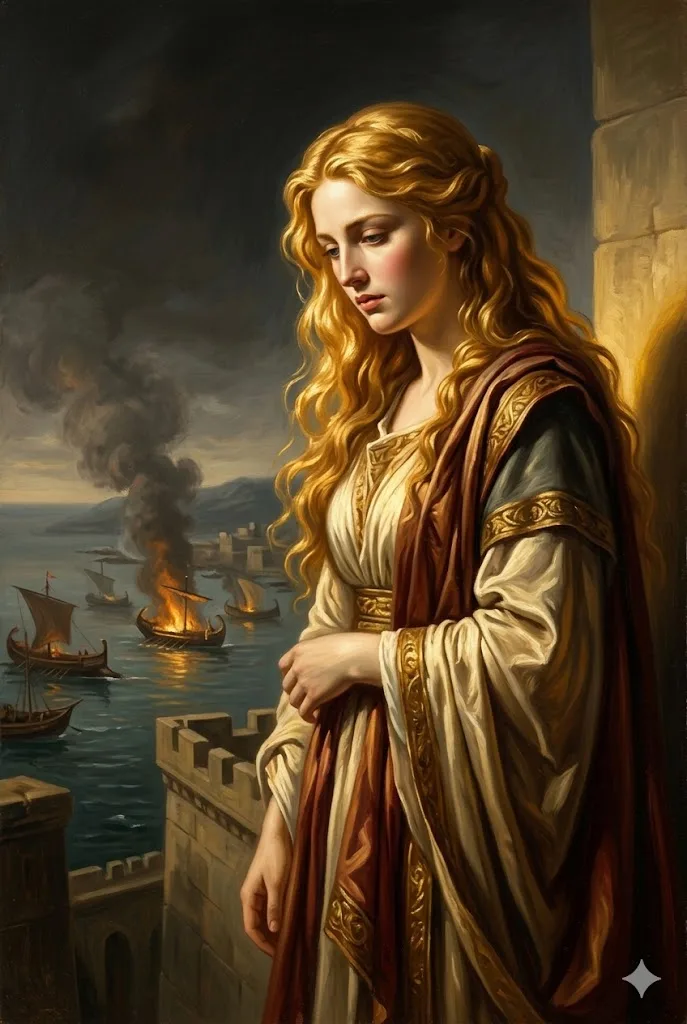
Daughter of Zeus
Helen was the most beautiful woman in the world, and her beauty was the direct cause of the most devastating war in Greek mythology. She was the daughter of Zeus and Leda, queen of Sparta. Zeus came to Leda in the form of a swan, and Helen was born from an egg along with her siblings: Clytemnestra, and the divine twins Castor and Pollux. From childhood, her beauty was so extraordinary that it caused conflict. Theseus kidnapped her when she was still a girl, and her brothers had to rescue her.
The Oath of the Suitors
When Helen came of age, every king and prince in Greece sought her hand in marriage. Her stepfather Tyndareus, terrified that the rejected suitors would start a war, made them all swear an oath: they would accept Helen's choice and defend her chosen husband against anyone who tried to take her. This oath, devised by the cunning Odysseus, would later bind every Greek king to sail to Troy. Helen chose Menelaus, king of Sparta, and they ruled together in wealth and apparent happiness.
The Abduction
The peace was shattered when Paris, a young prince of Troy, visited Sparta as a guest. Aphrodite had promised Paris the most beautiful woman in the world as a reward for judging her the fairest goddess in the infamous Judgement of Paris. While Menelaus was away in Crete, Paris either abducted Helen or she went willingly, depending on the source. They sailed to Troy together, taking a substantial amount of Spartan treasure with them. Menelaus, invoking the oath of the suitors, assembled the greatest military force the ancient world had ever seen: over a thousand ships and the combined armies of every Greek kingdom.
Was Helen Willing?
The question of Helen's agency is one of the most debated topics in classical scholarship. Homer presents her with remarkable complexity. In the Iliad, she appears on the walls of Troy weaving a tapestry depicting the war being fought over her, expressing regret and self-loathing. She calls herself a shameless woman and wishes she had died before coming to Troy. Yet she also shows affection for Paris and seems unable or unwilling to leave. Some ancient authors blamed Aphrodite entirely, arguing that no mortal could resist a goddess's power. Others, like the playwright Euripides, presented Helen as a calculating woman who chose luxury in Troy over duty in Sparta.
After the War
When Troy fell, Menelaus stormed through the burning city intending to kill Helen for her betrayal. But when he saw her face, his sword fell from his hand. He took her back to Sparta, where they lived together for many more years, apparently reconciled. In the Odyssey, Homer depicts them entertaining Telemachus in their palace, a seemingly happy couple reminiscing about the war. Helen even drugs the wine with a substance that removes all grief and anger, a detail that suggests their reconciliation required chemical assistance.
Classical Sources
- 📜 Homer, Iliad & Odyssey (c. 750 BC)
- 📜 Hesiod, Theogony (c. 700 BC)
- 📜 Apollodorus, Bibliotheca (c. 1st-2nd century AD)
- 📜 Ovid, Metamorphoses (8 AD)
Cross-referenced with multiple classical sources for accuracy.
Explore More
Trojan War · Judgement of Paris · Achilles · Troy · Sparta · Home
Helen Who Never Went to Troy
The most surprising Helen story is the one in which she never left Greece. The sixth-century poet Stesichorus is said to have written a poem blaming Helen, been struck blind, and then recovered his sight after composing a Palinode ("recantation"). Plato quotes its opening in the Phaedrus: "That story is not true. You did not go in the well-benched ships, nor did you come to the citadel of Troy." In this version the gods sent a phantom (eidōlon) to Troy with Paris, so Greeks and Trojans died for ten years over an image made of air.
Herodotus heard a related story from Egyptian priests. Paris's ship was blown off course to Egypt, and King Proteus kept Helen and the treasure safe until Menelaus could collect them. Herodotus reasons that the Trojans would surely have handed her over if she had really been in the city. Euripides turned the idea into a play, Helen (412 BC). A faithful Helen has spent the whole war at Proteus's tomb in Egypt, fending off his son's demands that she marry him. A shipwrecked Menelaus arrives, and the two stage an escape. The play treats the Trojan War itself as a tragic misunderstanding.
Helen in Homer: Scenes Worth Knowing
- The view from the wall (Iliad 3). As she comes to the walls, the old Trojan elders say quietly that no one could blame men for suffering over such a woman, but that she should still go home. Priam calls her "dear child," says he blames the gods and not her, and asks her to name the Greek leaders on the plain. She identifies Agamemnon, Odysseus and Ajax, and looks in vain for her brothers Castor and Pollux, not knowing they are already dead and buried in Sparta.
- Defying Aphrodite (Iliad 3). After the duel, when Aphrodite orders her to go to Paris's bed, Helen refuses angrily and tells the goddess to go and sit with Paris herself. Aphrodite threatens to turn both armies against her, and Helen obeys, covering her face.
- The horse (Odyssey 4). Menelaus remembers that after Paris's death she was married to his brother Deiphobus. She walked around the Wooden Horse three times, calling the Greek leaders inside by name in the voices of their own wives, and only Odysseus stopped the men from answering.
- Odysseus in disguise (Odyssey 4). Helen tells a story of her own. Odysseus once slipped into Troy disguised as a beaten beggar. She recognised him, bathed him and kept his secret, because by then her heart had turned back toward home.
Parents, Children and a Divine Afterlife
The swan story is not the only account of her birth. The early epic Cypria makes Helen the daughter of Zeus and Nemesis. Nemesis fled from Zeus through many shapes. When she became a goose, he caught her as a swan, and the egg she laid was given to Leda to raise. Nemesis had a famous temple at Rhamnous in Attica, where Pausanias saw the cult statue's base carved with Leda bringing Helen to her real mother. Helen's only child with Menelaus in Homer is Hermione. Stesichorus and others claimed that Theseus had fathered a daughter on her during her girlhood abduction, and that the child was Iphigenia, who was then raised by Clytemnestra.
Proteus tells Menelaus in the Odyssey that he will not die at all. Because he is Zeus's son-in-law, he will be sent to the Elysian Fields. Pausanias reports a stranger tradition that Helen lives forever on the White Island in the Black Sea, married to Achilles.
Worship: Helen the Goddess
To modern readers Helen is a character in a story, but in Sparta she was worshipped. At Therapne, across the Eurotas from the city, a shrine called the Menelaion honoured her and Menelaus. Herodotus tells of an ugly baby girl whose nurse carried her to Helen's shrine every day. A mysterious woman stroked the child's head and said she would become the most beautiful woman in Sparta, and she later became the wife of King Ariston. Theocritus' Idyll 18, a wedding song for Helen, describes Spartan girls hanging wreaths on a sacred plane tree inscribed "Revere me, I am Helen's tree." On Rhodes, she was worshipped as Helen Dendritis ("of the tree"). Pausanias explains the name with a story: the widow Polyxo, blaming Helen for her husband's death at Troy, had her maids dress up as Furies and hang Helen from a tree.
Defending Helen became a classic exercise. The sophist Gorgias wrote his Encomium of Helen to show she was blameless whether she had been forced by the gods, carried off by violence, persuaded by words or overcome by love. Euripides' Trojan Women stages the opposite case. Helen argues for her life before Menelaus, and Hecuba demolishes her excuses.
Ancient sources
- Homer, Iliad 3, 6 and 24: the view from the wall, her clash with Aphrodite, her self-reproach to Hector, and her lament for him.
- Homer, Odyssey 4: Helen back in Sparta with Menelaus, the grief-banishing drug from Egypt, and stories of Odysseus and the Wooden Horse.
- Stesichorus, Palinode (fragments, quoted in Plato's Phaedrus): the claim that only a phantom of Helen went to Troy.
- Herodotus, Histories 2.112–120: the Egyptian version, in which Proteus keeps Helen safe in Egypt throughout the war.
- Euripides, Helen and Trojan Women: the faithful Helen in Egypt, and the debate in which Hecuba accuses her.
- Pausanias, Description of Greece 3.19: Helen's cult at Therapne, the story of Polyxo on Rhodes, and the White Island.
Frequently asked questions
Did Helen really go to Troy?
In Homer, yes. Stesichorus, Herodotus and Euripides' Helen offer a different version in which she spent the war in Egypt and only a phantom went to Troy.
Who was Helen's mother?
Usually Leda, wife of Tyndareus of Sparta. The Cypria instead makes her the daughter of Nemesis, with Leda only finding or raising the egg.
Was Helen worshipped as a goddess?
Yes. She had a shrine with Menelaus at Therapne near Sparta, a sacred tree cult described by Theocritus, and a cult as Helen Dendritis on Rhodes.
What happened to Helen after the Trojan War?
The Odyssey shows her back in Sparta with Menelaus, and Homer has Proteus foretell that Menelaus will go to Elysium as her husband. Other traditions place her on the White Island with Achilles, or have her killed on Rhodes. For how the war began, see who started the Trojan War.
Books to read next
- Homer, The Iliad (trans. Emily Wilson)
- Madeline Miller, The Song of Achilles
- Stephen Fry, Troy
- Pat Barker, The Silence of the Girls
Links go to Bookshop.org, which supports independent bookstores. We earn a small commission if you buy, at no extra cost to you.