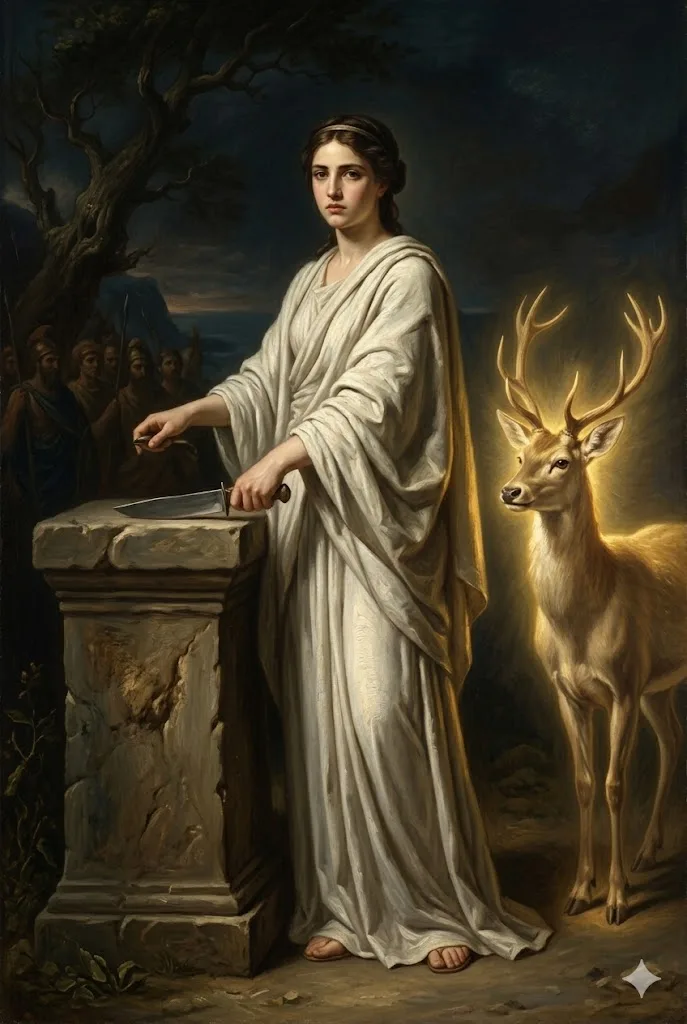
The Price of a Fair Wind
Before the Greek fleet could sail to Troy, a terrible price had to be paid. Agamemnon, king of Mycenae and commander of the Greek forces, had angered Artemis — either by killing a sacred deer or by boasting that he was a better hunter than the goddess herself. In retaliation, Artemis becalmed the winds at Aulis, trapping the entire Greek fleet in the harbor.
The seer Calchas delivered the devastating prophecy: the winds would only return if Agamemnon sacrificed his eldest daughter, Iphigenia, to Artemis.
A Father's Betrayal
Agamemnon was torn between his duty as a commander and his love as a father. Under pressure from the army and especially from his brother Menelaus (whose wife Helen had been taken to Troy), Agamemnon agreed. He sent word to Clytemnestra that Iphigenia should come to Aulis to marry Achilles.
The girl arrived joyfully, believing she was to be married to the greatest warrior in Greece. Instead, she was led to the altar of sacrifice. In Euripides' version, Iphigenia initially begged for her life, then chose to go willingly, declaring that her sacrifice would give glory to Greece.
Saved by the Goddess?
The traditions split here. In the older versions, Iphigenia died on the altar and the winds returned. But in Euripides' Iphigenia at Aulis and Iphigenia in Tauris, Artemis snatched the girl away at the last moment, replacing her with a deer on the altar, and transported Iphigenia to the land of the Taurians (modern Crimea), where she became a priestess of Artemis.
Years later, her brother Orestes arrived in Tauris, and the siblings recognized each other in a deeply emotional reunion before escaping together back to Greece.
The Root of the Curse
Whether Iphigenia lived or died, the sacrifice at Aulis set the entire tragic machinery of the House of Atreus in motion. Clytemnestra never forgave Agamemnon for murdering their daughter. When he returned from Troy ten years later, she killed him in his bath — and that murder led to Orestes killing Clytemnestra, and the Furies pursuing Orestes, until Athena finally broke the cycle.
Iphigenia's sacrifice is the match that lit a generational inferno.
Quick Facts
Parents: Agamemnon and Clytemnestra
Siblings: Orestes, Electra, Chrysothemis
Fate: Sacrificed at Aulis (or rescued by Artemis)
Purpose: To gain fair winds for the Greek fleet sailing to Troy
Source: Euripides' Iphigenia at Aulis, Iphigenia in Tauris
The oldest versions: Iphimede, the Cypria and a goddess-in-waiting
Homer never mentions the sacrifice. In Iliad 9 Agamemnon offers Achilles the hand of any of his three daughters, whom he names Chrysothemis, Laodice and Iphianassa, and there is no hint that a fourth was ever killed at Aulis. Whether Homer did not know the story or chose to suppress it is still argued, but it means the episode cannot be treated as part of the "original" Trojan saga.
The earliest surviving narrative comes from the lost epic Cypria, known through the prose summary of Proclus. There Agamemnon shoots a deer and boasts that he has surpassed even Artemis; the goddess holds back the winds; Calchas reveals the remedy; Iphigenia is summoned on the pretext of marriage to Achilles; and at the moment of sacrifice Artemis snatches her away to the land of the Taurians, makes her immortal, and leaves a deer on the altar. The rescue, in other words, is not a late Euripidean softening, as is often said; it was already in the epic tradition.
The Hesiodic Catalogue of Women goes further. It calls the girl Iphimede and says Artemis made her immortal and turned her into "Artemis of the Wayside" (Einodia), a title associated with Hecate. Pausanias records that, according to Hesiod, Iphigenia did not die but became Hecate by the will of Artemis. Many scholars take these traces to mean that Iphigenia began as a goddess, or a heroine closely bound to Artemis, before she became a sacrificial victim in epic.
Why Artemis was angry, and who Iphigenia's mother was
Ancient writers did not agree on the offence. The Cypria and Sophocles' Electra (where Electra says her father killed a dappled stag in the goddess's grove and boasted about it) blame a hunting incident. Aeschylus, in the great opening chorus of Agamemnon, gives no crime at all: two eagles devour a pregnant hare, Calchas reads it as an omen of Troy's fall, and Artemis, protector of young creatures, is offended by what the eagles stand for. Other later sources say Atreus had once failed to sacrifice a golden lamb he had promised her, or that Agamemnon had vowed to give the goddess the loveliest thing born in the year of Iphigenia's birth.
Even her parentage was disputed. Pausanias reports that Stesichorus, followed by Euphorion and Alexander of Pleuron, made Iphigenia the daughter of Helen and Theseus: Helen gave birth secretly at Argos after Theseus abducted her and handed the baby to her sister Clytemnestra to raise. The version is minor but shows how freely poets reworked the family of Atreus.
Aeschylus' account of the sacrifice is the harshest in Greek literature. Iphigenia is lifted over the altar "like a young goat," gagged so that she cannot curse the house, her saffron robe falling as she casts pleading glances at the men who had once heard her sing at her father's banquets. Pindar's eleventh Pythian later asks outright whether it was the slaughter of Iphigenia at the Euripus or adultery with Aegisthus that drove Clytemnestra to murder, a question the tragedians kept returning to.
Cult at Brauron and among the Taurians
Iphigenia was worshipped, not just remembered. Herodotus (4.103) says the Taurians of Crimea sacrificed shipwrecked strangers to a maiden goddess whom they themselves identified as Iphigenia, daughter of Agamemnon. At the end of Euripides' Iphigenia in Tauris, Athena instructs Orestes to carry the Taurian image of Artemis to Halai Araphenides in Attica, where the goddess will be called Tauropolos and a priest will draw a drop of blood from a man's throat with a sword as a token of the old human sacrifice. Iphigenia herself is to serve as key-bearer at Brauron, be buried there, and receive the fine garments of women who die in childbirth.
Brauron, on the east coast of Attica, was one of Artemis' most important sanctuaries, famous for the arkteia, a rite in which young Athenian girls "played the bear" for the goddess. Pausanias saw an old wooden image there that the locals claimed was the Taurian statue, though he notes that Sparta also claimed it for its sanctuary of Artemis Orthia.
In art, the most celebrated depiction was a lost painting by Timanthes (fourth century BC), praised by Cicero, Quintilian and Pliny because the painter, having exhausted every expression of grief on the onlookers, showed Agamemnon with his face veiled. A Roman fresco from the House of the Tragic Poet at Pompeii, now in the Naples Archaeological Museum, echoes the scheme, with Artemis and the deer appearing in the sky. Later retellings include Racine's Iphigénie (1674), Gluck's two Iphigenia operas (1774 and 1779) and Goethe's Iphigenie auf Tauris (1787).
Ancient sources
- Cypria (summary by Proclus) — the deer, Agamemnon's boast, the false marriage to Achilles, and Artemis carrying Iphigenia off to the Taurians and making her immortal.
- Hesiodic Catalogue of Women — names her Iphimede and says Artemis made her immortal as Artemis Einodia.
- Aeschylus, Agamemnon 184–247 — the chorus describes the omen of the eagles and the hare, Agamemnon's decision, and the gagged girl at the altar.
- Euripides, Iphigenia at Aulis and Iphigenia in Tauris — her change of heart and willing death in the first; her priesthood among the Taurians, recognition of Orestes, and future cult at Brauron in the second.
- Herodotus, Histories 4.103 — the Taurian maiden goddess identified with Iphigenia.
- Pausanias, Description of Greece — reports Stesichorus' claim that Helen was her mother, Hesiod's claim that she became Hecate, and the rival claims to the Taurian image at Brauron and Sparta.
Frequently asked questions
Did Iphigenia die in Greek mythology?
It depends on the author. Aeschylus and Pindar treat her death as real. The Cypria, the Hesiodic Catalogue and Euripides' Iphigenia in Tauris have Artemis substitute a deer and carry her away alive, in some versions as an immortal.
Why did Agamemnon have to sacrifice Iphigenia?
Artemis held back the winds at Aulis, and Calchas declared that only the sacrifice of Agamemnon's daughter would free the fleet. The reason for the goddess's anger varies: a killed deer and a boast, an unpaid vow, or, in Aeschylus, the omen of eagles devouring a pregnant hare.
Does Homer mention Iphigenia?
No. The Iliad names three daughters of Agamemnon, Chrysothemis, Laodice and Iphianassa, and says nothing about a sacrifice at Aulis. Some ancient readers identified Iphianassa with Iphigenia.
Where was Iphigenia worshipped?
Chiefly at Brauron in Attica, alongside Artemis, where she was said to be buried. The Taurians of Crimea were also said to sacrifice to a goddess they called Iphigenia.