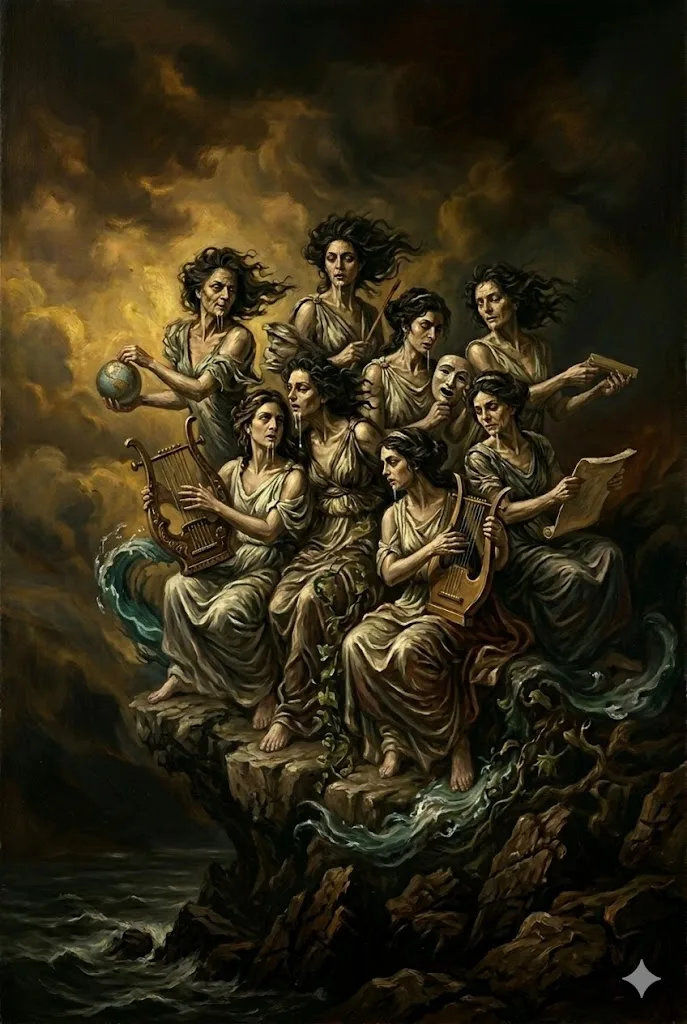
Daughters of Zeus and Memory
The Muses were nine goddesses who presided over the arts, sciences, and all forms of intellectual and creative expression. They were daughters of Zeus and the Titaness Mnemosyne (Memory), conceived during nine consecutive nights of union. The ancient Greeks believed that all artistic creation, scientific discovery, and philosophical insight came from the Muses. A poet did not simply compose verses; the Muse spoke through him. A historian did not merely record events; Clio, the Muse of History, guided his pen.
The Nine
Each Muse governed a specific domain: Calliope (Epic Poetry) was the eldest and most distinguished, often depicted with a writing tablet. Clio (History) carried a scroll and books. Erato (Love Poetry) held a lyre and was crowned with roses. Euterpe (Music and Lyric Poetry) played the double flute. Melpomene (Tragedy) wore the mask of tragedy and carried a club. Polyhymnia (Sacred Hymns) was veiled and meditative. Terpsichore (Dance) was depicted dancing with a lyre. Thalia (Comedy) wore the mask of comedy and a crown of ivy. Urania (Astronomy) held a celestial globe and compass.
Mount Helicon and Parnassus
The Muses were associated with two sacred mountains: Helicon in Boeotia and Parnassus near Delphi. On the slopes of Helicon, the sacred springs of Aganippe and Hippocrene bubbled up, their waters said to grant poetic inspiration to anyone who drank from them. The spring of Hippocrene was created when Pegasus struck the rock with his hoof. At Delphi, the Muses were associated with Apollo, who led them in song and dance as Apollo Musagetes (Apollo Leader of the Muses). The connection between the Muses and Delphi reinforced the link between artistic inspiration and prophetic revelation.
Legacy
The Muses gave us the word 'music' (mousike, originally meaning any art over which the Muses presided), 'museum' (mouseion, a place sacred to the Muses and devoted to learning), and 'muse' as a verb meaning to think creatively. Every major Greek epic begins with an invocation of the Muses: Homer's Iliad opens with 'Sing, O Muse, of the rage of Achilles,' and the Odyssey begins 'Tell me, O Muse, of the man of many ways.' These invocations were not mere literary conventions but genuine prayers for divine assistance in the act of creation.
Classical Sources
- 📜 Homer, Iliad & Odyssey (c. 750 BC)
- 📜 Hesiod, Theogony (c. 700 BC)
- 📜 Apollodorus, Bibliotheca (c. 1st-2nd century AD)
- 📜 Ovid, Metamorphoses (8 AD)
Cross-referenced with multiple classical sources for accuracy.
Explore More
Apollo · Mnemosyne · Zeus · Delphi · Home
Hesiod's meeting with the Muses
The fullest early portrait of the Muses opens Hesiod's Theogony. Hesiod says they met him while he was shepherding lambs below Mount Helicon, mocked shepherds as "mere bellies", and then gave him a staff of laurel and breathed a divine voice into him so he could sing of past and future. Their warning is one of the most quoted lines in Greek literature: they know how to tell many lies that sound like truth, and also how to speak the truth when they wish. The passage is an early statement that poetry can deceive as well as reveal.
Hesiod is also the first to name all nine: Clio, Euterpe, Thalia, Melpomene, Terpsichore, Erato, Polyhymnia, Urania and Calliope, whom he calls the most important because she attends on revered kings. He places their birth in Pieria, near Mount Olympus, which is why they are also called the Pierides. Crucially, he gives them no separate departments. The neat assignment of one art to each Muse, with masks, globes and scrolls, belongs to later Hellenistic and Roman tradition, and even then the lists vary from author to author.
Three Muses or nine?
Nine was not the only number. Pausanias reports a tradition that the sons of Aloeus, Otus and Ephialtes, were the first to sacrifice to the Muses on Helicon and recognised only three: Melete (Practice), Mneme (Memory) and Aoede (Song). Plutarch mentions that at Delphi the Muses were known as three, named after the high, middle and low strings of the lyre. Some writers made the Muses daughters of Uranus and Gaia rather than of Zeus and Mnemosyne, which would make them far older than the Olympians.
The Muses also had children. Calliope is most often named as the mother of Orpheus, with the Thracian king Oeagrus or Apollo as father. The singer Linus and the Thracian king Rhesus, killed at Troy, are each given a Muse for a mother in various sources. Apollodorus makes the Sirens daughters of the river-god Achelous and a Muse, Melpomene in his account.
Challengers and their punishments
Like other deities, the Muses punished presumption. In the Iliad's Catalogue of Ships, the Thracian singer Thamyris boasted he could beat the Muses even if they sang against him; they maimed him, took away his song and made him forget his lyre-playing. Later writers say he was blinded.
Ovid tells of the nine daughters of Pierus, king of Emathia, who challenged the Muses to a singing contest. The nymphs of the region acted as judges and found for the goddesses, and when the sisters jeered at the verdict they were turned into magpies, forever chattering. The story is told by one of the Muses herself to Athena, who had come to Helicon to see the spring struck by Pegasus.
Pausanias records that the Sirens were also persuaded by Hera to compete with the Muses. The Muses won, plucked the Sirens' feathers, and made crowns from them.
Worship, festivals and art
The Muses had real cult places. In the Valley of the Muses below Helicon, near Thespiae, stood a grove with statues of the goddesses, and the people of Thespiae held a festival called the Mouseia with musical and poetic competitions. Pieria had its own sanctuary at Dion. Philosophical schools adopted them too: Plato's Academy and Aristotle's Lyceum both had shrines to the Muses, and the Ptolemies' great research institution in Alexandria, the Mouseion, housed the famous library. In Plato's Phaedrus, Socrates tells a charming myth that cicadas were once humans so absorbed in song that they forgot to eat, and now report to the Muses which mortals honour them.
In art, Roman sarcophagi often show the nine in a row, each with her attribute, which is where the standard iconography became fixed. Renaissance painters favoured Apollo leading them on Parnassus; Andrea Mantegna's Parnassus and Raphael's fresco of the same name in the Vatican are the best-known examples.
A common modern muddle comes from Disney's Hercules, which shows five Muses as a gospel chorus. Ancient sources fix the number at nine (or three in older local cults), and the Muses have no role in Heracles' story. Another is the idea that Calliope always presides over epic: some Roman writers link her with other forms of poetry or with eloquence in general.
Ancient sources
- Hesiod, Theogony 1–115 — the Muses on Helicon, their meeting with Hesiod, their birth from Zeus and Mnemosyne in Pieria, and the first list of the nine names.
- Homer, Iliad 2.594–600 — the punishment of Thamyris for boasting he could outsing the Muses.
- Ovid, Metamorphoses 5.250–678 — Athena's visit to Helicon and the contest with the daughters of Pierus, who become magpies.
- Pausanias, Description of Greece 9.29–31 and 9.34.3 — the three original Muses on Helicon, the Valley of the Muses and its statues, the Mouseia festival, and the contest with the Sirens.
- Plato, Phaedrus — Socrates' myth of the cicadas as messengers of the Muses, and inspired madness as a gift from them.
Frequently asked questions
Who is the most important Muse?
Hesiod calls Calliope the foremost of the nine. She is also the Muse most often named as a mother, especially of Orpheus.
Who were the parents of the Muses?
Most sources say Zeus and Mnemosyne, the Titaness of memory. A minority tradition makes them daughters of Uranus and Gaia.
Why are there nine Muses?
Hesiod links the number to the nine nights Zeus spent with Mnemosyne. Older local cults on Helicon and at Delphi worshipped only three.
Did each Muse always have one specific art?
No. The early poets treat them as a group. The fixed list of domains developed later and differs slightly between ancient writers.
Books to read next
- Stephen Fry, Mythos
- Edith Hamilton, Mythology
- Apollodorus, The Library of Greek Mythology (Oxford World's Classics)
Links go to Bookshop.org, which supports independent bookstores. We earn a small commission if you buy, at no extra cost to you.