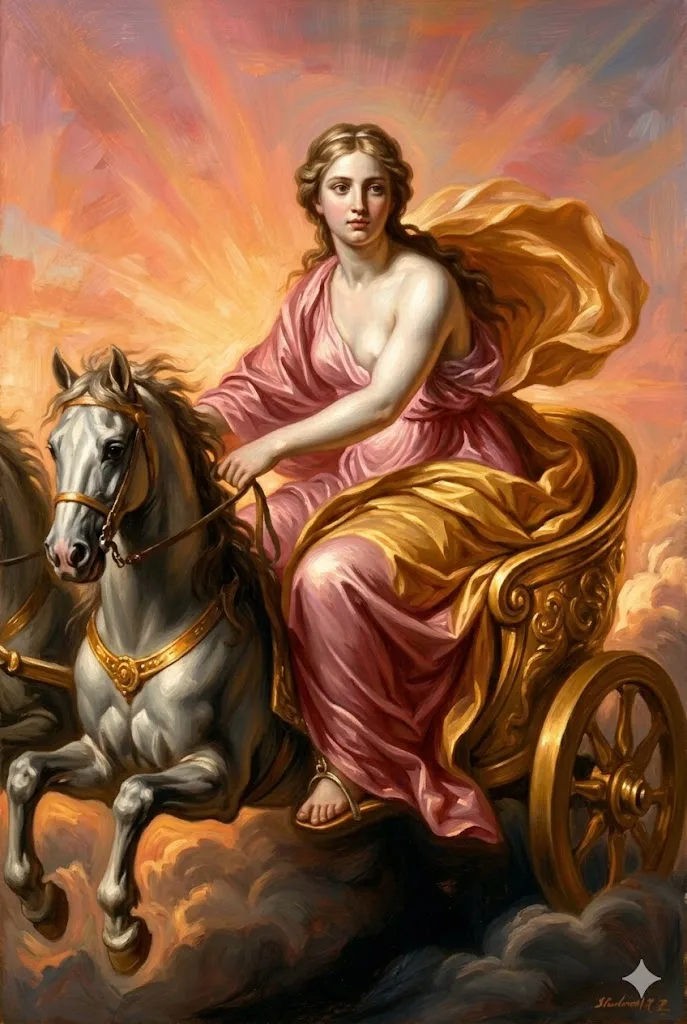
Bringer of Light
Eos was the Titan goddess of the dawn — the luminous, saffron-robed deity who rose each morning from the edge of the Ocean to open the gates of heaven for her brother Helios, the Sun. Homer immortalized her with the epithet 'rosy-fingered Dawn,' one of the most beautiful phrases in all of literature, describing the delicate pink light that spreads across the sky before sunrise.
Each day, Eos rode her chariot — drawn by the immortal horses Lampus and Phaethon — from her palace in the east, scattering the darkness before her and announcing the coming of the sun. She was the transitional deity par excellence: neither night nor day, but the magical threshold between them. The dew that covered the earth each morning was said to be the tears of Eos, shed for her fallen son Memnon.
Family
Eos was the daughter of the Titans Hyperion and Theia, and sister to Helios (the Sun) and Selene (the Moon). Her parentage placed her among the second generation of cosmic deities — those who governed the celestial bodies and the passage of time. With the Titan Astraeus (god of the stars and planets), Eos bore the four Anemoi (Winds): Boreas (North), Notus (South), Zephyrus (West), and Eurus (East). She was also the mother of Eosphorus, the Morning Star — the planet Venus as it appears before dawn.
The Curse of Aphrodite
Eos became famous in mythology for her insatiable desire for handsome mortal men — a compulsion that was not entirely her fault. When Eos had an affair with Ares, the god of war, Aphrodite discovered the betrayal and cursed the dawn goddess with an uncontrollable longing for mortal men. From that point forward, Eos abducted one beautiful youth after another, carrying them off in her chariot to satisfy a desire that could never be fully quenched.
Her most famous mortal lovers included Cephalus, a hunter whom she snatched from his wife Procris, and Orion, the giant huntsman. But the most significant — and most tragic — was Tithonus, a prince of Troy whose story became one of mythology's most poignant cautionary tales.
Eos and Tithonus
Eos fell so deeply in love with the Trojan prince Tithonus that she asked Zeus to grant him immortality so they could be together forever. Zeus agreed — but Eos had forgotten to ask for eternal youth as well. Tithonus lived on and on, but he continued to age. His hair turned white, his body withered, his strength faded, and still he could not die. Eventually, he shrank into a tiny, babbling creature — some versions say he was transformed into a cicada, chirping endlessly but unable to die.
The myth of Tithonus became the ancient world's definitive warning about the difference between immortality and eternal youth. It was referenced by philosophers, poets, and storytellers for centuries as proof that even divine gifts, if carelessly requested, could become curses. The Victorian poet Alfred Lord Tennyson later wrote a famous dramatic monologue in Tithonus's voice, lamenting his eternal decay.
Legacy
The Romans identified Eos with their goddess Aurora, and the phenomenon of the aurora borealis (northern lights) takes its name from her. The scientific term for the dawn — the 'aurora' — likewise derives from Eos's Roman counterpart. In this way, every sunrise carries the memory of the ancient goddess who, each morning without fail, opened the gates of heaven and reminded the world that after every night, light returns.
Primary Classical Sources
The mythology of Eos is preserved in numerous ancient texts, including:
- 📜 Homer, Iliad & Odyssey (c. 750 BC) — The foundational texts of Greek literature, containing extensive references to the gods and their interventions in mortal affairs.
- 📜 Hesiod, Theogony (c. 700 BC) — The primary source for the genealogy and origins of the Greek gods, including the succession myths and the rise of the Olympians.
- 📜 Homeric Hymns (c. 7th–6th century BC) — A collection of hymns to individual deities providing detailed mythological narratives not found elsewhere.
- 📜 Apollodorus, Bibliotheca (c. 1st–2nd century AD) — The most comprehensive ancient handbook of Greek mythology, systematically cataloguing myths and genealogies.
- 📜 Ovid, Metamorphoses (8 AD) — The Roman poet's masterwork retelling Greek myths with a focus on transformation, preserving many stories that would otherwise be lost.
- 📜 Pausanias, Description of Greece (c. 150 AD) — A detailed travelogue recording temples, cult sites, and local mythological traditions across the Greek world.
All content on this page has been cross-referenced with multiple classical sources and modern scholarly works to ensure accuracy.
Join the Pantheon
Weekly mythology stories & deep dives delivered to your inbox.