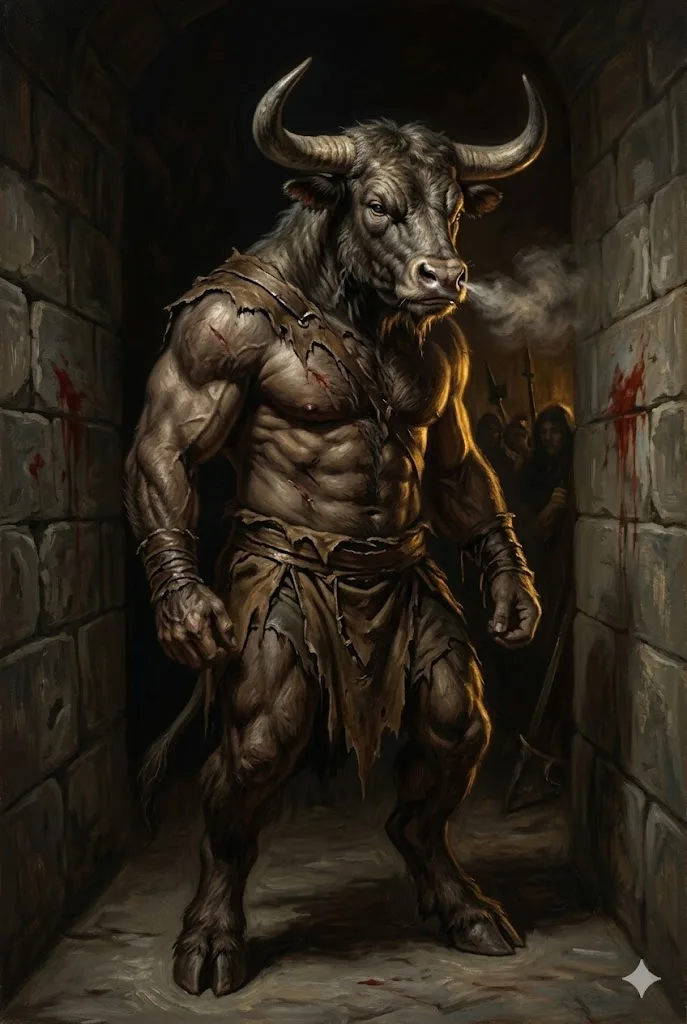
I. What Was the Minotaur?
The Minotaur was a monstrous creature with the body of a man and the head and tail of a bull, imprisoned in the Labyrinth — an immense, winding maze beneath the palace of King Minos on the island of Crete. It was born from one of mythology's most disturbing unions: Queen Pasiphaë, wife of Minos, was cursed by Poseidon to fall in love with a beautiful white bull, and the Minotaur was their unnatural offspring.
Unable to kill the creature but horrified by its existence, Minos commissioned the legendary inventor Daedalus to construct the Labyrinth — a structure so complex that no one who entered could ever find their way out. There the Minotaur was confined, fed a diet of human flesh: every nine years, Athens was forced to send seven young men and seven young women as tribute, to be devoured by the beast in the darkness of the maze.
II. Theseus and the Labyrinth
The hero Theseus, son of King Aegeus of Athens, volunteered to be one of the fourteen sacrifices, determined to end the tribute forever. When he arrived on Crete, Minos's daughter Ariadne fell in love with him and gave him a ball of thread (the "clue" — origin of the English word) so he could retrace his steps out of the Labyrinth after confronting the beast.
Theseus ventured into the maze, found the Minotaur in its dark center, and slew it with his bare hands (or, in some versions, with a sword Ariadne had hidden for him). Following the thread back through the winding corridors, he escaped with the other Athenian youths and sailed home — though his journey was marked by tragedy when he forgot to change his ship's sails from black to white, causing his father Aegeus to believe him dead and throw himself into the sea (thereafter called the Aegean).
III. Symbolism & Legacy
The Minotaur and its Labyrinth have become among the most powerful symbols in Western culture. The maze represents confusion, the subconscious, and the hidden darkness within civilization. The Minotaur itself symbolizes the monstrous consequences of unnatural desire and divine punishment. Archaeological discoveries at the Palace of Knossos on Crete — with its labyrinthine corridors and bull-jumping frescoes — suggest that the myth may have roots in actual Minoan religious practices.
Classical Sources
Ancient accounts of Minotaur appear in:
- 📜 Hesiod, Theogony (c. 700 BC) — Origin and genealogy of mythological creatures.
- 📜 Apollodorus, Bibliotheca (c. 1st–2nd century AD) — Detailed descriptions of monsters and their encounters with heroes.
- 📜 Ovid, Metamorphoses (8 AD) — Vivid retellings of creature myths with emphasis on transformation.
- 📜 Homer, Iliad & Odyssey (c. 750 BC) — Encounters with mythological beasts during the Trojan War cycle.
Cross-referenced with multiple classical sources for accuracy.
Explore More Mythology
Get weekly deep dives into the gods, heroes, and myths of ancient Greece.