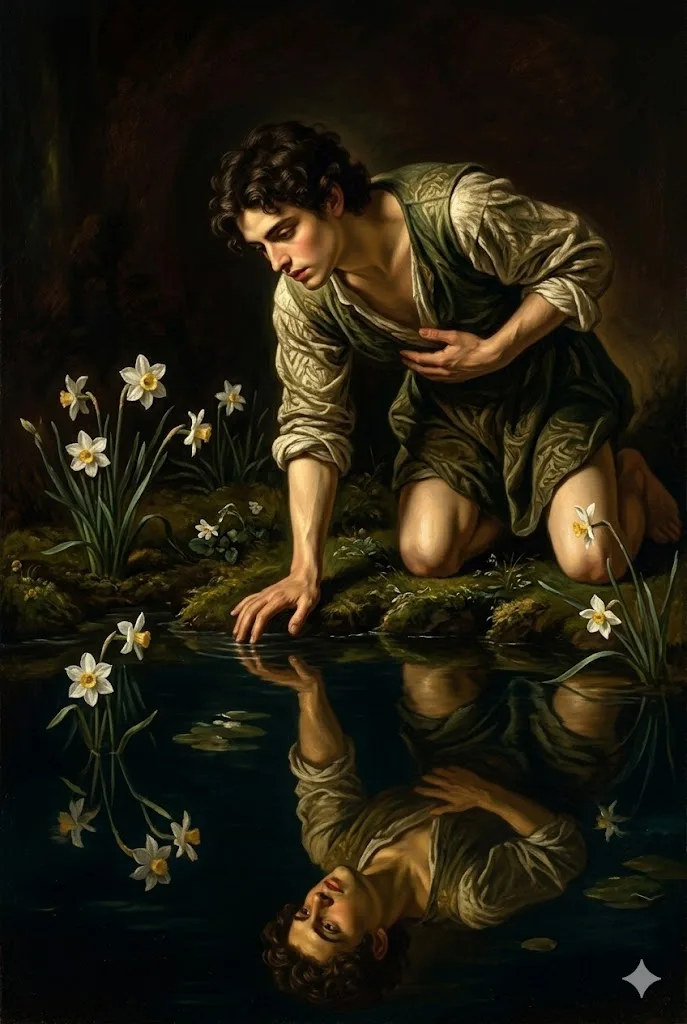
I. Who Was Narcissus?
Narcissus was a youth of extraordinary, almost supernatural beauty — the son of the river god Cephissus and the nymph Liriope. He was so beautiful that everyone who saw him fell in love, but Narcissus was cold and proud, rejecting every suitor with cruel indifference. He scorned the advances of both men and women, including the nymph Echo, who loved him desperately.
Echo had been cursed by Hera to only repeat the last words spoken to her (punishment for distracting Hera with chatter while Zeus pursued other nymphs). When she tried to declare her love to Narcissus, she could only echo his words back to him. Humiliated and rejected, Echo wasted away in grief until only her voice remained — forever repeating the sounds of the world around her.
The goddess Nemesis, hearing the prayers of those Narcissus had spurned, led the youth to a clear, still pool in the forest. When Narcissus leaned over to drink, he saw his own reflection for the first time and fell hopelessly in love with it. He could not tear himself away. He lay beside the pool, gazing at the beautiful face in the water, unable to embrace it, wasting away with longing. Eventually he died — or transformed — and in the place where he had lain, a flower grew: the narcissus, white petals surrounding a golden center, forever bowed toward the water.
The word "narcissism" derives directly from this myth — the pathological obsession with one's own image and self. Sigmund Freud used the myth as the basis for his concept of narcissistic personality, making Narcissus one of the most psychologically influential figures in Greek mythology.
Primary Classical Sources
The legends of Narcissus are drawn from these ancient texts:
- 📜 Homer, Iliad & Odyssey (c. 750 BC) — The earliest and most authoritative accounts of the Greek heroes and the Trojan War cycle.
- 📜 Apollodorus, Bibliotheca (c. 1st–2nd century AD) — Comprehensive mythological handbook containing detailed accounts of heroic genealogies and adventures.
- 📜 Ovid, Metamorphoses (8 AD) — Roman retelling preserving many heroic myths with vivid narrative detail.
- 📜 Pindar, Odes (c. 5th century BC) — Victory odes celebrating athletic champions that frequently reference heroic mythology.
- 📜 Greek Tragedians (5th century BC) — Aeschylus, Sophocles, and Euripides dramatized heroic myths for Athenian audiences, adding psychological depth and moral complexity.
All content on this page has been cross-referenced with multiple classical sources and modern scholarly works to ensure accuracy.
Explore More Mythology
Get weekly deep dives into the gods, heroes, and myths of ancient Greece.