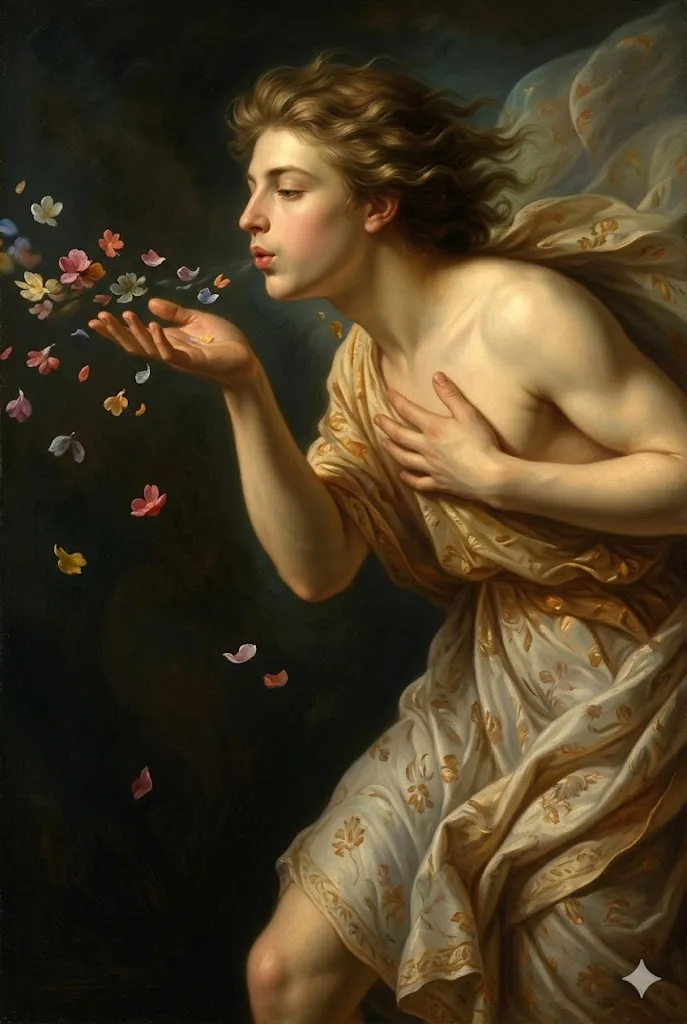
The Gentlest Wind
Among the four Anemoi — the wind gods of Greek mythology — Zephyrus was the most benign. While his brother Boreas brought harsh northern gales and Notus carried autumn storms, Zephyrus breathed the warm western wind that announced spring's arrival. The ancient Greeks considered him the herald of the growing season, his gentle breezes coaxing flowers to bloom and fruit trees to blossom.
Homer called him the swiftest of winds, and his domain stretched across the western sky where the sun descended each evening. Sailors prayed to Zephyrus for favorable passage, knowing his winds were kinder than those of his brothers.
The Tragedy of Hyacinthus
Zephyrus's most famous myth involves a devastating love triangle with Apollo. Both gods fell in love with the beautiful Spartan prince Hyacinthus. When the youth chose Apollo over Zephyrus, the rejected wind god waited for his revenge.
One day, as Apollo and Hyacinthus practiced discus throwing, Zephyrus blew Apollo's discus off course with a jealous gust. The heavy disc struck Hyacinthus on the head, killing him instantly. From the boy's blood, Apollo created the hyacinth flower — but Zephyrus would carry the weight of that murder forever.
This myth appears in Ovid's Metamorphoses and illustrates how even the gentlest forces of nature contain destructive potential when driven by jealousy.
Zephyrus and Chloris
In a more romantic tale, Zephyrus abducted the nymph Chloris and made her his wife. As a wedding gift, he transformed her into Flora, the goddess of flowers and spring. Together they ruled over the season of renewal, with Zephyrus providing the warm winds and Chloris-Flora scattering blossoms across the meadows.
This myth gave the Romans their springtime goddess and explains why the west wind is associated with flowering and growth throughout Mediterranean cultures. Botticelli immortalized this moment in his masterpiece Primavera, showing Zephyrus reaching for Chloris as flowers spill from her lips.
Worship and Legacy
Zephyrus had a cult center at Athens, where a Tower of the Winds (the Horologion) depicted all four Anemoi. His image showed a young man scattering flowers, in contrast to the bearded, fierce depictions of Boreas.
The word 'zephyr' survives in English today, meaning a gentle, mild breeze — a fitting legacy for the kindest of the wind gods.
Quick Facts
Domain: West Wind, Spring Breezes
Parents: Eos (Dawn) and Astraeus
Siblings: Boreas (North), Notus (South), Eurus (East)
Consort: Chloris/Flora
Symbols: Flowers, light fabrics, spring
Roman Name: Favonius
Zephyrus in Homer: Fire, Horses and Paradise
Homer's Zephyrus is not always gentle. In the Iliad he is often a stormy wind that churns up the sea, and he plays a striking role at the funeral of Patroclus. When the pyre will not catch, Achilles prays to Boreas and Zephyrus and promises them fine offerings. Iris carries the message to the house of Zephyrus, where the winds are feasting together. They rush across the sea, and they fan the flames all night until the body has burned.
Zephyrus also fathered the most famous horses in the epic. Xanthus and Balius, the immortal team that pulls Achilles' chariot, were born to him and the Harpy Podarge as she grazed in a meadow beside the stream of Ocean. Ancient writers liked the idea that the fastest horses were the children of wind, and Roman authors such as Virgil and Pliny repeated a belief that mares in Lusitania (modern Portugal) could conceive just by turning toward the west wind.
The Odyssey shows his kinder side. In the gardens of the Phaeacian king Alcinous, the west wind blows all year round, so that some fruit is always budding while other fruit ripens. In the Elysian plain promised to Menelaus there is no snow or storm, and Ocean always sends up the clear-blowing breezes of Zephyrus to refresh people. This is the source of his long-lasting association with Elysium and the idea of eternal spring. When Aeolus gives Odysseus the bag of winds, he leaves Zephyrus alone outside it, so that he will blow the ship home to Ithaca.
Lovers and Children
The Chloris story is told most fully by Ovid in the Fasti, not the Metamorphoses. There Flora herself explains that she was once the nymph Chloris, that Zephyrus carried her off, and that he made up for it by marrying her and giving her rule over flowers and a garden of everlasting spring. The Hyacinthus story needs a correction too. Ovid's version in Metamorphoses book 10 never names Zephyrus. The discus simply bounces off the ground and hits the boy. The jealous wind appears in other authors, such as Lucian's Dialogues of the Gods and Philostratus' Imagines. A few late writers blame Boreas instead.
The lyric poet Alcaeus, quoted by Plutarch, gave one of the strangest genealogies in Greek poetry. He made Eros the son of Zephyrus and Iris, the rainbow, which is a fitting pairing of the spring wind and the shimmering sky that follows rain. In Apuleius' Latin novel, Zephyrus is the obliging servant who lifts Psyche gently from the cliff and sets her down in the valley of Cupid's palace, a scene repeated in countless later paintings of Cupid and Psyche.
Worship and Images
Zephyrus had genuine, if modest, cult. Pausanias saw an altar of Zephyrus on the Sacred Way from Athens to Eleusis, close to a sanctuary of Demeter and Kore. Near Sicyon he describes an altar of the winds at Titane, where a priest made a secret sacrifice to them one night every year and sang charms said to come from Medea. Farmers and sailors had good practical reasons to keep the west wind on their side. Hesiod's Works and Days, for example, connects the sailing and farming year closely to the seasonal winds.
The Tower of the Winds in Athens, built in the first century BC and usually credited to Andronicus of Cyrrhus, was a public water clock and weather vane rather than a temple. On its west face, Zephyrus is a barefoot youth carrying a fold of flowers in his cloak, while Boreas, on the north face, is a heavily bearded, cloaked old man. In the Renaissance, Botticelli painted him twice in famous works: reaching for Chloris in Primavera, and flying in from the left with puffed cheeks, wrapped together with a female companion, to blow Venus ashore in The Birth of Venus.
Ancient sources
- Homer, Iliad 16.148–151 and 23.192–230: Zephyrus as father of Achilles' horses by the Harpy Podarge, and the winds kindling Patroclus' pyre.
- Homer, Odyssey 4.561–568 and 7.117–121: the west wind blowing on the Elysian plain and ripening the fruit of Alcinous' orchards.
- Hesiod, Theogony 378–380: Zephyrus, Boreas and Notus as children of Eos and Astraeus.
- Ovid, Fasti, book 5: Flora tells how Zephyrus carried off Chloris and made her goddess of flowers.
- Pausanias, Description of Greece 1.37.2 and 2.12.1: the altar of Zephyrus on the Sacred Way and the night sacrifice to the winds at Titane.
- Apuleius, Metamorphoses (The Golden Ass), books 4–5: Zephyrus carries Psyche to Cupid's palace.
Frequently asked questions
What is Zephyrus the god of?
The west wind, which the Greeks associated above all with the arrival of spring, though Homer can also describe it as violent at sea.
Did Zephyrus kill Hyacinthus?
In several Greek versions, yes. He blew Apollo's discus off course out of jealousy. Ovid's well-known Latin version, however, presents the death as an accident and does not mention him.
Who is Zephyrus' wife?
Chloris, whom the Romans identified with Flora. Some poets also pair him with Iris, and others with the Harpy Podarge, mother of Achilles' horses.
What is Zephyrus called in Roman mythology?
Favonius, a name the Romans connected with favere, "to favour," because his wind encouraged growth.