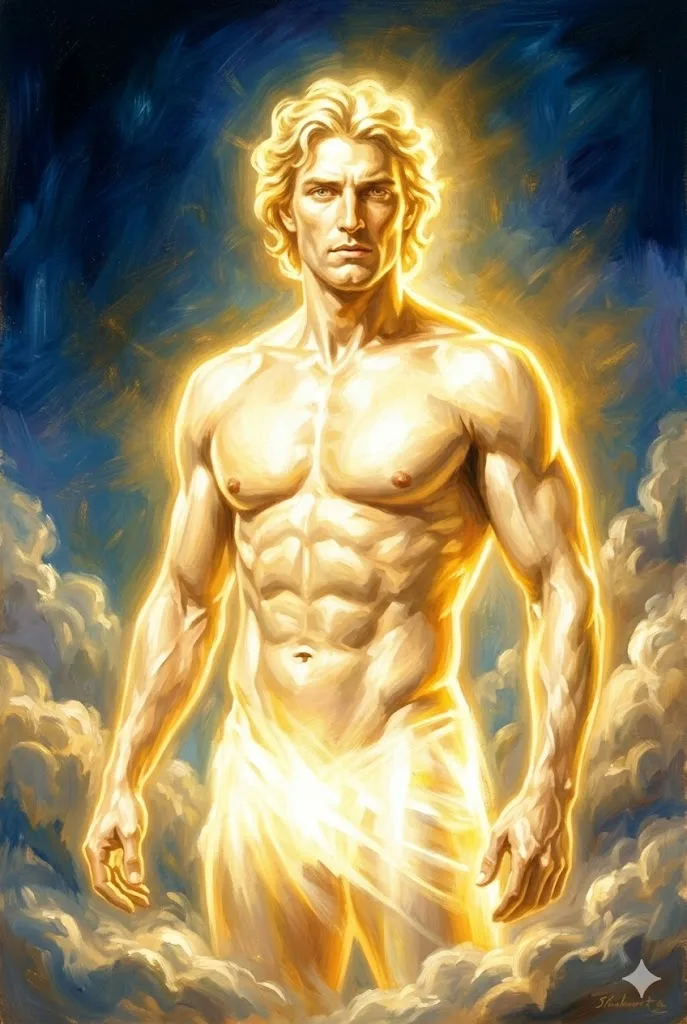
I. Who Was Hyperion?
Hyperion was one of the twelve original Titans, son of Uranus (Sky) and Gaea (Earth), and the god of heavenly light — the light of the sun, moon, and dawn that illuminated the ancient world. His name means "He Who Goes Above" or "The High One," referring to the celestial bodies that traversed the sky above the earth. He was the Titan of watchfulness, wisdom, and the light of heaven.
With his sister-wife Theia, Hyperion fathered three of the most important celestial deities: Helios (the Sun), who drove his golden chariot across the sky each day; Selene (the Moon), who rode her silver chariot through the night; and Eos (the Dawn), who opened the gates of heaven for her brother each morning. Through these children, Hyperion's legacy illuminated every hour of every day.
During the Titanomachy, Hyperion was one of the four Titans stationed at the corners of the earth to hold Uranus in place while Cronus castrated him. After the Olympians defeated the Titans, Hyperion was cast into the pit of Tartarus along with his brothers. His domain of heavenly light was inherited by his son Helios and, eventually, by Apollo.
Classical Sources
The mythology of Hyperion is preserved in:
- 📜 Hesiod, Theogony (c. 700 BC) — The primary source for Titan mythology, genealogy, and the Titanomachy.
- 📜 Apollodorus, Bibliotheca (c. 1st–2nd century AD) — Comprehensive handbook of Titan genealogies and myths.
- 📜 Aeschylus, Prometheus Bound (c. 5th century BC) — Dramatic portrayal of Titan defiance against Olympian authority.
- 📜 Ovid, Metamorphoses (8 AD) — Roman accounts of Titan mythology and transformations.
Cross-referenced with multiple classical sources for accuracy.
Explore More Mythology
Get weekly deep dives into the gods, heroes, and myths of ancient Greece.