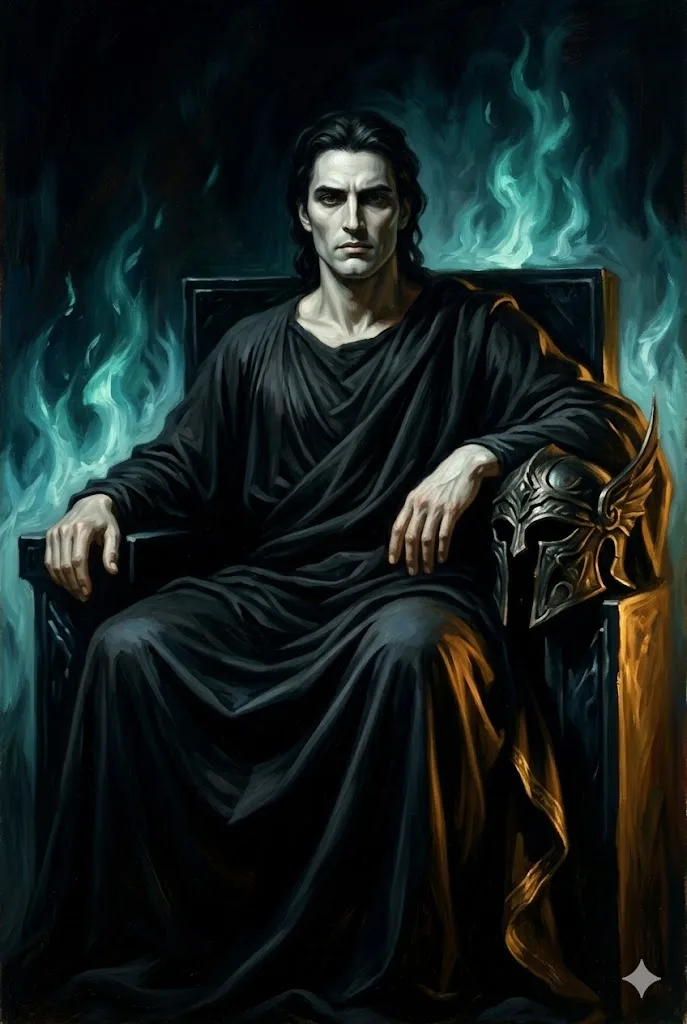
I. Who Was Hades?
Hades was the eldest brother of Zeus and Poseidon, yet he is often the most misunderstood of the Greek gods. As ruler of the underworld and lord of the dead, he presided over the afterlife — a vast subterranean kingdom where the souls of every mortal eventually came to rest. Despite his fearsome reputation, Hades was not a god of evil. He was stern, just, and unyielding, but he was not cruel. The Greeks distinguished clearly between Hades, who simply governed the dead, and the concept of death itself, which was personified by the god Thanatos.
The Greeks rarely spoke his name aloud, fearing it might attract his attention. Instead, they used euphemisms like "the Rich One" (Plouton, from which the Roman name Pluto derives) — a reference to the precious metals and gems hidden beneath the earth, which fell within his domain. He was also called "the Unseen One," referring both to his Helm of Darkness, which rendered him invisible, and to the hidden nature of the underworld itself.
Unlike the other Olympians, Hades did not reside on Mount Olympus. He preferred the solitude and silence of his underground palace, ruling over the dead with absolute authority. He was not worshipped with temples and festivals like Zeus or Athena — instead, the Greeks honored him through funerary rites, libations poured into the earth, and the sacrifice of black animals at pits dug in the ground.
II. The Realm of the Dead
The underworld that Hades ruled was a complex geography of rivers, fields, and eternal punishments. To reach Hades' domain, the dead had to cross the River Styx — the river of hatred — by paying the ferryman Charon a single coin (an obol), which is why the Greeks placed coins on the eyes or in the mouths of their dead. Those who could not pay were condemned to wander the shores for a hundred years.
Beyond the Styx, the dead were greeted by Cerberus, the monstrous three-headed hound who guarded the gates of the underworld. Cerberus allowed all souls to enter but prevented any from leaving. Inside, the dead were judged by three former mortal kings — Minos, Rhadamanthys, and Aeacus — who determined their eternal fate.
Most souls were sent to the Asphodel Meadows, a neutral, grey plain where the ordinary dead existed as shadows, neither punished nor rewarded. The virtuous and heroic were granted entry to Elysium (the Elysian Fields), a paradise of eternal sunshine, feasting, and joy. The wicked and those who had offended the gods were cast into Tartarus, the deepest pit of the underworld, where they suffered elaborate punishments for eternity — Sisyphus pushing his boulder, Tantalus reaching for fruit that forever retreated from his grasp.
III. Powers & Symbols
Hades possessed the Helm of Darkness (also called the Cap of Invisibility), forged for him by the Cyclopes during the Titanomachy. This magical helm rendered the wearer completely invisible — not merely to mortals, but to gods, Titans, and all supernatural beings. During the war against the Titans, Hades used the helm to slip past enemy lines and destroy the Titans' weapons, turning the tide of battle.
As lord of the dead, Hades held power over every soul that entered his realm. No god or mortal could reclaim the dead without his consent, and he was legendarily reluctant to release them. His other symbols included the cypress tree (associated with mourning and death), the narcissus flower (which Persephone was picking when he abducted her), the bident (a two-pronged fork, as opposed to Poseidon's trident), and the screech owl.
IV. Hades & Persephone
The myth of Hades and Persephone is one of the most important stories in Greek mythology, as it explains the origin of the seasons. Hades fell deeply in love with Persephone, the daughter of Zeus and the harvest goddess Demeter. With Zeus's tacit permission but without Demeter's knowledge, Hades burst from the earth in his golden chariot and carried Persephone down to the underworld to be his queen.
Demeter, devastated by her daughter's disappearance, wandered the earth searching for her. In her grief, she caused all crops to wither and die, threatening humanity with famine. Zeus, pressured by the pleas of starving mortals and the other gods, eventually ordered Hades to return Persephone. Hades complied — but first offered Persephone a pomegranate seed. Because she ate the food of the dead, she was bound to the underworld and had to return for a portion of each year.
The compromise was thus established: Persephone would spend spring and summer with her mother on earth, during which time Demeter rejoiced and the world bloomed with life. When Persephone returned to the underworld in autumn, Demeter mourned and the earth grew cold and barren — giving rise to winter. This cycle of growth and death, joy and mourning, became one of the central myths of Greek religion and was celebrated through the Eleusinian Mysteries, the most sacred rites of the ancient world.
V. Key Myths
Orpheus in the Underworld
When the legendary musician Orpheus lost his beloved wife Eurydice to a snakebite, he descended into the underworld and played his lyre so beautifully that even Hades was moved to tears. The god agreed to let Eurydice return to the living world — on one condition: Orpheus must walk ahead and not look back until both had reached the surface. Tragically, overcome with doubt, Orpheus glanced back at the last moment and Eurydice vanished forever into the shadows.
Heracles and Cerberus
The final and most dangerous of Heracles' Twelve Labours was to descend into the underworld and capture Cerberus alive, without using any weapons. Heracles wrestled the three-headed beast into submission with his bare hands and dragged it to the surface. After showing the captured beast to King Eurystheus (who hid in terror), Heracles returned Cerberus to the underworld unharmed — the only hero ever to enter Hades' realm and return without trickery.
Sisyphus Cheats Death
The cunning king Sisyphus managed to cheat death twice — first by trapping Thanatos (Death itself) in chains, and then by persuading Persephone to let him return to the living world on a false pretense. When he was finally dragged back to the underworld permanently, Hades devised a fitting punishment: Sisyphus would push an enormous boulder up a steep hill for all eternity, only to watch it roll back down each time he neared the summit.
"Do not be afraid. I am the lord of the dead, not the lord of death. There is a difference." — Modern interpretation of Hades' character
VI. Worship & Cultural Impact
Hades had no major temples in the ancient Greek world — approaching his domain was considered dangerous, and the Greeks preferred to keep him at a respectful distance. Offerings to Hades were made by averting one's gaze and pouring libations into pits dug in the earth, or by sacrificing black sheep and cattle at nighttime rituals. The city of Elis in the Peloponnese was one of the few places with a temple dedicated specifically to Hades.
His Roman equivalent Pluto became associated more strongly with wealth and the riches hidden beneath the earth. In the modern era, Hades has experienced a remarkable cultural revival through literature, film, and video games — often reimagined as a complex, sympathetic figure rather than a villain, reflecting a more nuanced understanding of the ancient Greeks' view of death and the afterlife.
Hades in Classical Sources
Unlike his brothers Zeus and Poseidon, Hades rarely appears as an active character in Greek literature. His most prominent mythological role is in the abduction of Persephone, told most fully in the Homeric Hymn to Demeter (c. 7th century BC). In this account, Hades erupts from the earth in his golden chariot, seizes the young goddess while she gathers flowers, and carries her screaming into the Underworld. The hymn portrays the abduction as sanctioned by Zeus but carried out without Demeter's knowledge — a divine conspiracy between brothers that sets in motion the crisis that creates the seasons.
In Homer's Iliad, Hades is mentioned primarily as a feared power who rules beneath the earth. When Poseidon causes an earthquake during the Trojan War, Hades leaps from his throne in terror, fearing that the earth will crack open and reveal his gloomy realm to the sunlight — which would horrify both gods and mortals. This brief passage is one of the few moments where Hades shows genuine emotion, revealing a god who is protective of his dark domain and anxious about its exposure.
The Geography of the Underworld
Hades ruled over one of the most elaborately imagined realms in world mythology. The Underworld was not a single place but a vast subterranean geography with distinct regions, rivers, and landmarks. The five rivers — Styx (hatred), Acheron (woe), Lethe (forgetfulness), Phlegethon (fire), and Cocytus (lamentation) — each served a specific function in the afterlife. Souls arrived at the banks of the Acheron, where Charon ferried them across for the price of an obol. Upon landing, they passed through gates guarded by Cerberus and were judged by three judges of the dead: Minos, Rhadamanthys, and Aeacus.
The Asphodel Meadows received the majority of souls — those who were neither exceptionally virtuous nor wicked. Elysium (the Elysian Fields) was reserved for heroes and the righteous, while Tartarus — located as far below the Underworld as the earth is below the sky — imprisoned the wicked and the enemies of the gods. This moral geography of the afterlife influenced later religious traditions, particularly the Christian concepts of Heaven, Hell, and Purgatory.
Hades in Modern Culture
Hades has undergone a remarkable transformation in modern popular culture. In ancient Greece, he was not considered evil — merely stern, just, and implacable. But centuries of conflation with the Christian Devil transformed his image. Disney's Hercules (1997) portrayed him as a fast-talking villain, cementing this characterization for a generation. However, more recent portrayals have returned to a more nuanced view. The critically acclaimed video game Hades (2020) by Supergiant Games presents Hades as a complex, authoritarian father figure — strict and emotionally distant but not malevolent. Rick Riordan's Percy Jackson series similarly portrays Hades with more depth than simple villainy.
The rehabilitation of Hades in modern storytelling reflects a growing cultural sophistication about death and the afterlife. As societies become less superstitious about death, the god who rules the dead becomes less fearsome and more fascinating — a figure who embodies the universal reality that all things end, and that someone must govern what comes after.
VII. Quick Facts
Explore More Mythology
Get weekly deep dives into the gods, heroes, and myths of ancient Greece.