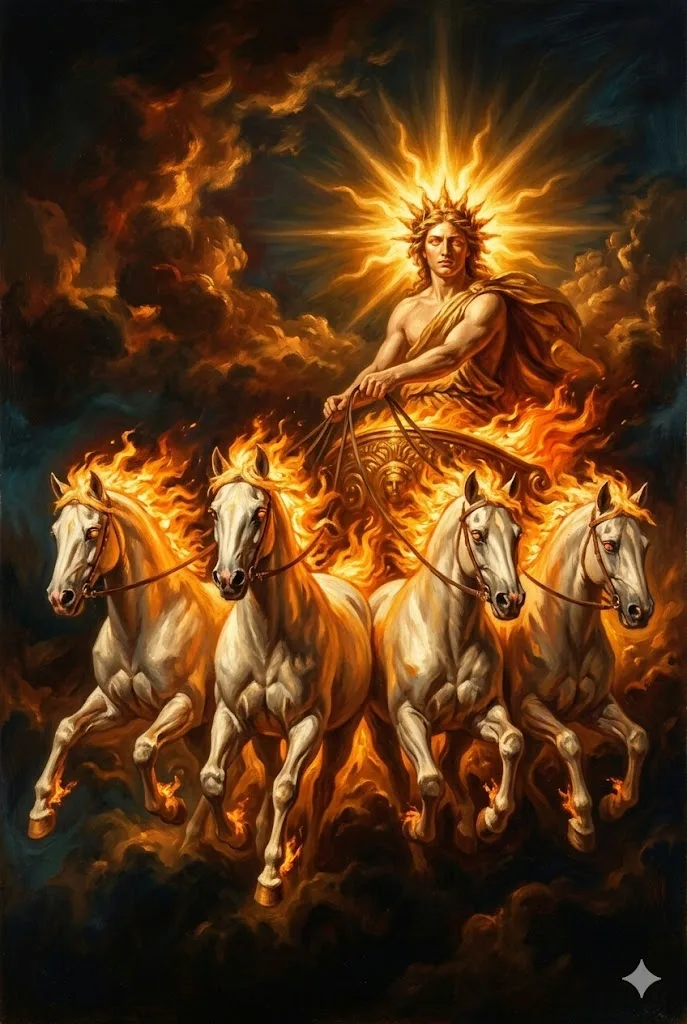
I. Who Was Helios?
Helios was the Titan god of the sun — the divine charioteer who drove a blazing golden chariot pulled by four immortal horses across the sky from east to west each day, bringing light and warmth to the world. Each dawn, his sister Eos (the Dawn) would open the gates of heaven, and Helios would begin his journey. Each evening, he descended into the western ocean and sailed back east in a great golden cup along the river Oceanus to start again at sunrise.
As the sun, Helios was the all-seeing eye of heaven. Nothing that happened under the open sky could escape his gaze. It was Helios who witnessed Hades abducting Persephone and informed her mother Demeter. It was Helios who saw Aphrodite and Ares together and told Hephaestus. This role as cosmic witness made him a god of oaths and truth — you could not lie under the sun's watchful eye.
His most famous myth involves his son Phaethon, who begged to drive the sun chariot for a day. Helios reluctantly agreed, but the boy could not control the immortal horses. The chariot veered wildly across the sky, scorching the earth and creating the Sahara Desert. Zeus was forced to strike Phaethon down with a thunderbolt to prevent the destruction of the world — one of mythology's most poignant tales of youthful ambition and tragic consequences.
Helios was later largely absorbed into the cult of Apollo, and the two gods were frequently conflated in later antiquity. The Colossus of Rhodes — one of the Seven Wonders of the Ancient World — was a 108-foot bronze statue of Helios that stood at the harbor entrance.
Classical Sources
The mythology of Helios is preserved in:
- 📜 Hesiod, Theogony (c. 700 BC) — The primary source for Titan mythology, genealogy, and the Titanomachy.
- 📜 Apollodorus, Bibliotheca (c. 1st–2nd century AD) — Comprehensive handbook of Titan genealogies and myths.
- 📜 Aeschylus, Prometheus Bound (c. 5th century BC) — Dramatic portrayal of Titan defiance against Olympian authority.
- 📜 Ovid, Metamorphoses (8 AD) — Roman accounts of Titan mythology and transformations.
Cross-referenced with multiple classical sources for accuracy.
The Cattle of the Sun
One of the oldest and most consequential Helios myths is in book 12 of the Odyssey. On the island of Thrinacia, Helios kept seven herds of cattle and seven flocks of sheep, fifty in each, which neither bred nor died; they were tended by his daughters Phaethusa and Lampetia. Both Circe and the seer Tiresias warned Odysseus not to touch them. Stranded by contrary winds and starving, his crew slaughtered the best of the cattle while he slept. The meat lowed on the spits and the hides crept along the ground. Lampetia told her father, and Helios threatened Zeus that unless the crime was punished he would go down to Hades and shine among the dead. Zeus destroyed the ship with a thunderbolt, and only Odysseus survived. The opening lines of the poem single out this episode as the reason his companions never came home (see The Odyssey).
The Homeric Hymn to Apollo also mentions flocks of Helios grazing at Taenarum in the Peloponnese, which suggests that sacred herds of the sun were a widespread idea and not only a fairy-tale detail.
Helios's Loves and Children
Helios had a large and important family. By the Oceanid Perse he fathered Circe and Aeëtes, king of Colchis (Hesiod's Theogony); later sources add Pasiphaë, wife of Minos, and Perses. This made Medea, daughter of Aeëtes, his granddaughter, and in Euripides' Medea she escapes Corinth in a chariot sent by her grandfather the Sun. Augeas, owner of the famous stables, was called a son of Helios in some versions.
Phaethon's mother is Clymene in Ovid's Metamorphoses books 1–2. After Zeus struck the boy down, his body fell into the river Eridanus, and his sisters, the Heliades, mourned until they turned into poplars whose tears hardened into amber. Ovid also tells how Libya was dried into desert and the Ethiopians' skin darkened when the chariot swerved too low. Earlier, Euripides had written a tragedy, Phaethon, which survives only in fragments.
Ovid's book 4 contains a less familiar love story. Helios fell for the princess Leucothoë and visited her disguised as her mother. Her rival Clytie, who also loved the Sun, told Leucothoë's father, who buried her alive. Helios could not save her and turned her into the frankincense shrub. Clytie, rejected, sat on the ground for nine days gazing at the Sun and became a flower that always turns to follow him, usually identified with the heliotrope.
Rhodes, Corinth and the Cult of the Sun
Helios was not a major cult figure in most Greek cities, with one great exception. Pindar's seventh Olympian ode tells how the gods divided the earth by lot while Helios was away; to make amends, Zeus let him claim an island then rising from the sea, Rhodes. Helios married the nymph Rhodos, and their sons, the Heliadai, were ancestors of the Rhodians. The island honoured him with the Halieia festival, which included athletic contests, and in the early third century BC the sculptor Chares of Lindos built the Colossus, a bronze Helios about seventy cubits high, which stood for little more than fifty years before an earthquake brought it down. Pliny the Elder notes that even lying on the ground it was a wonder. Despite popular images, there is no ancient evidence that it straddled the harbour.
At Corinth, Pausanias records a local myth that Helios and Poseidon disputed ownership of the land; the Hundred-Hander Briareus awarded the Isthmus to Poseidon and the heights of Acrocorinth to Helios. Pausanias also reports that the Spartans sacrificed horses to Helios on Mount Taygetus, and other writers say the Rhodians threw a four-horse chariot into the sea for him.
Because he saw everything, Helios was invoked in oaths. In Iliad book 3 Agamemnon calls on Zeus and on "Helios, who sees all things and hears all things" as witnesses to the treaty before the duel of Paris and Menelaus.
Helios, Apollo and Other Confusions
In Homer and Hesiod, Helios and Apollo are separate gods. Identification of the two appears in some fifth-century writers and became common in Hellenistic and Roman times, which is why later poets call Apollo the sun-god and why Ovid's Phaethon story uses "Phoebus" for the Sun. The cup in which Helios sails back each night is borrowed by Heracles in Apollodorus's account of the cattle of Geryon, after Heracles threatened him with his bow for being too hot. Helios is sometimes called a Titan because he is the son of the Titans Hyperion and Theia, though he fought on no side in the Titanomachy and kept his office under Zeus. For a fuller profile, see Helios, god of the sun; his sisters are Selene and Eos.
Ancient sources
- Homer, Odyssey book 12 — the cattle of Helios on Thrinacia, the crew's sacrilege and Zeus's punishment.
- Homeric Hymn 31, To Helios — his parentage from Hyperion and Euryphaessa and his blazing chariot.
- Hesiod, Theogony — Helios as child of Hyperion and Theia, and father of Circe and Aeëtes by Perse.
- Pindar, Olympian 7 — how Helios received the island of Rhodes.
- Ovid, Metamorphoses books 1, 2 and 4 — Phaethon and the Heliades; Leucothoë and Clytie.
- Pausanias, Description of Greece books 2 and 3 — Helios at Corinth and the horse sacrifices on Taygetus.
Frequently asked questions
Is Helios a Titan or an Olympian?
Neither exactly. He is a son of two Titans and is often grouped with them, but he did not fight against Zeus and was never counted among the twelve Olympians.
Are Helios and Apollo the same god?
Originally no. Homer and Hesiod keep them separate. They were increasingly identified from the classical period onward, and in Roman poetry Apollo is often the sun.
What did Helios's horses look like, and what were their names?
Ovid names the four horses Pyrois, Eous, Aethon and Phlegon, all names connected with fire or dawn. They breathed flames and were immortal.
Who were Helios's children?
Circe, Aeëtes, Pasiphaë and Perses by Perse; Phaethon and the Heliades by Clymene; Phaethusa and Lampetia; and the Heliadai of Rhodes by the nymph Rhodos.
Explore More Mythology
Get weekly deep dives into the gods, heroes, and myths of ancient Greece.