I. Who Was Rhea?
Rhea was the Titan queen, wife of Cronus, and mother of the first generation of Olympian gods. She is one of the most important figures in Greek mythology — without her cunning intervention, Zeus would never have been born, the Titans would never have been overthrown, and the age of the Olympians would never have begun.
When Cronus received a prophecy that one of his children would overthrow him, he devoured each child as soon as Rhea gave birth. She watched in horror as Cronus swallowed Hestia, Demeter, Hera, Hades, and Poseidon. When she became pregnant with her sixth child, Rhea was determined to save him. She sought the counsel of her parents Gaea and Uranus, who advised her to give birth in secret on the island of Crete.
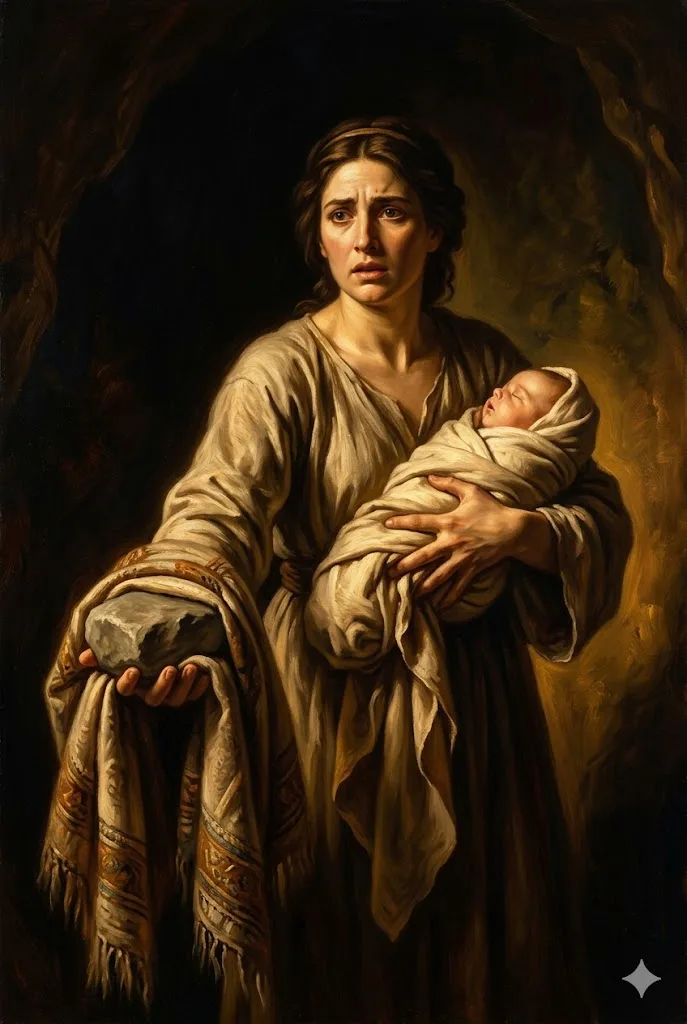
Rhea hid the infant Zeus in a cave on Mount Dicte, entrusting him to the care of the nymph Amalthea and the Kouretes warriors. She wrapped a large stone in swaddling clothes and presented it to Cronus, who swallowed it without suspicion. This single act of maternal defiance changed the course of cosmic history — Zeus grew to maturity, freed his siblings, and overthrew the Titans forever.
Rhea was closely associated with Cybele, the Anatolian mother goddess, and was worshipped as the "Mother of the Gods." Her Roman equivalent was Ops, goddess of abundance. Her sacred animals were the lion and the chariot drawn by lions.
Classical Sources
The mythology of Rhea is preserved in:
- 📜 Hesiod, Theogony (c. 700 BC) — The primary source for Titan mythology, genealogy, and the Titanomachy.
- 📜 Apollodorus, Bibliotheca (c. 1st–2nd century AD) — Comprehensive handbook of Titan genealogies and myths.
- 📜 Aeschylus, Prometheus Bound (c. 5th century BC) — Dramatic portrayal of Titan defiance against Olympian authority.
- 📜 Ovid, Metamorphoses (8 AD) — Roman accounts of Titan mythology and transformations.
Cross-referenced with multiple classical sources for accuracy.
Where was Zeus born? Crete, Arcadia and the stone
Hesiod's Theogony is the earliest account, and it differs in several ways from the familiar summary. Following Gaia and Uranus's advice, Rhea is sent to Lyctus in Crete. It is Gaia herself who takes the newborn and hides him in a cave beneath the earth on Mount Aegaeum. Rhea then gives Cronus the swaddled stone. Hesiod also says what became of it. After Cronus vomited it up, Zeus set it at Pytho, "a sign and a wonder for mortals." Pausanias saw a small stone at Delphi that was said to be the very one, oiled every day and wrapped in raw wool at festivals.
Later authors place the cave elsewhere. Apollodorus names Mount Dicte, and other writers prefer Mount Ida. Both mountains had sacred caves that people visited in antiquity: the Dictaean Cave near Psychro and the Idaean Cave. The Arcadians told their own story. In his Hymn to Zeus, Callimachus has Rhea give birth in Parrhasia in Arcadia. Finding no water to wash the baby, she struck the mountain with her staff and released the river Neda. Only then was the child carried to Crete. Pausanias records Arcadian claims about Mount Lycaeus and a peak called Thaumasion, where Rhea was said to have handed Cronus the stone. At Mantinea he heard an even stranger local story: Rhea saved Poseidon too by giving Cronus a foal to swallow in his place.
The Kouretes (or, in some versions, Korybantes) clashed their spears against their shields so Cronus would not hear the baby cry. Writers also name the nurses differently: Amalthea as a goat or a nymph, the nymphs Adrasteia and Ida, or bees that fed him honey.
Rhea, Cybele and the "Mother of the Gods"
From the fifth century BC onward, Greeks increasingly identified Rhea with Cybele, the Phrygian Great Mother, whose cult involved drums, cymbals and ecstatic dancing. Euripides' Bacchae shows the merger clearly. Dionysus calls the drum "an invention of Mother Rhea and mine," and the chorus traces the drum back to the Kouretes in the Cretan cave. Apollodorus has Rhea purify the maddened Dionysus in Phrygia and teach him the rites. This shows how the Titan queen, the Anatolian mother and the god of ecstasy came to be connected.
The connection should not be taken too far back. In Hesiod, Rhea is simply a Titaness and mother, with no lions and no mystery cult. Cybele's lion-drawn chariot and turreted crown come from Anatolian worship. The Athenian "Metroon," the Mother's shrine in the Agora that also held the city's official archives, honoured the Mother of the Gods, whom Athenians understood partly as Rhea and partly as Cybele. In Rome the identification was carried further. Cybele became Magna Mater, brought to Rome in 204 BC. Ops, the Roman goddess of plenty linked to Saturn, was treated as Rhea's counterpart.
Lesser-known roles and art
In Homer, Rhea appears mostly in family statements. Poseidon reminds Iris that he, Zeus and Hades are three brothers "whom Rhea bore to Cronus," who divided the world by lot. In the Homeric Hymn to Demeter, Zeus sends Rhea to bring Demeter back to Olympus and confirm the agreement over Persephone. So the mother of the gods also acts as a peacemaker within the family. Among the goddesses attending Leto's labour on Delos in the Homeric Hymn to Apollo, Rhea is named too.
The name's meaning is uncertain. Plato, in the Cratylus, plays with a link to rhein, "to flow," but this is a pun, not real etymology. In vase-painting the most popular scene is the deception. A red-figure pelike in the Metropolitan Museum of Art, attributed to the Nausicaa Painter, shows Rhea handing the wrapped stone to Cronus. On the Pergamon Altar and on Roman reliefs, a mother goddess riding a lion is usually read as Rhea-Cybele.
Common misunderstandings
The order of the children is easy to confuse. Hestia was swallowed first, so when Cronus vomited them up she came out last, and she was called both eldest and youngest. Hesiod says the stone came out first. Strictly speaking, it was not Rhea but Zeus, helped by Metis's drug or Gaia's cunning depending on the source, who forced Cronus to release his children. For how the six siblings divided power afterwards, see the siblings of Zeus.
Ancient sources
- Hesiod, Theogony 453–506: Rhea's children, the advice of Gaia and Uranus, the birth at Lyctus, the cave on Mount Aegaeum, the stone, and the stone set up at Pytho.
- Callimachus, Hymn to Zeus: the Arcadian birth, Rhea striking the mountain to release the Neda, and the nursing by Amalthea and the bees in Crete.
- Apollodorus, Library 1.1.5–1.2.1 and 3.5.1: the cave on Dicte, the Kouretes and nymphs, Metis's drug, and Rhea purifying Dionysus in Phrygia.
- Pausanias, Description of Greece 8.8, 8.36 and 10.24: the foal at Mantinea, the Arcadian sites of the stone story, and the stone at Delphi.
- Euripides, Bacchae: the drum as Rhea's invention and the Kouretes' cave, connecting Rhea, Cybele and Dionysus.
- Homeric Hymn to Demeter: Rhea sent by Zeus to settle the dispute over Persephone.
Frequently asked questions
Are Rhea and Cybele the same goddess?
They began as separate figures, one Greek and one Phrygian. From the fifth century BC Greeks increasingly treated them as one "Mother of the Gods."
What happened to the stone Cronus swallowed?
According to Hesiod, Zeus set it up at Delphi, and in Pausanias's time a stone there was still anointed with oil and wrapped in wool.
Why didn't Rhea save her other children?
The myths do not explain her earlier failure. Hesiod only says that her grief became unbearable and that, when she was about to bear Zeus, she asked her parents for a plan.
What is Rhea the goddess of?
She is mainly the mother of the gods. Through her link with Cybele she also became associated with fertility, mountains and ecstatic rites.
Explore More Mythology
Get weekly deep dives into the gods, heroes, and myths of ancient Greece.