King Minos — The Tyrant King Who Built the Labyrinth
⚡ Quick Facts
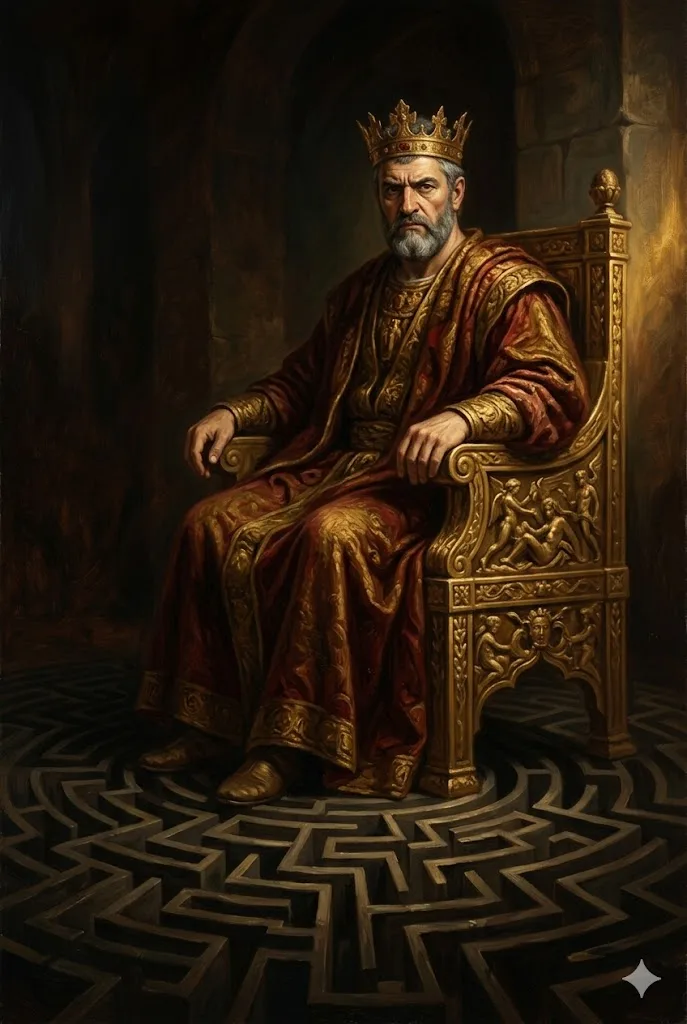
Son of Zeus and Europa
Zeus, disguised as a magnificent white bull, carried the Phoenician princess Europa across the sea to Crete. From their union came three sons: Minos, Rhadamanthys, and Sarpedon. Minos would grow to become the most powerful king in the Aegean, building a naval empire that dominated the Mediterranean.
When Minos competed with his brothers for the throne of Crete, he prayed to Poseidon to send a bull from the sea as a sign of divine favor, promising to sacrifice it afterward. Poseidon sent a magnificent white bull — but Minos found the creature so beautiful that he kept it and sacrificed an inferior animal instead.
The Curse and the Minotaur
Poseidon's punishment was creative and terrible: he caused Minos' wife Pasiphaë to fall madly in love with the bull. She enlisted Daedalus to build a hollow wooden cow in which she could mate with the animal. The result was the Minotaur — a creature with the body of a man and the head of a bull.
Horrified but unable to kill the creature (it was partly divine), Minos had Daedalus construct the Labyrinth beneath his palace at Knossos to contain it. After his son Androgeus was killed in Athens, Minos demanded a tribute of seven young men and seven young women sent to Crete every nine years to feed the Minotaur — until Theseus volunteered and slew the beast.
Judge of the Dead
Despite his tyranny in life, Minos was considered so just that after death he was appointed one of three judges in the Underworld, alongside his brother Rhadamanthys and Aeacus. Together they evaluated the souls of the dead and assigned them to their final destinations: the Elysian Fields for the virtuous, or Tartarus for the wicked.
Minos in Homer and the historians
The earliest picture of Minos is far kinder than the tyrant of Athenian legend. In the Odyssey (19.178–179) he rules Knossos as king "for nine years," or "in nine-year periods," and is called the familiar companion (oaristes) of great Zeus. Later writers, including Plato in the Laws and the dialogue Minos, read this as meaning that Minos visited Zeus' cave every ninth year to receive the laws he gave the Cretans. In the underworld scene of Odyssey 11, Odysseus sees him holding a golden sceptre and giving judgements to the dead, who plead their cases before him. Homer does not yet make him one of a panel of judges who sort souls into reward or punishment; that idea appears in Plato's Gorgias, where Minos holds the deciding vote between Rhadamanthys and Aeacus.
The historians treated him as a real ruler. Thucydides (1.4) calls Minos the first person known to have built a navy, ruling most of the Greek sea, colonising the Cyclades and suppressing piracy. Herodotus describes a Cretan expedition to Sicily to avenge his death there. When Arthur Evans excavated Crete's great palace at Knossos from 1900, he named the Bronze Age civilisation "Minoan" after the king, though nothing links any historical ruler to the name.
Diodorus and Plutarch even split him in two: an elder Minos, son of Zeus and the just lawgiver, and a grandson of the same name who fought Athens and imposed the tribute. Plutarch adds a shrewd observation, that Minos was always abused on the Athenian stage, and that it is dangerous to make enemies of a city with a literature.
Lesser-known episodes
Scylla of Megara. During his war against Athens, Minos besieged Megara, whose king Nisus had a purple lock of hair on which the city's safety depended. Nisus' daughter Scylla fell in love with Minos, cut the lock and brought it to him. Minos took the city but was disgusted by her treachery; in Ovid's telling he sails away and she clings to his ship until she is turned into the seabird ciris, pursued forever by her father in the form of a sea eagle.
Britomartis. Callimachus' Hymn to Artemis says Minos pursued the Cretan nymph Britomartis for nine months until she leapt from a cliff into the sea and was caught in fishermen's nets, which gave her the cult name Dictynna, "lady of the nets."
Procris and Pasiphaë's spell. According to Apollodorus, Pasiphaë, a daughter of Helios and a skilled sorceress, cursed her unfaithful husband so that any woman he slept with was killed by serpents and scorpions issuing from his body. Procris of Athens cured him with a root obtained from Circe and received as gifts the hound Laelaps that always caught its prey and a javelin that never missed.
The ring in the sea. In Bacchylides' seventeenth poem, Minos, sailing to Crete with the Athenian tribute, insults one of the girls. Theseus challenges him, and Minos throws his golden ring overboard daring Theseus to prove his descent from Poseidon. Theseus dives, is received by Amphitrite, and returns with a wreath. Theseus' visit to Amphitrite beneath the sea appears on a red-figure cup painted by Onesimos, now in the Louvre.
Glaucus. Minos' young son Glaucus drowned in a jar of honey. The seer Polyidus found him and, after watching one snake revive another with a herb, brought the boy back to life.
The death of Minos
When Daedalus fled Crete, Minos hunted him across the Mediterranean with a puzzle: whoever could pass a thread through the spirals of a seashell would reveal himself as the fugitive. At the court of King Cocalus in Sicily the shell came back threaded; Daedalus had tied the thread to an ant. Minos demanded his surrender, but Cocalus' daughters killed the king while he bathed, pouring boiling water (or pitch) over him. His bones were later said to have been returned to Crete. Dante kept the underworld role and made it grotesque: in Inferno 5 Minos snarls at the entrance to the second circle, wrapping his tail around himself as many times as the circle to which the sinner is sent.
His children, beyond the three most famous, included Deucalion (father of the Cretan leader Idomeneus at Troy), Catreus and Glaucus. Ariadne and Phaedra both married Theseus, the man who destroyed their half-brother the Minotaur.
Ancient sources
- Homer, Odyssey 11.568–571 and 19.178–179 — Minos judging the dead with a golden sceptre; his nine-year kingship and intimacy with Zeus.
- Thucydides, History 1.4 — Minos as the first naval power in the Aegean.
- Plato, Gorgias 523e–524a — the three judges of the dead, with Minos holding the deciding vote.
- Bacchylides, Ode 17 — the confrontation with Theseus and the ring thrown into the sea.
- Apollodorus, Library 3.1–3.15 and Epitome 1 — the bull from the sea, Pasiphaë's curse, Procris, Glaucus, Scylla and his death in Sicily.
- Ovid, Metamorphoses 8.1–151 — the siege of Megara and Scylla's betrayal of Nisus.
Frequently asked questions
Was King Minos a real person?
There is no evidence of a historical Minos. Thucydides and Herodotus treated him as real, and archaeologists borrowed his name for the Bronze Age "Minoan" civilisation of Crete, but no inscription or record confirms an actual king of that name.
How did King Minos die?
Pursuing Daedalus to Sicily, he was killed in his bath by the daughters of King Cocalus, who scalded him with boiling water.
Why is Minos a judge of the dead if he was cruel?
Cretan and early Greek tradition remembered him as a just lawgiver taught by Zeus. His cruelty belongs mostly to Athenian stories about the tribute, and some ancient writers resolved the tension by imagining two kings called Minos.
Who were Minos' brothers?
Rhadamanthys, who also became a judge of the dead, and Sarpedon, who in some versions quarrelled with Minos and left Crete for Lycia.