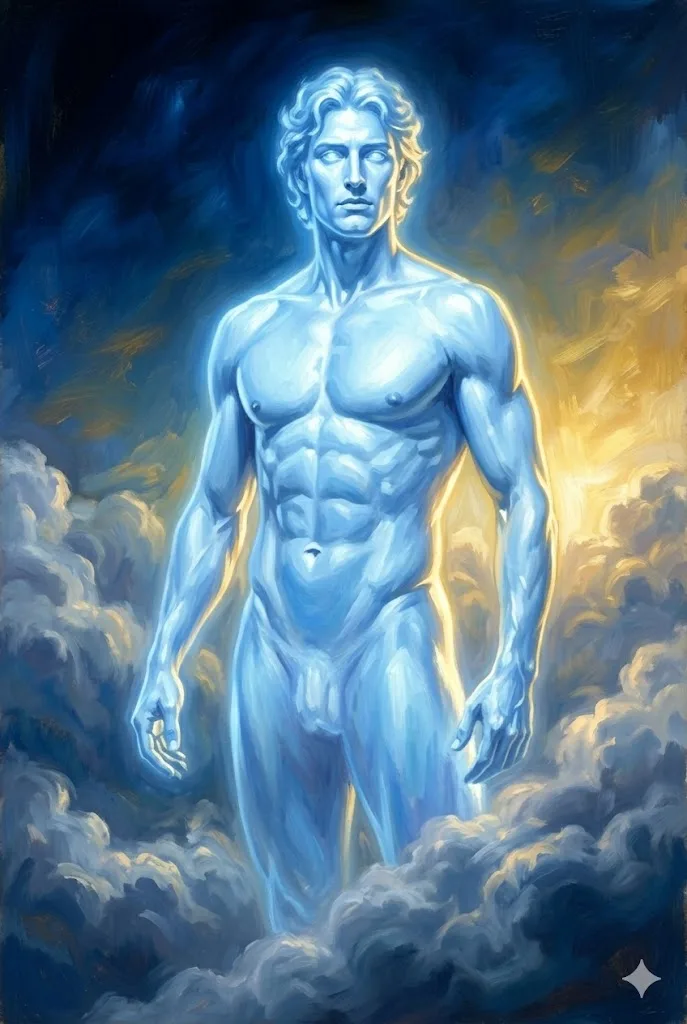
The Radiant Sky
Aether was the primordial personification of the upper sky — the bright, glowing atmosphere where the gods dwelled, as opposed to the common air (Aer) breathed by mortals below. While humans lived beneath gray, misty skies, the gods basked in Aether's eternal brilliance above the clouds. He represented the purest, most luminous layer of the cosmos, the dazzling light that separated the heavenly realm from the earthly world. In the cosmology of the ancient Greeks, Aether was literally the substance of the divine realm.
Origins and Family
Aether was born from Erebus (Darkness) and Nyx (Night) — a paradox that fascinated ancient philosophers. From the union of the two darkest primordial forces came the brightest substance in existence. This was not contradiction but cosmic balance: light emerging from darkness, day born from night. His sister and counterpart was Hemera (Day), and together they embodied the cycle of light that governed the world. Each morning, Hemera would draw back Erebus's dark mists to reveal Aether's brilliant light; each evening, Nyx would spread her veil and hide him again.
The Substance of Heaven
To the Greeks, Aether was more than a god — he was a physical element. Aristotle proposed that while the terrestrial world was composed of earth, water, air, and fire, the celestial spheres were made of a fifth element: aether. This concept proved enormously influential. It passed into Roman philosophy, medieval science, and persisted well into the 19th century, when physicists hypothesized a 'luminiferous aether' that carried light waves through space. Even after Einstein's relativity disproved the physical aether, the concept echoes in words like 'ethereal' — meaning heavenly, otherworldly, impossibly delicate.
In Ancient Thought
The Orphic tradition gave Aether a more prominent role than the Hesiodic one. In Orphic cosmogony, Aether was one of the first beings to emerge from the cosmic egg, and the entire universe was surrounded by his radiant substance. The philosopher Empedocles used the word aether for air; it was Anaxagoras, according to Aristotle, who identified Aether with the fire that composed the heavenly bodies. For the Stoics, Aether was the active, intelligent element that pervaded all of creation. Across these traditions, Aether was understood as the fundamental substance of the divine — literally the air that the gods breathed, the light in which they lived.
Classical Sources
- 📜 Hesiod, Theogony (c. 700 BC)
- 📜 Aristotle, On the Heavens (c. 350 BC)
- 📜 Orphic Fragments
- 📜 Empedocles, On Nature (c. 450 BC)
Cross-referenced with multiple classical sources for accuracy.
Explore More
Aether in Homer and Hesiod
In the earliest poetry aither is a region before it is a god. Homer separates the hazy lower air (aēr) from the bright upper sky. In the Iliad, Hypnos hides in a fir tree on Mount Ida that "reached through the aēr to the aither", and Zeus is repeatedly called the god "who dwells in the aither". When Athena or Hera flies down from Olympus, she passes from the aither through the mist into the world of men. Homer never personifies Aether as a separate figure; the bright sky simply belongs to Zeus.
Hesiod makes him a person, but only in a couple of lines. In the Theogony, Nyx unites in love with Erebus and bears Aether and Hemera. Hesiod gives him no myths, no offspring and no further role, which is why he stays a shadowy figure next to Gaia or Uranus.
Other Genealogies
Because Hesiod says so little, later writers filled the gap in conflicting ways:
- Hyginus, in the preface to his Fabulae, makes Aether and Day (Dies) the parents of Earth, Sky and Sea. He also gives a long list of personified abstractions as children of Aether and Earth, including Grief, Deceit, Anger and Lamentation.
- Cicero, in On the Nature of the Gods, reports a tradition in which Caelus (the Roman Uranus) was the son of Aether and Dies, so Aether becomes the grandfather of the Titans.
- Orphic theogonies, as summarised by late Neoplatonists such as Damascius, start with Chronos (Time), who produces Aether and Chaos. The cosmic egg from which Phanes hatches forms within Aether. In this tradition Aether is near the very start of everything, not a second-generation child of Night.
So "Aether's parents were Erebus and Nyx" is Hesiod's answer, not the only ancient one. See the Greek creation myth for how these competing cosmogonies fit together.
Where Souls Go: Aether and the Afterlife
One of the most striking uses of aether in classical Athens appears on a public monument. The epitaph for the Athenians who fell at Potidaea in 432 BC states that "aether received their souls, and earth their bodies". Euripides repeats the idea in his Suppliants: each part returns to where it came from, the spirit to the aether and the body to the earth. This contradicts the Homeric picture of every shade going down to Hades and shows a strand of Greek thought in which the soul was made of the same luminous stuff as the sky.
Euripides went further in a famous fragment, asking the audience to look at "this boundless aether on high" and to regard it as Zeus. Aristophanes mocks this kind of thinking in the Clouds, where Socrates prays to "Air" and "Aether" in place of the Olympians, one way comedy portrayed the new philosophy as impious.
Philosophers and a Common Confusion
Both Plato's Cratylus and Aristotle's On the Heavens derive aithēr from aei thein, "always running", because the heavens move in perpetual circular motion. That derivation is how Aristotle justified a fifth body, distinct from fire, that moves naturally in circles and never changes. It is this "first body" that later writers called the quintessence, literally "fifth essence".
Ancient thinkers did not use the word in one consistent way. In Empedocles' surviving fragments aithēr usually means air, one of his four roots, not fire. According to Aristotle, it was Anaxagoras who equated aether with fire. In Plato's Phaedo, Socrates imagines a "true earth" above our misty hollows, where aether is to its inhabitants what air is to us. Modern summaries that treat "aether" as a single fixed idea from Homer to the Stoics blur these differences.
Aether was not a widely worshipped god. There were no known temples or festivals for him, and his presence in religion was almost entirely through poetry, philosophy and Orphic texts.
Ancient sources
- Hesiod, Theogony 124–125: Nyx and Erebus produce Aether and Hemera.
- Homer, Iliad Book 14: the fir tree on Ida reaching "through the aēr to the aither"; elsewhere Zeus is the god "dwelling in the aither".
- Hyginus, Fabulae, preface: Aether and Day as parents of Earth, Sky and Sea, plus a list of children of Aether and Earth.
- Cicero, On the Nature of the Gods Book 3: Caelus as the son of Aether and Dies.
- Aristotle, On the Heavens Book 1: the fifth, circularly moving body and the "always running" derivation.
- Euripides, Suppliants and fragments: the soul returning to aether, and aether identified with Zeus.
Frequently asked questions
What is the difference between Aether and Aer?
In Greek usage aēr was the thick, misty air near the ground that mortals breathe. Aithēr was the pure, bright upper sky where the gods lived. Homer clearly distinguishes them.
Who were Aether's parents?
In Hesiod, Erebus and Nyx. Orphic accounts make him a product of Chronos, and other sources reverse the order entirely by making Aether a parent of the sky and earth.
Is Aether the same as Uranus?
No. Uranus is the sky as a solid dome and the father of the Titans; Aether is the shining substance of the upper air. Some Roman traditions make Aether the father of Uranus (Caelus).
Where does the word "ethereal" come from?
From Greek aithēr by way of Latin aetherius, "belonging to the upper sky". The word kept the sense of something light, pure and not of this earth.