The Beginning of Everything
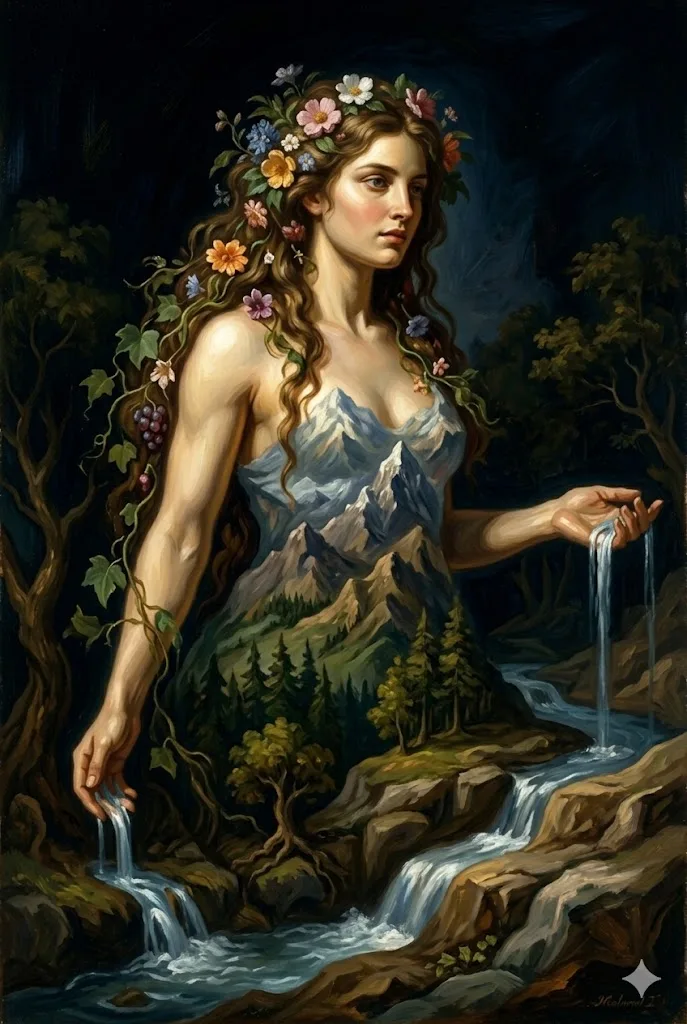
Gaia (also spelled Gaea) was the primordial goddess of the Earth and one of the very first beings to emerge after Chaos at the dawn of creation. She was not merely a goddess who ruled over the earth — she was the Earth itself, the living, breathing foundation upon which the entire Greek cosmos was built. Every mountain was part of her body, every cave was her womb, every earthquake was her movement. She was the most ancient deity in Greek religion, worshipped long before Zeus or the Olympians existed, and her influence runs through virtually every major myth.
The Creation
According to Hesiod's Theogony, in the beginning there was only Chaos, a yawning void of nothingness. After Chaos came Gaia (Earth), Tartarus (the Abyss), and Eros (Love), while from Chaos itself came Erebus (Darkness) and Nyx (Night). Gaia, without any partner, gave birth to Uranus (Sky), Ourea (Mountains), and Pontus (Sea). She then took Uranus as her consort, and together they produced the first generation of divine beings: the twelve Titans, the three Cyclopes, and the three Hecatoncheires (Hundred-Handed Ones).
Mother of All
Gaia's offspring are staggering in their scope. Through Uranus, she bore the Titans who would become the parents of the Olympian gods. Through Pontus, she bore the ancient sea deities. She was the mother of Typhon, the most terrifying monster in all of mythology, whom she produced to challenge Zeus after he imprisoned her Titan children. She was grandmother to Zeus, Poseidon, Hades, Hera, and nearly every other major deity. In a very real sense, everything in the Greek cosmos descended from Gaia.
The Castration of Uranus
When Uranus imprisoned the Cyclopes and Hecatoncheires inside Gaia's body (the earth), she was wracked with pain and fury. She fashioned a great sickle of grey flint and asked her Titan children to punish their father. Only the youngest, Cronus, had the courage to act. Gaia hid him in ambush, and when Uranus came to lie with Gaia that night, Cronus castrated his father with the sickle and threw the severed parts into the sea. From the blood that fell on the earth sprang the Furies, the Giants, and the Meliae (ash tree nymphs). From the severed parts floating in the sea foam, Aphrodite was born.
Gaia and the Olympians
Gaia's relationship with Zeus and the Olympians was complicated and often antagonistic. She helped Zeus overthrow the Titans by revealing a prophecy about how to win. But when Zeus imprisoned the Titans in Tartarus just as Uranus had imprisoned her earlier children, Gaia felt betrayed. In later accounts such as Apollodorus's (Hesiod does not narrate it), she sent the Giants against the Olympians in the Gigantomachy, and when they failed, she produced Typhon, a monster so terrifying that all the Olympians except Zeus fled in terror. Zeus eventually defeated Typhon, but only barely, and the struggle demonstrated that Gaia's power was something even the king of the gods had to take seriously.
Modern Significance
Gaia has experienced a remarkable revival in modern culture. The Gaia Hypothesis, proposed by scientist James Lovelock in the 1970s, suggests that the Earth functions as a single self-regulating living system, essentially giving scientific language to the ancient Greek intuition that the Earth is alive. The name Gaia has been adopted by environmental movements, ecological organizations, and spiritual practices worldwide. In an age of climate crisis and ecological awareness, the ancient Greek concept of the Earth as a living, responsive, and potentially wrathful mother goddess has never been more relevant.
Classical Sources
- 📜 Homer, Iliad & Odyssey (c. 750 BC)
- 📜 Hesiod, Theogony (c. 700 BC)
- 📜 Apollodorus, Bibliotheca (c. 1st-2nd century AD)
- 📜 Ovid, Metamorphoses (8 AD)
Cross-referenced with multiple classical sources for accuracy.
Explore More
Cronus · Rhea · Zeus · Typhon · Home
Gaia as Counsellor and Prophet
In Hesiod's Theogony, Gaia is more than a mother of monsters. She is the cosmos' great strategist, and she backs whichever generation is being oppressed at the time. When Cronus began swallowing his children, it was Gaia, together with Uranus, who advised Rhea to give birth secretly in Crete. Gaia herself took the newborn Zeus and hid him in a cave, and Cronus was handed a stone wrapped in swaddling clothes to swallow. During the Titanomachy she told the gods they would win only if they freed the Hundred-Handers from their prison under the earth. After the victory, she and Uranus warned Zeus that his first wife Metis would bear a son stronger than him, so Zeus swallowed Metis, and Athena was later born from his head. Gaia's knowledge of what is to come is a recurring thread, and it explains why she was linked to prophecy.
That link is clearest at Delphi. At the opening of Aeschylus' Eumenides, the Pythia lists the oracle's owners in order. First Earth, the original prophetess, then her daughter Themis, then the Titaness Phoebe, who gave it as a birthday gift to Phoebus Apollo. Other versions are more violent. The serpent Python, which guarded the site for Earth, had to be killed by Apollo before he could take it over. Pausanias adds that the oracle at Delphi had once belonged to Ge.
Children Beyond the Theogony
Several famous figures were born from Earth outside Hesiod's main genealogy:
- Typhon — Hesiod says Gaia bore him after uniting with Tartarus. In the Homeric Hymn to Apollo, by contrast, Hera produces Typhaon alone in anger at Zeus.
- Erichthonius — an early king of Athens. He sprang from the soil when Hephaestus' seed fell on the ground during his attempted assault on Athena. Earth handed the baby to Athena to raise, a scene Athenian vase painters often showed, with Gaia rising waist-deep from the ground.
- Antaeus — the Libyan wrestler, son of Gaia and Poseidon. He grew stronger every time he touched his mother. Heracles beat him by lifting him off the ground.
- The Giants — born from the blood of Uranus. In Apollodorus, Gaia searches for a magic herb that would make them invulnerable, and Zeus forbids Dawn, Moon and Sun to shine until he has found it first.
Gaia also gave Hera a wedding gift: the tree of golden apples guarded by the Hesperides and the dragon Ladon.
Worship: Ge in Cult
Unlike the other primordial beings, Gaia (usually Ge in prose and inscriptions) did receive real worship. Athens honoured Ge Kourotrophos, "Nurse of the Young," with offerings before other sacrifices. There was also a precinct of Ge Olympia inside the enclosure of the Olympieion, where Pausanias saw a cleft in the ground through which the waters of Deucalion's flood were said to have drained away. At Olympia there was an altar of Ge at the place called the Gaion, which had also once been an oracle. Earth was also called on as a witness in oaths. In the Iliad, Agamemnon swears by Zeus, the Sun, the Rivers and Earth before the duel between Paris and Menelaus, because the Earth sees and holds everything, including the dead who punish oath-breakers.
Gaia in Art, and Some Corrections
Greek artists rarely showed Gaia in full. Usually they depicted her as a matronly woman rising from the ground from the waist up. The most dramatic example is on the Great Altar of Pergamon, where she emerges at the edge of the Gigantomachy frieze, pleading with Athena while Athena drags her son, the giant Alcyoneus, away by the hair.
Two common simplifications deserve correction. First, Hesiod does not say that Eros and Tartarus came "from" Chaos. They simply came into being after it, and only Erebus and Night are described as Chaos' offspring. Second, the full war of the Giants is not in Hesiod; it is told by later writers such as Apollodorus. For the whole story see the Gigantomachy and the Greek creation myth.
Ancient sources
- Hesiod, Theogony — Gaia's emergence after Chaos, her children with Uranus and Pontus, the plot against Uranus, the hiding of Zeus, her advice in the Titanomachy, and the birth of Typhon.
- Homeric Hymn 30, To Earth the Mother of All — a short hymn praising Earth as the oldest being, who feeds all creatures and gives wealth to the righteous.
- Aeschylus, Eumenides 1–8 — the Pythia names Earth as the first holder of the Delphic oracle.
- Apollodorus, Library 1.6 and 3.14 — Gaia and the Giants' magic herb, and the earth-birth of Erichthonius.
- Pausanias, Description of Greece 1.18 and 5.14 — the precinct of Ge Olympia in Athens and the altar of Ge at Olympia.
Frequently asked questions
Is Gaia a Titan?
No. She is a primordial deity and the mother of the Titans. People often group her with them, but in Hesiod she belongs to the generation before.
Who was Gaia's husband?
Uranus (Sky), whom she produced by herself and then took as her mate. She also had children with Pontus (Sea) and with Tartarus.
What is the Roman name for Gaia?
Tellus, or Terra Mater ("Mother Earth"). She had a temple in Rome on the Esquiline.
Why did Gaia turn against Zeus?
In the later tradition, she was angry that Zeus had imprisoned her Titan children in Tartarus, as Uranus had imprisoned her earlier offspring. She sent first the Giants and then Typhon against him.
Books to read next
- Hesiod, Theogony and Works and Days (Oxford World's Classics)
- Stephen Fry, Mythos
- Apollodorus, The Library of Greek Mythology (Oxford World's Classics)
Links go to Bookshop.org, which supports independent bookstores. We earn a small commission if you buy, at no extra cost to you.