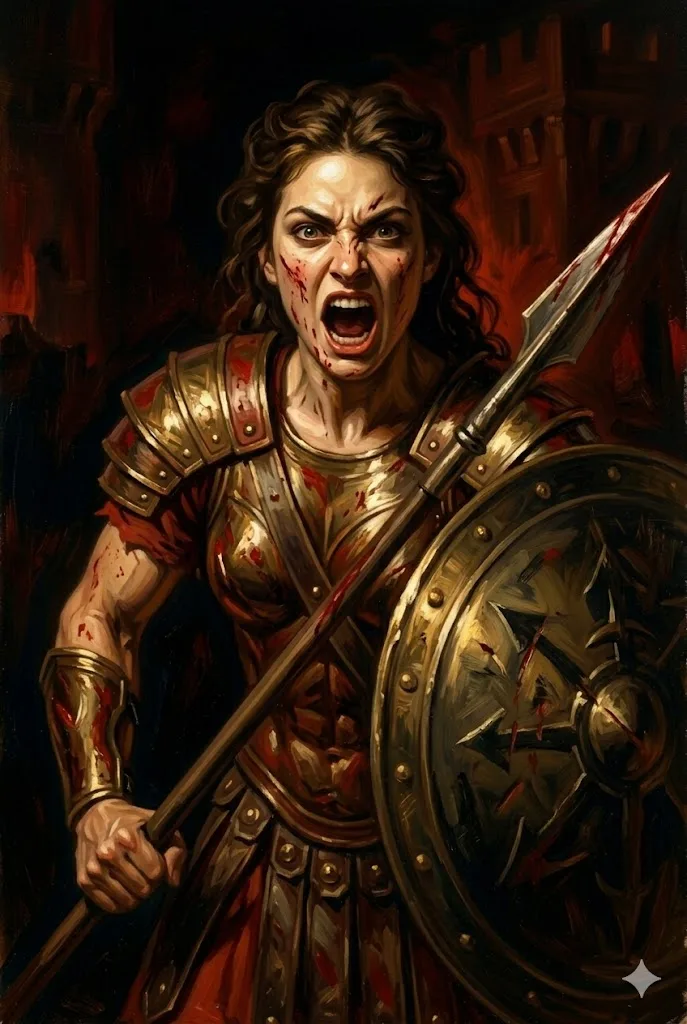
Sister of War
Enyo was the goddess of war, destruction, and the sacking of cities. While Ares represented the violence and brutality of combat, Enyo personified the devastation that war leaves behind: the burning cities, the shattered walls, the civilian casualties. She was variously described as the sister, daughter, or mother of Ares, but in every account she was his constant companion on the battlefield, walking beside him as cities fell and armies broke.
On the Battlefield
In the Iliad, Enyo appears alongside Ares during the fighting at Troy, described as carrying the turmoil of war with her. Where Ares inspired the bloodlust of individual warriors, Enyo brought the large-scale chaos of collapsing battle lines, panicking horses, and the screams of the dying. Later poets, rather than Homer, pictured her drenched in blood as walls crumbled and defenders fled. The Greeks did not romanticize her. She was the horrifying reality of what war does to civilization.
The Roman Bellona
The Romans identified Enyo with their own war goddess Bellona, from whom we get the word 'bellicose.' Bellona had her own temple in Rome, and declarations of war were made by a priest throwing a spear from Bellona's column into a patch of ground designated as 'enemy territory.' The fact that both Greek and Roman cultures had female war deities alongside their male ones reflects the ancient understanding that war is not exclusively a masculine domain.
Classical Sources
- 📜 Homer, Iliad & Odyssey (c. 750 BC)
- 📜 Hesiod, Theogony (c. 700 BC)
- 📜 Apollodorus, Bibliotheca (c. 1st-2nd century AD)
- 📜 Ovid, Metamorphoses (8 AD)
Cross-referenced with multiple classical sources for accuracy.
Explore More
Ares · Athena · Trojan War · Phobos & Deimos · Home
Enyo in Homer: what the text actually says
Enyo appears only briefly in the Iliad, but the two passages are worth reading closely. In Book 5, after Diomedes wounds Aphrodite in the hand, Homer explains that he recognised her as a weak goddess, "not one of those who rule over the battle of men, neither Athena nor Enyo, sacker of cities". So Enyo is grouped with Athena as a true war goddess, and her epithet ptoliporthos, "sacker of cities", is one Homer otherwise uses for heroes such as Achilles and Odysseus.
Later in the same book, Hector charges forward with Ares beside him, and "lady Enyo" leads the Trojans. She is said to bring with her Kydoimos, the shameless Din of Battle. Homer does not call her Ares' sister or describe her laughing or covered in blood. Those images belong to later poetry and modern retellings. Her family relationship to Ares varies between authors. The name of Ares' own title Enyalios is clearly related to hers, and some ancient commentators treated Enyalios as a separate war god, sometimes her son.
The other Enyo: one of the Graeae
The same name belongs to a completely different figure. In Hesiod's Theogony, Phorcys and Ceto have two daughters called the Graiai, "the Grey Ones", who were grey-haired from birth: Pemphredo "of the fair robe" and Enyo "of the saffron robe". Hesiod does not mention the shared eye. That comes from later versions of the Perseus story. Apollodorus counts three sisters, Enyo, Pephredo and Deino, who share one eye and one tooth. Perseus steals these to force them to reveal the way to the nymphs who held the winged sandals and the cap of invisibility, and from there to the Gorgons. The Graeae are sisters of the Gorgons, not of Ares. Mixing up the two Enyos is a frequent mistake in modern summaries.
Oaths, statues and Eastern goddesses
Enyo shows up where Greek writers wanted the bare horror of war personified. In Aeschylus' Seven Against Thebes, the seven champions sacrifice a bull and swear by Ares, Enyo and blood-loving Phobos (Rout) that they will either destroy Thebes or die. The grouping matches Homer: Enyo belongs with Ares and with Phobos and Deimos as part of the machinery of slaughter, not as a planner of campaigns.
She had little organised cult of her own in mainland Greece, but she was not forgotten in sacred art. Pausanias, describing the temple of Ares in the Athenian Agora, lists a statue of Enyo made by the sons of Praxiteles, alongside images of Aphrodite and Athena. In the Hellenistic and Roman East, Greek writers used her name for local war goddesses. Strabo describes the great temple-state of Comana in Cappadocia, where the goddess Ma, served by thousands of temple personnel, was identified with Enyo. Romans in turn equated Ma with Bellona, which is how Enyo, Ma and Bellona came to be treated as one goddess.
Later epic gave her more to do. Quintus of Smyrna's Posthomerica, which fills the gap between the Iliad and the fall of Troy, repeatedly has Enyo roaming the battlefield and stirring up the fighting. In Nonnus' Dionysiaca, she plays a part in the battles of the gods. In both poets she is a dramatic personification, not a figure with a myth cycle of her own. No surviving source gives her a lover, children she raised, or a story in which she is the main character.
She should also not be confused with Eris. Strife starts quarrels: Homer calls Eris the sister and companion of Ares and has her throw the conflict into the middle of the armies. Enyo is the destruction that follows. For the wider family, see the children of Ares and Athena vs Ares.
Ancient sources
- Homer, Iliad 5.330–333: Diomedes knows Aphrodite is no war goddess like Athena or Enyo, "sacker of cities".
- Homer, Iliad 5.592–593: Ares and lady Enyo lead the Trojans, with Enyo bringing Kydoimos, the Din of Battle.
- Hesiod, Theogony 270–273: Enyo as one of the Graiai, daughters of Phorcys and Ceto.
- Aeschylus, Seven Against Thebes: the seven attackers swear by Ares, Enyo and Phobos.
- Pausanias, Description of Greece 1.8: a statue of Enyo by the sons of Praxiteles in the temple of Ares at Athens.
- Strabo, Geography 12.2: the goddess Ma of Comana, identified with Enyo.
Frequently asked questions
Is Enyo Ares' sister, mother or daughter?
Ancient sources do not settle it. Homer pairs them without saying how they are related. Later writers and commentators made her variously his sister, mother, daughter or nurse.
Is Enyo the same as Bellona?
Romans identified the two, and also equated both with the Anatolian goddess Ma. Bellona had her own Roman cult and was originally a separate Italian goddess.
Is Enyo one of the Graeae?
One of the Graeae has the same name, but she is a different figure: a grey-haired daughter of Phorcys and Ceto in the Perseus story, not the war goddess who goes with Ares.
What is the difference between Enyo and Eris?
Eris is strife, the quarrel that starts a war. Enyo is the destruction of war at its height, especially the sack of cities.
Books to read next
Links go to Bookshop.org, which supports independent bookstores. We earn a small commission if you buy, at no extra cost to you.