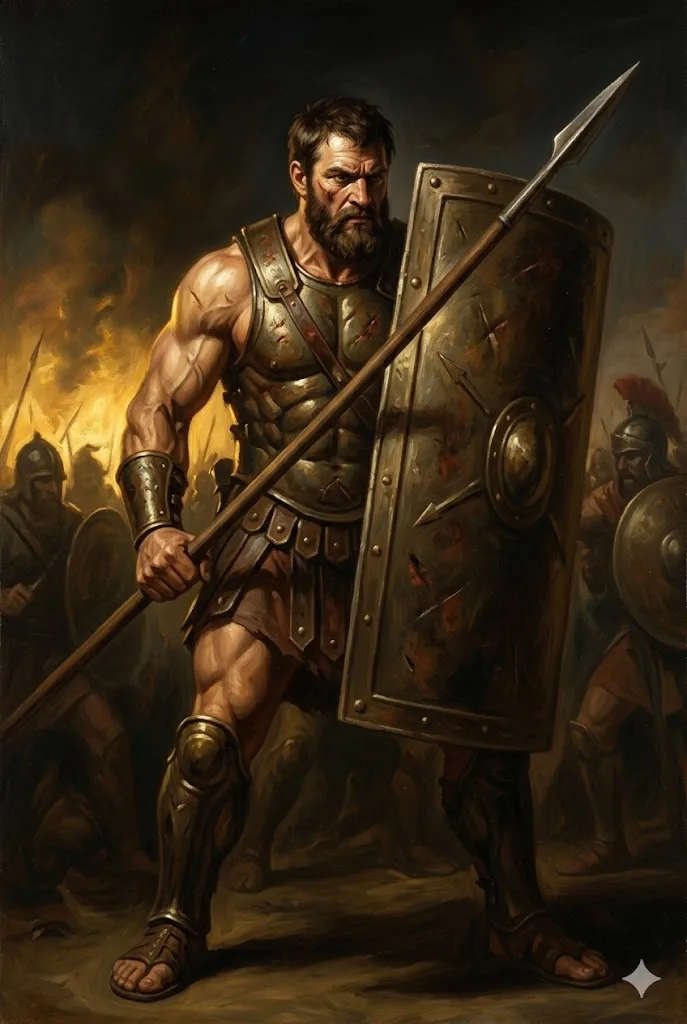
The Towering Warrior
Ajax, son of Telamon and king of Salamis, was the largest and strongest of the Greek warriors at Troy after Achilles. He carried an enormous shield made of seven layers of ox-hide reinforced with bronze, a shield so large it was described as a wall unto itself. While other heroes had divine parents or magical weapons, Ajax relied on nothing but his own physical prowess and indomitable will. He was never wounded in the entire Iliad, a feat no other warrior on either side can claim.
Holding the Line
Ajax's greatest moment came when Achilles withdrew from battle and the Trojans, led by Hector, pushed the Greeks back to their ships. With the entire army in retreat and the war on the verge of being lost, Ajax stood alone on the decks of the Greek ships and fought off the entire Trojan advance with a massive naval pike. Homer describes him striding from ship to ship, a colossus who refused to give ground when every other Greek had broken. He did not save the day through cleverness like Odysseus or divine intervention like Diomedes. He saved it through sheer stubborn refusal to die or retreat.
The Arms of Achilles
When Achilles was killed, his divine armour, forged by Hephaestus, was awarded not to Ajax but to Odysseus. The decision was made by the Greek commanders (or in some versions, by Trojan prisoners asked who had hurt them most). Ajax, who had carried Achilles' body from the battlefield while Odysseus fought off the Trojans, believed the armour was rightfully his. The rejection drove him mad. In his madness, sent by Athena, he slaughtered a flock of sheep believing they were Odysseus and the Greek leaders. When sanity returned and he saw what he had done, Ajax fell on his own sword.
The Tragedy of Ajax
Sophocles' Ajax (c. 440 BC) is one of the great tragedies about honour and the cruelty of a system that rewards cunning over loyalty. Ajax did everything right. He fought harder than anyone. He never asked for divine help. He held the line when everyone else ran. And his reward was to be passed over for a man who fought with words instead of weapons. His suicide is not weakness but a final assertion of the warrior code: better to die with honour than live with the knowledge that honour means nothing to those in power.
Classical Sources
- 📜 Homer, Iliad & Odyssey (c. 750 BC)
- 📜 Hesiod, Theogony (c. 700 BC)
- 📜 Apollodorus, Bibliotheca (c. 1st-2nd century AD)
- 📜 Ovid, Metamorphoses (8 AD)
Cross-referenced with multiple classical sources for accuracy.
Explore More
Achilles · Odysseus · Trojan War · Troy · Home
Birth, family and the eagle omen
Ajax (Greek Aias) was the son of Telamon of Salamis and Periboea (also called Eriboea), and grandson of Aeacus, which made him a first cousin of Achilles. His half-brother Teucer, son of Telamon by the Trojan princess Hesione, was the finest archer in the Greek army and fought crouched behind Ajax's great shield. Pindar tells how Heracles, visiting Telamon, prayed to Zeus for a brave son for his friend; Zeus answered with an eagle (aietos), and Heracles told Telamon to name the child after the bird. A later variant claims Heracles wrapped the baby in his lion skin and made him invulnerable everywhere except the spot the skin did not touch, which explains why in some versions Ajax had to find a weak point in his side or armpit when he killed himself.
He must not be confused with Ajax the Lesser, son of Oileus, the fast-running Locrian who dragged Cassandra from Athena's statue. Homer often pairs the two as "the Aiantes", which adds to the confusion.
Episodes in the Iliad beyond the defence of the ships
In Book 7 Ajax is chosen by lot to meet Hector in single combat. He has the better of the fight, knocking Hector down with a boulder, but heralds stop the duel at nightfall and the two exchange gifts: Hector gives a silver-studded sword, Ajax a purple belt. Later poets turned this courtesy into a tragic irony, since it is Hector's sword that Ajax falls on in Sophocles. In the Book 9 embassy to Achilles, Ajax speaks last and most bluntly, telling his cousin that he is pitiless and that men accept compensation even for a murdered brother. In Book 17 he leads the fight over the body of Patroclus, standing over it "like a lion over its cubs". At the funeral games in Book 23 he wrestles Odysseus to a draw, a small foreshadowing of their later contest.
The contest for the arms and its versions
The judgement of Achilles' armour was told differently by different poets. In the Odyssey the judges are "the sons of the Trojans and Pallas Athena". The lost epic Little Iliad had Greek spies overhear Trojan girls debating which hero was braver: one said Ajax, who carried the corpse, the other argued that Odysseus, who covered the retreat, deserved the prize. Pindar, in Nemean 7 and 8, complains that Ajax was beaten by secret ballots and the smooth lies of Odysseus. Ovid's Metamorphoses Book 13 stages the whole debate as a pair of speeches, with the blunt soldier losing to the skilled orator. Ovid also says a flower sprang from Ajax's blood marked with the letters AI, the same marks earlier associated with the boy loved by Apollo (see Apollo and Hyacinthus), so that the bloom carried both a lament and the hero's name.
One of the most admired scenes in the Odyssey follows from this. When Odysseus meets the dead in Book 11, every shade talks to him except Ajax, who stands apart, still angry, and walks away into the darkness without a word. The ancient critic Longinus thought that silence was greater than any speech.
Hero cult, Athens and art
Ajax was a protecting hero of Salamis, honoured with a festival called the Aianteia. Athens, which took control of the island, adopted him: when Cleisthenes reorganised the citizen body around 508 BC, one of the ten new tribes was named Aiantis after him. Before the battle of Salamis in 480 BC, Herodotus reports, the Greeks prayed to the gods and summoned Ajax and Telamon from Salamis to fight alongside them.
The painter Exekias returned to Ajax repeatedly. His amphora in the Vatican shows Ajax and Achilles bent over a board game during a lull in the war, and another of his vases, now in Boulogne, shows Ajax alone planting his sword in the ground before falling on it, one of the most restrained death scenes in Greek art. The suicide itself is almost never depicted at the moment of impact in early art; painters preferred the preparation or the body.
A common modern mistake is to describe Ajax as slow-witted. Homer calls him the "bulwark of the Achaeans" and gives him a sharp speech in Book 9. His flaw in the tradition is pride and inflexibility, not stupidity. For more on how his fate fits the wider war, see the Trojan War and our Iliad study guide.
Ancient sources
- Homer, Iliad 7, 9, 15 and 17 — the duel with Hector, the embassy speech, the stand at the ships and the fight over Patroclus' body.
- Homer, Odyssey 11 — the contest for the arms judged by Trojans and Athena, and Ajax's silent refusal to speak to Odysseus in the underworld.
- Sophocles, Ajax — Athena's deception, the slaughter of the herds, the suicide on Hector's sword, and the debate over his burial in which Odysseus argues for honouring him.
- Pindar, Isthmian 6 and Nemean 7–8 — the eagle omen at his naming and Pindar's protest that Odysseus won the arms through deceit.
- Ovid, Metamorphoses 13 — the speeches of Ajax and Odysseus for the armour, and the flower that grew from Ajax's blood.
- Herodotus, Histories 8.64 — the Greeks summoning Ajax and Telamon before the battle of Salamis.
Frequently asked questions
Why did Ajax kill himself?
After losing the armour of Achilles to Odysseus he tried to murder the Greek leaders, but Athena deluded him into slaughtering livestock instead. Waking to the disgrace, he chose death rather than living as a laughing-stock.
What is the difference between Ajax the Great and Ajax the Lesser?
Ajax the Great was the son of Telamon from Salamis, a massive warrior with a tower-like shield. Ajax the Lesser was the son of Oileus from Locris, small and fast, and notorious for violating Athena's sanctuary at the fall of Troy.
Was Ajax related to Achilles?
Yes. Their fathers, Telamon and Peleus, were brothers, both sons of Aeacus, so Ajax and Achilles were first cousins.
Was Ajax invulnerable?
Not in Homer, though he is never wounded in the Iliad. The story of near-invulnerability from Heracles' lion skin comes from later writers.