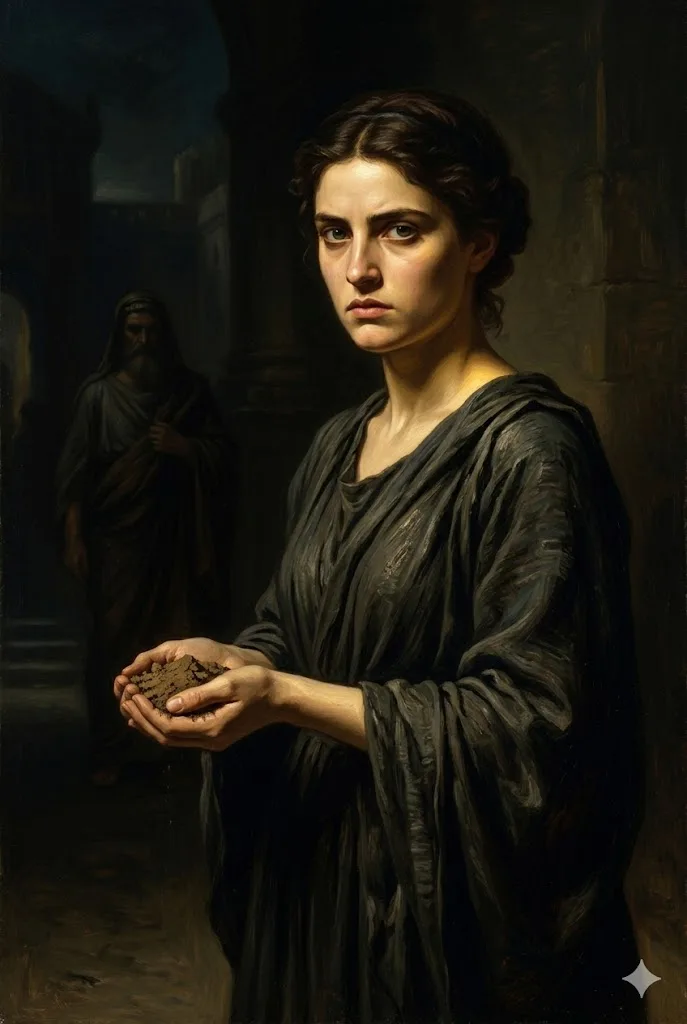
Daughter of Tragedy
Antigone was the daughter of Oedipus and Jocasta, born from the most cursed union in Greek mythology. Her father was also her half-brother. When the truth about Oedipus was revealed, Jocasta hanged herself and Oedipus blinded himself and was exiled from Thebes. Antigone, barely more than a girl, chose to accompany her blind father into exile, guiding him through years of wandering until his death. Her loyalty to family would define her life and seal her fate.
The Burial
After Oedipus died, his two sons Eteocles and Polynices fought for control of Thebes. They killed each other in single combat. The new king, Creon, decreed that Eteocles would receive a hero's burial but Polynices, who had attacked Thebes with a foreign army, would be left unburied, his body exposed to dogs and birds. Anyone who attempted to bury him would be executed.
Antigone defied the order. She went to the battlefield and performed the burial rites for her brother, sprinkling earth over his body and pouring libations. She was caught, brought before Creon, and given a chance to deny her actions. She refused. She told the king that the laws of the gods, which require proper burial of the dead, outweigh the laws of any mortal ruler. Creon sentenced her to be sealed alive inside a stone tomb.
The Tragedy
Creon's son Haemon, who was engaged to Antigone, begged his father to relent. The blind prophet Tiresias warned Creon that the gods were angry. Creon finally changed his mind and rushed to free Antigone, but he was too late. She had hanged herself inside the tomb. Haemon, finding her dead, tried to kill his father and then fell on his own sword. Creon's wife Eurydice, learning of her son's death, killed herself as well. Creon was left alive, surrounded by the corpses of his family, destroyed by his own stubbornness.
Why Antigone Matters
Sophocles' Antigone, first performed around 441 BC, asks one of the most important questions in political philosophy: when the law of the state conflicts with a higher moral law, which should you obey? Antigone chose conscience over obedience and paid with her life. Her story has been invoked by every generation that has faced unjust authority, from the French Resistance to the Civil Rights movement to modern political prisoners. She is arguably the most important female character in Western literature.
Classical Sources
- 📜 Homer, Iliad & Odyssey (c. 750 BC)
- 📜 Hesiod, Theogony (c. 700 BC)
- 📜 Apollodorus, Bibliotheca (c. 1st-2nd century AD)
- 📜 Ovid, Metamorphoses (8 AD)
Cross-referenced with multiple classical sources for accuracy.
Explore More
Oedipus · Sphinx · Athens · Home
Antigone at Colonus and the war of the Seven
Sophocles returned to Antigone near the end of his life in Oedipus at Colonus, produced after his death in 401 BC. There she and her sister Ismene care for the blind Oedipus as he reaches the grove of the Eumenides at Colonus, just outside Athens. Creon tries to seize both girls as leverage to bring Oedipus home, and Theseus rescues them. Polynices comes to beg his father's blessing for the attack on Thebes, and Oedipus curses both sons instead. Before leaving, Polynices asks his sisters to give him a burial if he dies, which sets up the play Sophocles had in fact written decades earlier.
That order matters: the three "Theban plays" are not a trilogy. Antigone came first (around 441 BC), Oedipus the King around 429 BC, and Oedipus at Colonus last, and they do not fully agree with each other. Creon, for example, is a fairly reasonable man in Oedipus the King and a tyrant in the other two.
The war itself, the expedition of the Seven Against Thebes, was led by Adrastus of Argos on behalf of Polynices, his son-in-law. The six attackers besides Polynices were killed or scattered, and it is not only Polynices whom Creon leaves unburied in some versions: Euripides' Suppliants has the Argive mothers appeal to Athens, and Theseus marches on Thebes to recover all the dead.
Other versions of her story
Sophocles' plot became so dominant that the variants are often forgotten.
- Euripides, Phoenician Women: Jocasta is still alive during the war, tries to reconcile her sons, and kills herself over their bodies. Oedipus has been living hidden in the palace, and Antigone leaves with him into exile only at the end, after Creon's burial ban.
- Euripides' lost Antigone: fragments and later summaries suggest a gentler ending in which Haemon helps her, they marry, and she has a son. The mythographer Hyginus tells a related story: Creon handed Antigone to Haemon for execution, he hid her instead, and years later their son was recognised at Thebes by a family birthmark; Heracles pleaded for them in vain, and Haemon killed Antigone and himself.
- Statius, Thebaid 12: Antigone works with Argia, Polynices' Argive widow. Together they place his body on the still-burning pyre of Eteocles, and the flames split in two, the brothers' hatred continuing even in death.
- Apollodorus gives the bare outline: she secretly buried the body and Creon entombed her alive.
Pausanias was shown a spot at Thebes called the "Drag of Antigone", where locals said she had hauled Polynices' corpse, too heavy to carry, to his brother's burning pyre.
Ismene deserves more attention than she usually gets. In Sophocles she refuses to help with the burial but later tries to claim a share of the guilt, and Antigone rejects her coldly. She is not a coward so much as the voice of ordinary survival under a dangerous ruler.
Reading the play: puzzles and misreadings
Several details in Sophocles puzzle readers. The body is covered twice, once mysteriously before Antigone is caught, which ancient and modern critics have explained as divine help, dramatic convenience, or a sign that Antigone returned to finish the rites. In a famous speech she says she would not have risked death for a husband or child, since they could be replaced, but a brother cannot be once both parents are dead; the argument echoes a story in Herodotus about the wife of Intaphernes, and some scholars once suspected the lines were added later. She also speaks of her tomb as her bridal chamber and of marrying Acheron, the river of Hades.
It is a mistake to treat Antigone as the only voice of right in the play. Hegel famously read it as a clash between two legitimate claims, family and city, each pursued to destruction. Creon's punishment, losing his son and his wife, is not the gods siding with rebellion in general but a specific judgement that leaving the dead unburied pollutes the city, as Tiresias tells him when the altars are fouled by birds and dogs that have fed on the corpse.
Modern versions have kept the story political. Jean Anouilh's Antigone was staged in Paris in 1944 under German occupation; Bertolt Brecht adapted it in 1948 as a response to Nazism; Seamus Heaney's The Burial at Thebes (2004) was written with the Iraq war in view. Her story sits alongside the other saddest Greek myths.
Ancient sources
- Sophocles, Antigone — the burial, the confrontation with Creon, the entombment, and the deaths of Antigone, Haemon and Eurydice.
- Sophocles, Oedipus at Colonus — Antigone and Ismene with their father at Colonus, Polynices' request for burial, and Oedipus' death.
- Aeschylus, Seven Against Thebes — the brothers' mutual killing; its closing scene, where Antigone defies a herald's ban, is widely thought to be a later addition influenced by Sophocles.
- Euripides, Phoenician Women — a version with Jocasta alive during the war and Antigone leading Oedipus into exile.
- Statius, Thebaid 12 — Antigone and Argia at the pyre of the brothers.
- Pausanias, Description of Greece 9.25 — the place at Thebes associated with Antigone dragging her brother's body.
Frequently asked questions
Why did Antigone bury her brother?
She believed the unwritten laws of the gods required the dead to receive burial rites, and that loyalty to her brother outweighed Creon's decree. An unburied soul could not properly enter the underworld.
Is Antigone a sequel to Oedipus Rex?
Only in story order. Sophocles wrote Antigone about twelve years before Oedipus the King, and the plays were never performed as a set.
Did Antigone marry Haemon?
Not in Sophocles, where they are engaged and both die. Some lost or later versions, reflected in Hyginus, let them marry and have a son.
What happened to Ismene?
Sophocles leaves her alive at the end of Antigone. A rarer tradition, known from the poet Mimnermus and vase painting, has her killed by the hero Tydeus.