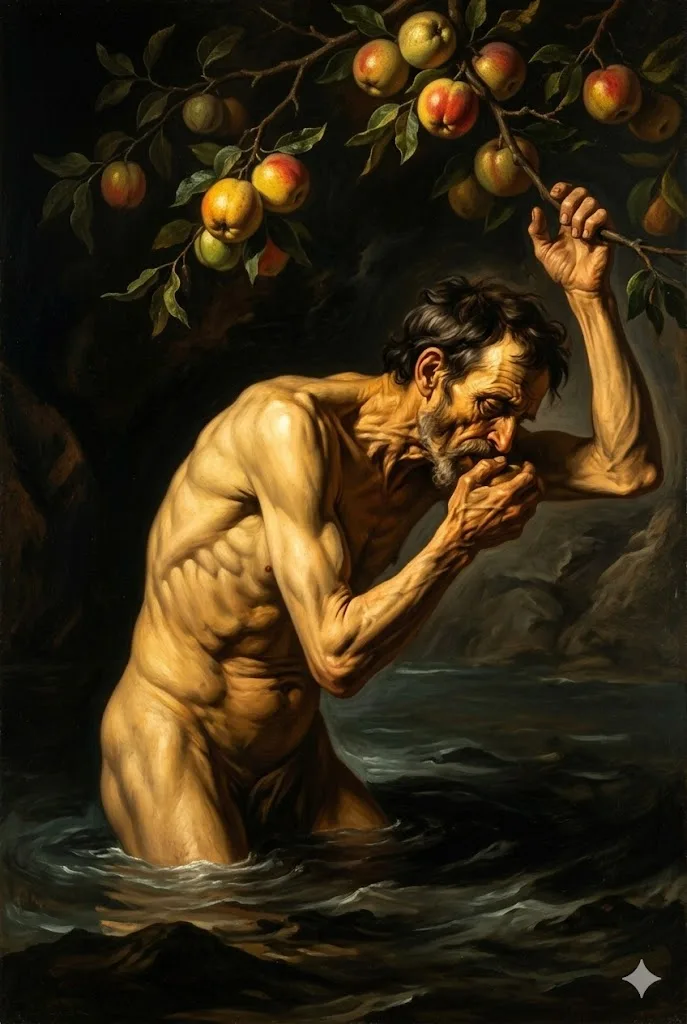
Favored by the Gods
Tantalus was a son of Zeus and the nymph Plouto, which made him a demigod king of extraordinary privilege. He was one of the few mortals invited to dine at the table of the gods on Mount Olympus, where he ate ambrosia and drank nectar alongside the immortals.
But privilege bred arrogance, and Tantalus committed a series of crimes that escalated from theft to horror.
Three Crimes Against the Gods
First, Tantalus stole ambrosia and nectar from the gods' table and shared it with mortals, revealing divine secrets. Second, he stole a golden dog crafted by Hephaestus that guarded Zeus's temple in Crete.
But his third crime was unforgivable. To test whether the gods were truly omniscient, Tantalus killed his own son Pelops, butchered him, and served his flesh at a banquet for the Olympians. The gods immediately recognized the horrific meal and refused to eat — all except Demeter, who was distracted by grief over Persephone and accidentally consumed Pelops's shoulder.
The gods restored Pelops to life, replacing the eaten shoulder with one made of ivory. Then they turned their full wrath on Tantalus.
Eternal Punishment
Tantalus was cast into Tartarus and given one of mythology's most memorable punishments. He was made to stand in a pool of clear water beneath branches heavy with ripe fruit. Whenever he bent to drink, the water receded. Whenever he reached for fruit, the branches lifted just beyond his grasp.
He stood in eternal hunger and thirst, surrounded by abundance he could never touch. This punishment gave us the English word tantalize — to torment someone by showing them something desirable they cannot have.
The Curse of the House of Atreus
Tantalus's crime didn't end with his punishment. It launched a generational curse that plagued his descendants for centuries. His son Pelops won his bride Hippodamia through treachery and murder. Pelops's son Atreus suffered his own crimes, and Atreus's sons Agamemnon and Menelaus went on to suffer their own tragedies — the sacrifice of Iphigenia, the Trojan War, Clytemnestra's murder of Agamemnon.
The curse didn't end until Electra and Orestes took their vengeance and were finally absolved by Athena in Aeschylus's Oresteia.
Quick Facts
Domain: King of Sipylus (Lydia)
Parents: Zeus and Plouto
Children: Pelops, Niobe
Crime: Murdered and served his son to the gods
Punishment: Eternal hunger and thirst in Tartarus
Legacy: English word 'tantalize'; Curse of the House of Atreus
Pool or stone? Two punishments
The pool-and-fruit punishment comes from the Odyssey. In Book 11, Odysseus sees Tantalus standing in a lake up to his chin. Whenever he bends to drink, the water disappears and black earth shows at his feet. Above him hang pears, pomegranates, apples, figs and olives, and whenever he reaches for them a wind blows them up toward the clouds. Homer, typically, does not name the crime. A second, equally old tradition replaces or adds a huge stone hanging over his head, always about to fall, so that he lives in permanent terror. Pindar knows this version in Olympian 1. Euripides uses it in the opening lines of Orestes, where Electra describes Tantalus "fearing the rock that hangs over his head". Pausanias says Polygnotus' painting of the underworld at Delphi showed both torments together.
Pindar refuses the cannibal story
The most famous ancient discussion of Tantalus is an argument against the usual version. In Olympian 1, written for Hieron of Syracuse in 476 BC, Pindar says he will not call any god a cannibal. In his telling, Tantalus held a proper feast for the gods at Mount Sipylus. Poseidon, overcome by desire for young Pelops, carried him off to Olympus, just as Zeus later carried off Ganymede. When the boy went missing, a jealous neighbour invented the rumour that he had been chopped up, boiled and eaten. Pindar's Tantalus is punished for a different crime. He could not handle his good fortune and stole nectar and ambrosia, which had made him immortal, to share with his drinking companions. The gods' response was to send Pelops back down to mortal life, where he would win his bride in a chariot race.
The theft of the golden dog is also told in different ways. In some versions, such as the one Antoninus Liberalis preserves, it was Pandareus who stole the dog from Zeus' sanctuary in Crete and left it with Tantalus. Tantalus then swore a false oath to Hermes that he had never received it. His crime there is perjury, not theft. Euripides points to yet another fault, his "unbridled tongue": he gave away what the gods had said at their table. Most writers agree that his offence was abusing the intimacy of the divine table, whatever form it took.
Sipylus, Niobe, and the family curse
Tantalus was located in Lydia or Phrygia, around Mount Sipylus near modern Manisa in western Turkey. Pausanias, who seems to have come from that region, says he saw the tomb of Tantalus there and a lake named after him, and describes Niobe's "weeping rock" on the mountain. His mother was the nymph Plouto, "Wealth". Sources name his wife variously as Dione, Euryanassa or others. His children were Pelops, Niobe and Broteas. Niobe repeated her father's arrogance by boasting she was a better mother than Leto, and lost her children to Apollo and Artemis.
The family line runs through Pelops to his sons Atreus and Thyestes. It is their quarrel, including Atreus serving Thyestes his own children, that echoes Tantalus' banquet. The next generation, Atreus' sons Agamemnon and Menelaus, are the great-grandchildren of Tantalus. Pelops' own guilt came from the chariot race against Oenomaus. He bribed the charioteer Myrtilus to sabotage his master's chariot, then threw Myrtilus into the sea, and the dying man cursed the family. A second Tantalus appears later in the line: Euripides' Iphigenia at Aulis has Clytemnestra remind Agamemnon that he killed her first husband, a Tantalus, and her baby before taking her by force.
Pelops became the great hero of Olympia, with his own precinct beside the temple of Zeus. Pausanias reports that his famous ivory shoulder, or a shoulder-bone said to be his, was taken to Troy as one of the conditions for the city's fall, was lost in a shipwreck on the way home, and was later fished up by a man from Eretria.
A name in science and theatre
When the Swedish chemist Anders Gustaf Ekeberg isolated a new element in 1802, he named it tantalum because its oxide, placed in acid, could not absorb any of it, much like Tantalus with his water. When a related element was later found in the same ores, it was named niobium after his daughter. Seneca's tragedy Thyestes opens with the ghost of Tantalus, driven up from the underworld by a Fury to infect his grandsons' house with his own crimes. For the myth in brief, see the story of Tantalus.
Ancient sources
- Homer, Odyssey 11.582–592: the earliest description of the pool and the fruit trees that move away from him.
- Pindar, Olympian 1: rejects the cannibal feast, says Poseidon took Pelops, and names stolen nectar and ambrosia as the crime, with a stone hanging over his head.
- Euripides, Orestes 1–10: the hanging rock, and a crime of an "unbridled tongue".
- Pausanias, Description of Greece 2.22.3, 5.13.4–7 and 10.31.12: the tomb and lake at Sipylus, the relic of Pelops' shoulder, and Tantalus in Polygnotus' painting at Delphi.
- Antoninus Liberalis, Metamorphoses 36: Pandareus, the golden dog and Tantalus' false oath.
- Seneca, Thyestes: Tantalus' ghost summoned to curse the house of Atreus.
Frequently asked questions
Where does the word "tantalize" come from?
From Tantalus' punishment. Water and fruit always come close and then pull away, so to tantalize means to tease with something desirable that cannot be reached.
Did Tantalus really serve his son to the gods?
That is the most widespread version, told by Apollodorus, Ovid and Hyginus, among others. Pindar explicitly rejected it as a slander against the gods and gave a different crime.
How is Tantalus related to Agamemnon?
Tantalus was Agamemnon's great-grandfather. The line runs Tantalus, Pelops, Atreus, then Agamemnon and Menelaus. See also Orestes, who ends the curse.
What was Tantalus' punishment?
In Homer he stands in water he can never drink, under fruit he can never reach. Other poets add, or substitute, a rock hanging over his head that is always about to fall.