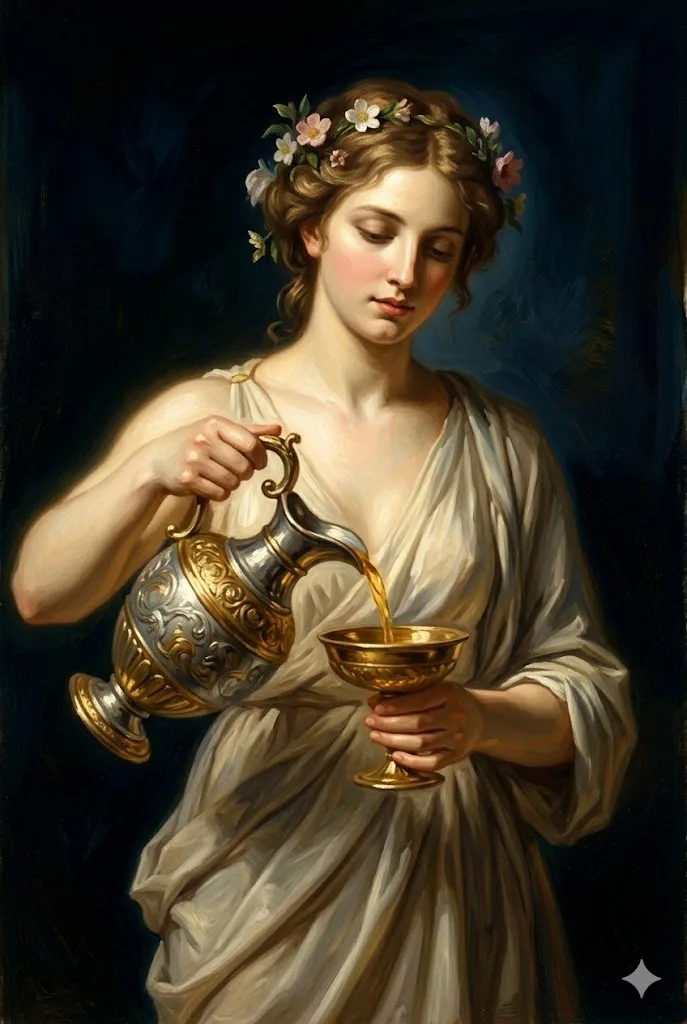
Cupbearer of the Gods
Hebe was the goddess of youth and the cupbearer of Mount Olympus, serving nectar and ambrosia to the gods at their feasts. She was the daughter of Zeus and Hera, and her very presence radiated the vitality and beauty of youth. Her name literally means 'Youth' in Greek, and she had the power to restore youth to the aged, a gift that made her one of the most symbolically important deities on Olympus.
Wife of Heracles
Hebe's most significant mythological role came after the death and apotheosis of Heracles. When the greatest hero in Greek mythology died in agony from the poisoned shirt of Nessus and was carried to Olympus by Zeus, he was granted immortality and reconciled with Hera at last. As a final blessing, he was given Hebe as his wife. The marriage was deeply symbolic: the hero who had endured more suffering than any mortal was rewarded with eternal youth and the end of all pain. Heracles and Hebe had two sons, and their union represented the ultimate reward for a life of extraordinary service.
Replaced by Ganymede
According to some traditions, Hebe lost her position as cupbearer when she stumbled and fell during a feast, exposing herself in an undignified manner. Zeus then replaced her with Ganymede, a beautiful Trojan prince whom he abducted in the form of an eagle. This story was controversial even in antiquity, and many versions omit it entirely. Hebe remained an honoured goddess regardless, worshipped at sanctuaries in Phlius and Sicyon where she was associated with the forgiveness of sins and the release of prisoners.
Classical Sources
- 📜 Homer, Iliad & Odyssey (c. 750 BC)
- 📜 Hesiod, Theogony (c. 700 BC)
- 📜 Apollodorus, Bibliotheca (c. 1st-2nd century AD)
- 📜 Ovid, Metamorphoses (8 AD)
Cross-referenced with multiple classical sources for accuracy.