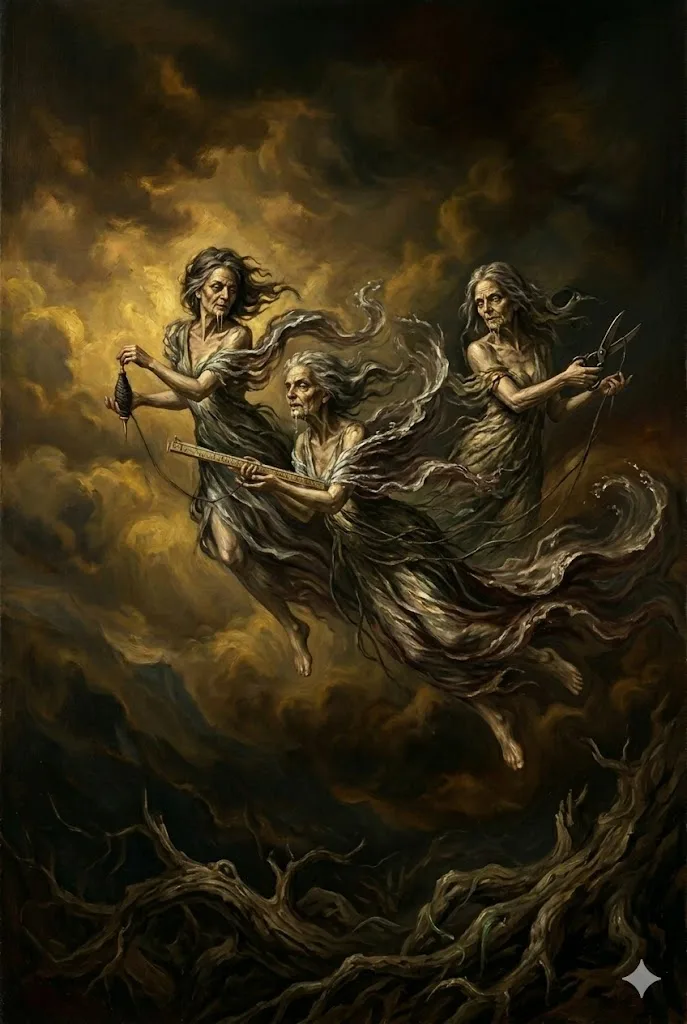
The Three Sisters
The Moirai, known in English as the Fates, were three sisters who controlled the destiny of every living being, mortal and immortal alike. They were among the most powerful forces in the Greek cosmos, and their authority was absolute. Not even Zeus could overrule their decisions. They spun, measured, and cut the thread of every life, and once the thread was cut, nothing in heaven or earth could undo it.
The three Fates were: Clotho ('The Spinner'), who spun the thread of life on her spindle, determining the moment of birth. Lachesis ('The Allotter'), who measured the thread with her rod, determining the length and nature of each life. And Atropos ('The Inflexible'), who cut the thread with her shears, determining the moment and manner of death. Atropos was the most feared of the three, because her cut was final and irreversible.
Children of Nyx or Zeus?
The parentage of the Fates is one of the great contradictions in Greek mythology and a frequent topic of debate among enthusiasts. Hesiod provides two different accounts in the same poem. In one passage of the Theogony, the Fates are daughters of Nyx (Night), born without a father alongside other primordial forces like Death, Sleep, and the Furies. In another passage, they are daughters of Zeus and the Titan goddess Themis (Divine Law), sisters of the Horae (Seasons). The Nyx version makes them older and more primordial, placing them beyond the authority of the Olympians. The Zeus version brings them within the Olympian family structure but doesn't diminish their power.
Most modern Hellenists and scholars who prefer mythological consistency favour the Nyx origin. The Fates feel like they belong among the primordial forces of the cosmos, alongside Death, Sleep, and the Furies, rather than as daughters of Zeus. Their power over destiny is older and more fundamental than Zeus's kingship, and placing them as his daughters creates a paradox: how can Zeus be subject to the authority of his own children?
Power Over the Gods
The most extraordinary thing about the Fates is that their power extended over the gods themselves. In the Iliad, Zeus weighs the fates of Achilles and Hector on golden scales, but he does not choose the outcome. He merely reveals what the Fates have already determined. When his own son Sarpedon is fated to die at Troy, Zeus considers saving him but is warned by Hera that defying Fate would unravel the cosmic order itself. Even the king of the gods submits.
This raises profound philosophical questions that the ancient Greeks found endlessly fascinating. If the Fates predetermine everything, do the gods have free will? Do mortals? The Greeks never fully resolved this tension, and their mythology is richer for it. The coexistence of fate and free will, divine power and cosmic necessity, gives Greek mythology a philosophical depth that simple good-vs-evil narratives lack.
The Thread of Life
The image of the Fates spinning, measuring, and cutting the thread of life is one of the most enduring metaphors in Western civilization. It appears in Shakespeare, Milton, Dante, and countless other works. The English expressions 'the thread of life,' 'hanging by a thread,' 'cutting the thread,' and 'spinning a tale' all derive from the mythology of the Moirai. The concept has parallels in nearly every world mythology, from the Norse Norns to the Hindu concept of karma, suggesting that the idea of a predetermined destiny woven into the fabric of existence is a near-universal human intuition.
Classical Sources
- 📜 Homer, Iliad & Odyssey (c. 750 BC)
- 📜 Hesiod, Theogony (c. 700 BC)
- 📜 Apollodorus, Bibliotheca (c. 1st-2nd century AD)
- 📜 Ovid, Metamorphoses (8 AD)
Cross-referenced with multiple classical sources for accuracy.
Explore More
Nyx · Zeus · Themis · The Furies · Home
From One Moira to Three Sisters
The three named spinners are not where the idea started. In Homer, moira is usually singular and often closer to an abstract "portion" or "lot" than to a person. A hero dies when his moira overtakes him, and the word can also mean a share of meat at a feast. The plural Moirai appear only once in the Iliad, when Apollo says the Moirai have given mortals an enduring heart. The Odyssey refers to the Klōthes, "Spinners," who spin out at birth what a man must suffer. Hesiod is the first to give three names, Clotho, Lachesis and Atropos, and the image of the thread grows out of the ordinary women's work of spinning wool.
Plato gives the sisters a new role in the Myth of Er at the end of the Republic. There they are daughters of Ananke (Necessity), dressed in white and seated around the great spindle that turns the cosmos, singing with the Sirens who sit on its whorls. Lachesis sings of the past, Clotho of the present and Atropos of the future. Souls about to be reborn receive their lots from Lachesis, choose their next lives, and have the choice confirmed by Clotho and made irreversible by Atropos. In Plato, destiny is partly something the soul chooses for itself, which answers the free-will question raised above more directly than any myth does.
When the Fates Could Be Tricked, or Fought
For all their inflexibility, the Fates appear in a few memorable myths. Apollo wanted to save his friend Admetus from an early death, so he made the Moirai drunk and persuaded them to accept a substitute. Admetus could live if someone died in his place, and only his wife Alcestis agreed. In Aeschylus' Eumenides, the Furies angrily remind Apollo of this trick as an example of his disrespect for ancient powers. Euripides' Alcestis also refers to it.
At the birth of Meleager, the Moirai visited his mother Althaea and declared that the baby would live only as long as a log burning in the hearth. Althaea snatched it from the fire and hid it. Years later, after Meleager killed her brothers, she threw it back into the flames, and he died as it burned away. Ovid tells this story at length, calling the sisters the Parcae. Apollodorus gives the Fates two more active roles. In the battle against the Giants they fought with bronze clubs and killed Agrius and Thoas. When Typhon attacked the gods, they tricked him into eating "ephemeral fruits," promising they would strengthen him, which weakened him before Zeus' final victory. See the Gigantomachy.
Worship and Sanctuaries
The Moirai received real cult, often alongside Zeus. At Delphi, Pausanias saw an altar of Poseidon and statues of two Moirai in the temple, with Zeus and Apollo standing beside them under the title Moiragetes, "Leader of the Fates." He also mentions an altar of Zeus Moiragetes at Olympia. At Sicyon there was a grove and sanctuary of the Eumenides with an altar of the Moirai in the open air, honoured with the same kind of offerings as the Furies. At Corinth the Moirai had a shrine near those of Demeter and Kore, and at Sparta a sanctuary of the Moirai stood near the tomb of Orestes. The Fates were also linked to marriage and birth, which explains their presence in the wedding poetry of Catullus. In his poem 64 the three Parcae, white-haired and robed, spin at the wedding of Peleus and Thetis while singing the future of Achilles.
In Art, and Some Common Confusions
The Moirai fight among the gods on the great Gigantomachy frieze of the Pergamon Altar, and they appear in the wedding procession of Peleus and Thetis on the François Vase. Greek images usually give them a spindle, a scroll or a sceptre. The shears that Atropos holds in most modern images became standard in post-classical European art. The three seated goddesses from the east pediment of the Parthenon, long called "the Three Fates," are now usually identified as other deities, probably including Aphrodite.
Two other confusions come up often. The three women who share one eye in Disney's Hercules combine the Fates with the Graeae, the grey sisters whom Perseus robbed of their eye and tooth. And the Fates are not the Furies, although Hesiod's Nyx genealogy makes them siblings. The Moirai assign a person's lot, while the Erinyes punish those who violate it. The Romans called them Nona, Decima and Morta.
Ancient sources
- Hesiod, Theogony 217–222 and 904–906: the Moirai as daughters of Nyx and, later in the poem, of Zeus and Themis, with their three names.
- Homer, Iliad 24.49; Odyssey 7.196–198: the plural Moirai and the "Spinners" who spin a man's lot at birth.
- Plato, Republic 10.617b–621: the daughters of Necessity at the spindle of the cosmos in the Myth of Er.
- Aeschylus, Eumenides: the Furies accuse Apollo of making the Fates drunk to save Admetus.
- Apollodorus, Library 1.6.2–3 and 1.8.2: the Fates in the war with the Giants and Typhon, and at the birth of Meleager.
- Pausanias, Description of Greece 2.11.4 and 10.24.4: the Moirai's altar at Sicyon and their statues with Zeus Moiragetes at Delphi.
Frequently asked questions
Could the Fates be fooled?
Once, famously. Apollo got them drunk to win a reprieve for Admetus. They still required a life in exchange, though, so even then their terms held.
What are the Fates called in Roman mythology?
The Parcae: Nona, Decima and Morta, originally connected with birth and its timing. They were later identified with Clotho, Lachesis and Atropos.
Were the Fates worshipped?
Yes. They had altars and sanctuaries at Sicyon, Corinth, Sparta and Delphi, often linked with Zeus Moiragetes, "Leader of the Fates."
Are the Fates the same as the Graeae in Disney's Hercules?
No. Disney gave the Fates the Graeae's single shared eye. In myth the Graeae are a different set of sisters, encountered by Perseus.
Books to read next
- Stephen Fry, Mythos
- Edith Hamilton, Mythology
- Apollodorus, The Library of Greek Mythology (Oxford World's Classics)
Links go to Bookshop.org, which supports independent bookstores. We earn a small commission if you buy, at no extra cost to you.