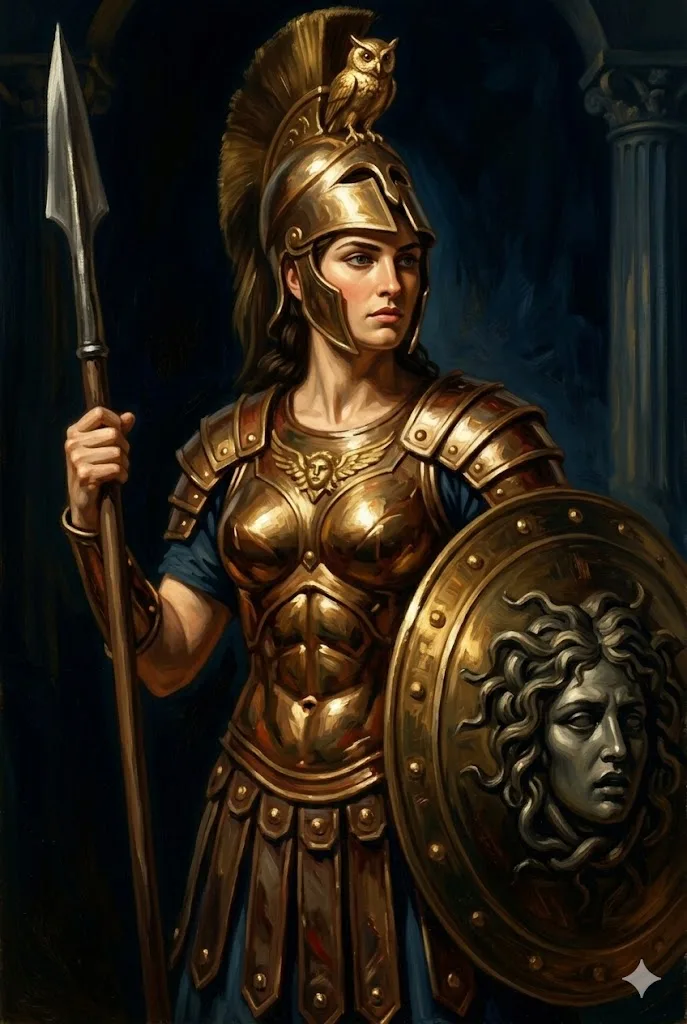
I. Who Was Athena?
Athena was the goddess of wisdom, courage, strategic warfare, mathematics, arts, and crafts — and arguably the most respected deity in the Greek pantheon after her father Zeus. While Ares represented the brutal, chaotic violence of battle, Athena embodied the intellectual and strategic side of war: the battle plan, the formation, the discipline that won campaigns. She was the goddess generals prayed to before a siege, and the patron of skilled artisans, weavers, and potters.
She was one of three virgin goddesses of Olympus (alongside Artemis and Hestia), having sworn to never marry or take a lover. This chastity was central to her identity — she channeled all her energy into wisdom, craft, and the protection of her chosen heroes. Odysseus, Perseus, Heracles, and Jason all received her divine guidance at critical moments in their quests, making her the patron goddess of Greek heroism itself.
The city of Athens, the cradle of Western civilization, bore her name. The Parthenon — one of the most iconic structures ever built — was her temple. The owl, symbol of wisdom to this day, was her sacred animal. In nearly every way, Athena was the goddess of civilization: of the arts and sciences that elevated humanity above barbarism.
II. A Birth Like No Other
Athena's birth is one of the most extraordinary events in all of mythology. Zeus had an affair with the Titaness Metis, goddess of wisdom and cunning. When a prophecy warned that Metis would bear a son who would overthrow Zeus (echoing the same pattern that had toppled Uranus and Cronus before him), Zeus swallowed Metis whole — just as his father Cronus had swallowed his own children.
But Metis was already pregnant. Inside Zeus, she began crafting armor and weapons for her unborn daughter. The hammering caused Zeus an unbearable headache that grew worse and worse until he could no longer stand it. He called upon Hephaestus (or Prometheus, in some versions) to split his skull open with an axe. From the wound, Athena sprang forth fully grown and fully armored — wearing a gleaming helmet, wielding a spear, and letting out a war cry so powerful it shook the heavens.
This miraculous birth gave Athena a unique status among the gods. Born from Zeus alone (her mother having been absorbed into him), she was considered his truest child — the embodiment of his intelligence. Zeus trusted her above all other gods, and she alone was permitted to wield his aegis, the divine shield that could scatter armies in terror.
III. Powers & Attributes
Athena's greatest weapon was her intellect. She was the supreme strategist, capable of devising plans that turned impossible odds into decisive victories. In the Trojan War, it was Athena who inspired Odysseus to conceive the Trojan Horse — the cunning stratagem that ended a decade of warfare in a single night.
In combat, she was nearly unbeatable. She wore the aegis — a goatskin shield or breastplate fringed with serpents and bearing the head of the Gorgon Medusa (a trophy from her protégé Perseus). The sight of it filled enemies with paralyzing dread. Her other symbols included the olive tree (her gift to Athens), the owl (representing wisdom and vigilance in darkness), the spear, and the distaff (representing her mastery of weaving).
IV. Athena & Athens
The founding myth of Athens centers on a contest between Athena and Poseidon for patronage of the city. Zeus decreed that each god should offer a gift to the citizens, who would then choose their patron. Poseidon struck the Acropolis with his trident and produced either a saltwater spring or a horse. Athena planted an olive tree — a source of food, oil, and wood that would sustain the city for generations.
The citizens (or, in some versions, the other gods) chose Athena's gift, and the city was named Athens in her honor. The olive tree became the symbol of peace and prosperity throughout the Greek world, and the rocky hill of the Acropolis became the site of Athena's greatest temple. Poseidon, enraged by the rejection, flooded the plain surrounding Athens, but eventually the rivalry settled into an uneasy coexistence.
V. Major Myths
Athena and Arachne
In the version told by the Roman poet Ovid, the mortal weaver Arachne boasted that her skill surpassed even Athena's. The goddess, disguised as an old woman, warned Arachne to show humility, but the weaver persisted. Athena revealed herself and challenged Arachne to a weaving contest. Athena's tapestry depicted the gods in their glory; Arachne's depicted the gods' misdeeds and transgressions. Though Arachne's work was flawless, her disrespect enraged Athena, who tore the tapestry apart and struck Arachne with her shuttle. Overcome with shame, Arachne hanged herself. Athena took pity and transformed her into a spider — doomed to weave for eternity. The word "arachnid" derives from her name.
Athena and Medusa
In one of the darker myths associated with Athena, mainly known from Ovid's version, the beautiful maiden Medusa was violated by Poseidon in Athena's temple. Athena, outraged at the desecration of her sacred space, punished Medusa by transforming her into a Gorgon — a monster with snakes for hair whose gaze turned men to stone. Later, Athena guided the hero Perseus in his quest to slay Medusa, and after the deed was done, she mounted Medusa's severed head on her aegis as a weapon of terror.
The Judgment of Paris
Athena was one of three goddesses (alongside Hera and Aphrodite) who competed for the golden apple inscribed "To the Fairest." Each goddess attempted to bribe the Trojan prince Paris: Hera offered power, Athena offered wisdom and military glory, and Aphrodite offered the most beautiful woman in the world. Paris chose Aphrodite, earning Athena's eternal enmity toward Troy — and ensuring that the goddess would fight relentlessly on the Greek side throughout the Trojan War.
"Of Pallas Athena, guardian of the city, I begin to sing. Dread is she, and with Ares she loves the deeds of war, the sack of cities, and the shouting and the battle." — Homeric Hymn to Athena (paraphrased)
VI. Worship & the Parthenon
The Parthenon, built between 447 and 432 BC under the direction of the statesman Pericles, was the crowning jewel of Athena's worship. Inside stood a massive chryselephantine (gold and ivory) statue of Athena Parthenos, crafted by the sculptor Phidias, standing roughly 40 feet tall. The festival of the Panathenaea, held every four years, was the most important civic and religious celebration in Athens, featuring athletic competitions, musical contests, and a grand procession to the Acropolis to present Athena with a new woven garment.
Her Roman counterpart Minerva was equally revered, and Athena's influence on Western culture is immeasurable. The owl of Athena appeared on Athenian coins and remains a symbol of wisdom worldwide. The concept of "wisdom in war" — of brain over brawn — is her enduring legacy in philosophy, politics, and military strategy.
Athena in the Iliad and Odyssey
Athena is arguably the most active deity in Homer's two great epics. In the Iliad, she is a fierce partisan of the Greeks, directly intervening in battle to aid her favourites. She guides Diomedes's spear, deflects arrows aimed at Menelaus, and engineers the death of Hector by appearing to him disguised as his brother Deiphobus, tricking him into standing and fighting Achilles rather than fleeing. Athena's warfare is never mindless — she fights with strategy, deception, and precise timing, embodying the Greek ideal of intelligent combat.
In the Odyssey, Athena is Odysseus's constant protector and the architect of his ultimate triumph. She disguises him as a beggar, counsels his son Telemachus, and orchestrates the final confrontation with the suitors. The relationship between Athena and Odysseus is one of the most compelling in Greek mythology — a partnership based on mutual respect for intelligence, cunning, and strategic thinking. Athena loves Odysseus not for his physical strength (that was Achilles' domain) but for his mind, which mirrors her own.
The Parthenon and Athenian Worship
Athena's worship reached its pinnacle in Athens, the city that bore her name. The Parthenon — her great temple on the Acropolis, completed in 432 BC — is the most iconic building of Western civilization. Designed by the architects Ictinus and Callicrates under the supervision of the sculptor Pheidias, the Parthenon was both a temple and a statement of Athenian power and cultural supremacy. Inside stood Pheidias's chryselephantine (gold and ivory) statue of Athena Parthenos, standing nearly 12 metres tall, holding a figure of Nike (Victory) in one outstretched hand and resting the other on a great shield.
The Panathenaic Festival, held every four years in Athena's honour, was the greatest celebration in the Athenian calendar. Citizens processed from the city gates to the Acropolis carrying a new peplos (robe) woven by the women of Athens to drape over the ancient wooden cult statue of Athena Polias. The frieze of the Parthenon — much of which is now in the British Museum — depicts this procession and remains one of the masterpieces of ancient sculpture.
Athena and the Invention of Civilization
More than any other Greek deity, Athena was associated with the practical skills that made civilized life possible. She invented the bridle, allowing humans to tame horses. She created the flute (though she discarded it when she saw it distorted her face while playing). She taught women the art of weaving, which in the ancient world was one of the most important domestic industries. She guided shipbuilders, potters, metalworkers, and craftsmen of every kind. The olive tree — her gift to Athens — provided not only food but lamp oil (for light), soap (for hygiene), and a trade commodity that made Athens wealthy.
Athena's association with practical wisdom distinguishes her from other "wisdom" figures in world mythology. She is not a contemplative philosopher but an active problem-solver — a goddess who rolls up her sleeves and gets things done. This pragmatic, applied intelligence was what the Greeks valued most, and it explains why Athena was worshipped not only in temples but in workshops, shipyards, and battlefields across the Greek world.
VII. Quick Facts
Epithets and local cults beyond the Parthenon
Athens was the most famous centre of Athena's worship, but it was only one of many. Her epithets show how many different jobs the Greeks gave her. As Athena Polias ("of the city") she was the guardian of the community, and it was this aspect, not the Parthenos of the great gold-and-ivory statue, that received the woven peplos at the Panathenaea. The peplos was laid on an old olivewood image which Athenians said had fallen from the sky. As Athena Ergane ("the worker") she oversaw spinning, weaving and handicraft. As Promachos ("who fights in front") she stood in colossal bronze on the Acropolis, a work Pausanias attributes to Pheidias. Sailors said the gleam of her spear-tip and helmet could be seen from out at sea off Sounion. She was also worshipped as Athena Nike in the small Ionic temple at the entrance to the Acropolis, and as Hygieia (health).
Outside Attica, worshippers at Delphi met Athena Pronaia ("before the temple") in the sanctuary below Apollo's, where the round tholos still stands. At Tegea in Arcadia she was Athena Alea, whose temple was rebuilt in the fourth century BC with sculpture associated with Skopas. At Corinth she was Chalinitis, "of the bridle", because she gave Bellerophon the golden bridle that tamed Pegasus. Sparta honoured her as Chalkioikos, "of the bronze house", after the bronze-plated temple on its acropolis.
Lesser-known myths
Erichthonius. One of the strangest Athenian stories explains how a virgin goddess came to be the "mother" of an Athenian king. Apollodorus says Hephaestus tried to force himself on Athena. She escaped, but his seed fell on her thigh. She wiped it away with wool and threw it to the ground, and Earth gave birth to Erichthonius. Athena hid the baby in a chest and gave it to the daughters of Cecrops, telling them not to open it. In most versions they opened it anyway, saw a child guarded by a serpent (or a child who was part serpent), and threw themselves from the Acropolis. Euripides' Ion builds its plot on this ancestry, which the Athenians used to support their claim that they were "born from the soil".
Pallas. The name "Pallas Athena" has rival explanations. Apollodorus says Athena was raised by Triton and accidentally killed his daughter Pallas, her companion, during a mock fight. In grief she made a wooden image of the girl, the Palladium, which later protected Troy. In his account of the Gigantomachy, Apollodorus also has Athena flay a Giant named Pallas and use his skin as armour, and bury Enceladus under Sicily.
Tiresias. In Callimachus' fifth hymn, The Bath of Pallas, the young Tiresias accidentally sees Athena bathing and is blinded. His mother Chariclo was one of the goddess's companions. Athena could not undo the blindness, so she gave him prophetic sight and a long life instead. This is a different story from Ovid's, where Hera blinds Tiresias.
The court of the Areopagus. In Aeschylus' Eumenides, Athena founds the first homicide court to try Orestes for killing his mother. She casts the deciding vote for acquittal, saying she favours the male side because she had no mother. She then persuades the Furies to accept a new home and new honours in Athens. For Athenian audiences this was the founding myth of civic justice.
What gets misremembered
The story of Medusa being violated in Athena's temple and then punished comes mainly from Ovid (Metamorphoses 4). Hesiod knows Medusa as one of three Gorgon sisters, a mortal one, and says nothing about her being a priestess or a transformed beauty. The Arachne story is also essentially Ovid's (Metamorphoses 6), so it is a Roman poet's narrative, not an archaic Greek myth. Ancient accounts of the birth also disagree about who split Zeus's head. Pindar's seventh Olympian names Hephaestus with a bronze axe, while other writers, Euripides in the Ion among them, give the job to Prometheus. Finally, the owl was linked mostly with Athens and its coinage. Athena does not have one fixed animal across all of Greece.
In art, the best-known images of the Athena Parthenos are small Roman-period copies such as the Varvakeion statuette in Athens. Pheidias' original disappeared in antiquity. The "Mourning Athena" relief in the Acropolis Museum shows her as a quiet, helmeted figure leaning on her spear, a sober counterweight to the armed Promachos type. For the full contest over the city, see Poseidon vs Athena. For the birth story, see the birth of Athena.
Ancient sources
- Hesiod, Theogony 886–900, 924–926: Zeus swallows Metis on the advice of Gaia and Ouranos, and Athena is born from his head.
- Homeric Hymn 28 (To Athena): describes her leaping armed from Zeus's head while Olympus shook and the sea heaved.
- Aeschylus, Eumenides: Athena founds the Areopagus court and casts her vote for Orestes.
- Callimachus, Hymn 5 (The Bath of Pallas): the blinding of Tiresias and his gift of prophecy.
- Ovid, Metamorphoses 6.1–145: the weaving contest with Arachne.
- Apollodorus, Bibliotheca 3.12 and 3.14: the Palladium and the death of Pallas, the birth of Erichthonius, and the contest with Poseidon.
Frequently asked questions
Why is Athena called Pallas Athena?
Ancient writers give competing explanations. In Apollodorus' version she took the name in memory of Pallas, a childhood companion she killed by accident. Another version says it came from a Giant named Pallas whom she defeated. Modern scholars link the name to words meaning "maiden" or "brandisher (of a spear)", but the origin is uncertain.
Did Athena have any children?
No. She was a virgin goddess. The nearest thing is Erichthonius, born from the earth after Hephaestus' failed assault. Athena raised him and the Athenians treated him as her foster-son.
Was Athena the goddess of war or Ares?
Both, in different ways. Athena stood for disciplined, strategic warfare and the defence of the city. Ares stood for the raw violence of combat. In the Iliad she beats him in open battle. See Athena vs Ares.
Who split Zeus's head to release Athena?
Most often Hephaestus, as in Pindar. Some authors name Prometheus instead, and a few vase paintings show other gods attending the birth.
Explore More Mythology
Get weekly deep dives into the gods, heroes, and myths of ancient Greece.