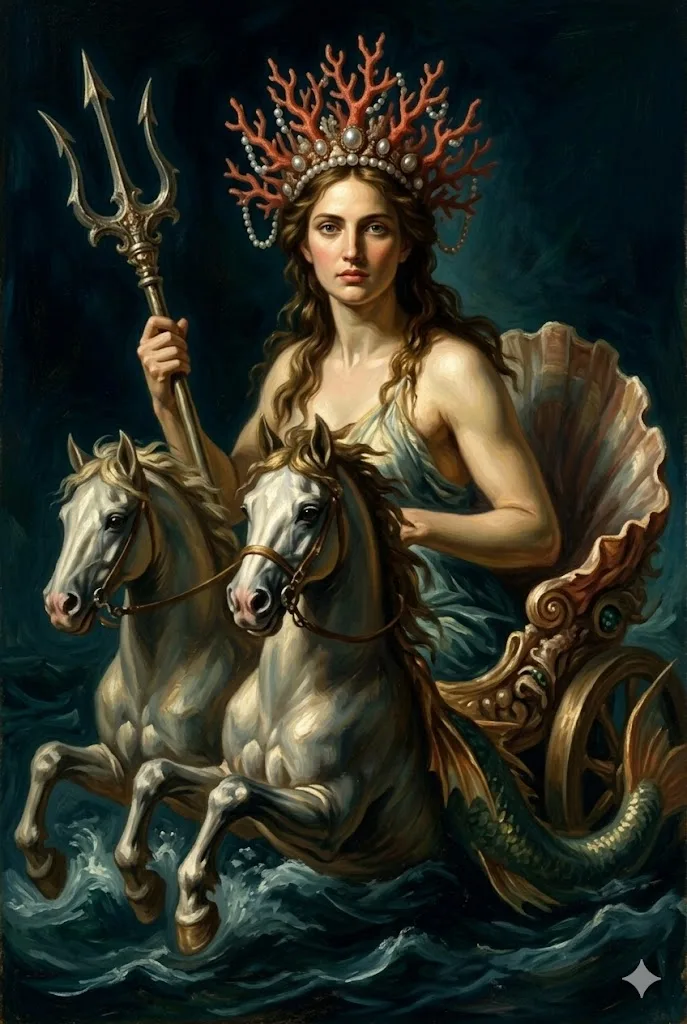
Queen of the Ocean
Amphitrite was one of fifty Nereids — sea nymphs born to the old sea god Nereus — but her destiny set her apart from her sisters. She became the queen of all the oceans as the wife of Poseidon, ruling beside him in a magnificent golden palace beneath the waves.
Unlike many divine consorts in Greek mythology, Amphitrite wielded genuine authority over the seas. She commanded sea creatures, calmed storms, and was honored by sailors who prayed to her alongside Poseidon for safe voyages.
The Reluctant Bride
Amphitrite did not go willingly to Poseidon. When the god of the sea first saw her dancing with her Nereid sisters near the island of Naxos, he was captivated. But when he approached her with his proposal, Amphitrite fled to the farthest reaches of the ocean, hiding near the Atlas Mountains.
Poseidon sent a dolphin named Delphinus to find her and plead his case. The clever dolphin spoke so eloquently of Poseidon's devotion that Amphitrite agreed to return. In gratitude, Poseidon placed the dolphin among the stars as the constellation Delphinus.
Powers and Domain
As queen, Amphitrite controlled the oceans in ways complementary to Poseidon. While he commanded storms and earthquakes, she governed the sea's calmer aspects — its creatures, tides, and the abundant life within it. Artists depicted her riding a chariot pulled by seahorses or hippocamps, often accompanied by dolphins and Tritons.
Her son Triton, the merman herald of the deep, inherited power from both parents, blowing his conch shell to calm or raise the waves at their command.
Amphitrite's Jealousy
Like Hera with Zeus, Amphitrite had to endure Poseidon's many affairs. Her most notable act of revenge was against the beautiful maiden Scylla. When Poseidon showed interest in Scylla, Amphitrite poisoned her bathing pool with magical herbs, transforming the girl into the terrifying six-headed sea monster that terrorized sailors in the Strait of Messina.
Quick Facts
Domain: The Sea, Marine Life
Parents: Nereus and Doris
Consort: Poseidon
Children: Triton, Rhode, Benthesicyme
Symbols: Trident, dolphins, seahorses, crab claw crown
Roman Name: Salacia
From the roaring sea to a sea queen
In Homer, Amphitrite is barely a person. The Odyssey uses her name almost as a poetic word for the sea itself. "Loud-moaning Amphitrite" breeds monsters in her depths, sends great waves, and keeps countless sea creatures. She is never called Poseidon's wife there. Hesiod gives her a clearer identity. In the Theogony she is one of the fifty daughters of Nereus and Doris, and later in the poem she and the loud-roaring Earth-shaker are the parents of Triton, who lives in a golden house in the depths with his parents. By the Classical period her role as Poseidon's queen was settled, and painters regularly showed her beside him.
Her lineage was never completely fixed. Apollodorus names an Amphitrite among the daughters of Oceanus as well as among the Nereids. That may be simple duplication, but it shows the mythographers sorting through local traditions. The meaning of her name is uncertain. Ancient and modern guesses connect amphi-, "around", with the sea surrounding the land, but no explanation has won agreement.
Amphitrite and Theseus
The most memorable story about her is not her own courtship but her welcome of Theseus. In Bacchylides' Ode 17, Minos challenges Theseus during the voyage to Crete to prove he is Poseidon's son by fetching a gold ring thrown into the sea. Theseus dives in, and dolphins carry him to his father's palace. There he sees the Nereids dancing, and Amphitrite, "ox-eyed" and majestic, wraps him in a purple robe and sets a wreath on his hair. He comes back up dry, to the astonishment of the Cretans. An Attic red-figure cup of about 500 BC, signed by Euphronios as potter and now in the Louvre, shows the scene: the young Theseus, held up by Triton, standing before an enthroned Amphitrite.
Pausanias describes a painting of the same episode in the Theseion at Athens, in which Theseus returns with the ring and a gold crown given to him by Amphitrite. Some ancient explanations of the constellation Corona Borealis link a crown from the sea with Ariadne. The more common explanation, covered on Ariadne's page, is that the crown was Dionysus's wedding gift.
Courtship, children and rivals
The story of Amphitrite running away from Poseidon and being won back by a dolphin is late. It survives mainly in the astronomical handbooks of Pseudo-Eratosthenes and Hyginus, which use it to explain the constellation Delphinus. Earlier writers simply assume the marriage. Besides Triton, Apollodorus names two daughters. One is Rhode, the nymph of Rhodes, although Pindar and others make Rhodos a daughter of Aphrodite. The other is Benthesicyme, who brought up Poseidon's son Eumolpus in Ethiopia, the Eumolpus later linked with the Eleusinian priesthood.
Her jealousy of Scylla is reported by late sources and ancient commentators. It is not the only version. In Ovid's Metamorphoses it is Circe who poisons the pool, out of jealousy over the sea god Glaucus, and Poseidon plays no part. Readers who meet both stories should know they are rival accounts, not one combined tale.
Worship and images
Amphitrite had little cult of her own, but she was often honoured alongside Poseidon. At the Isthmian sanctuary near Corinth, Pausanias saw a lavish group dedicated by Herodes Atticus: Poseidon and Amphitrite standing in a chariot, with the boy Palaemon on a dolphin, Tritons and horses with human-like hind parts. On the Cycladic island of Tenos the main sanctuary belonged to Poseidon and Amphitrite together, and inscriptions name both. In vase painting and Roman mosaics she rides a sea creature or shares Poseidon's chariot, holds a sceptre, and sometimes wears a headdress of crab claws, a detail that becomes common in Roman art. Her Roman counterpart, Salacia, was a minor deity with a small cult, which is why Amphitrite is less known than most Olympian consorts.
Ancient sources
- Homer, Odyssey 5, 12: uses "Amphitrite" for the sea itself, the "loud-moaning" mother of sea monsters and great waves.
- Hesiod, Theogony 243, 930–933: lists her among the Nereids, then names her and Poseidon as parents of Triton.
- Bacchylides, Ode 17: Theseus dives to Poseidon's palace, where Amphitrite gives him a purple robe and a wreath.
- Apollodorus, Library 1.2, 1.4.6, 3.15.4: lists her among Oceanids and Nereids, and names Triton, Rhode and Benthesicyme as her children by Poseidon.
- Hyginus, Astronomica 2.17: the dolphin that persuaded Amphitrite to marry Poseidon and was set among the stars.
- Pausanias, Description of Greece 1.17.3; 2.1.7–8: the Theseion painting of Theseus returning with Amphitrite's crown, and the Poseidon and Amphitrite group at the Isthmian sanctuary.
Frequently asked questions
Was Amphitrite a goddess or a nymph?
Both. By birth she was a Nereid, a sea nymph, but as Poseidon's wife she ranked as queen of the sea, and Homer treats her name almost as the sea itself.
Is Amphitrite the mother of all of Poseidon's children?
No. Most of Poseidon's offspring, including Theseus, Polyphemus and Pegasus, had other mothers. Her own children are Triton, Rhode and Benthesicyme. See children of Poseidon for the full list.
How is Amphitrite related to Thetis?
They were sisters, both daughters of Nereus and Doris. Thetis married the mortal Peleus while Amphitrite married Poseidon.
What is Amphitrite's Roman name?
Salacia, a minor Roman sea goddess paired with Neptune. Roman writers and artists usually simply took over Amphitrite's Greek image.