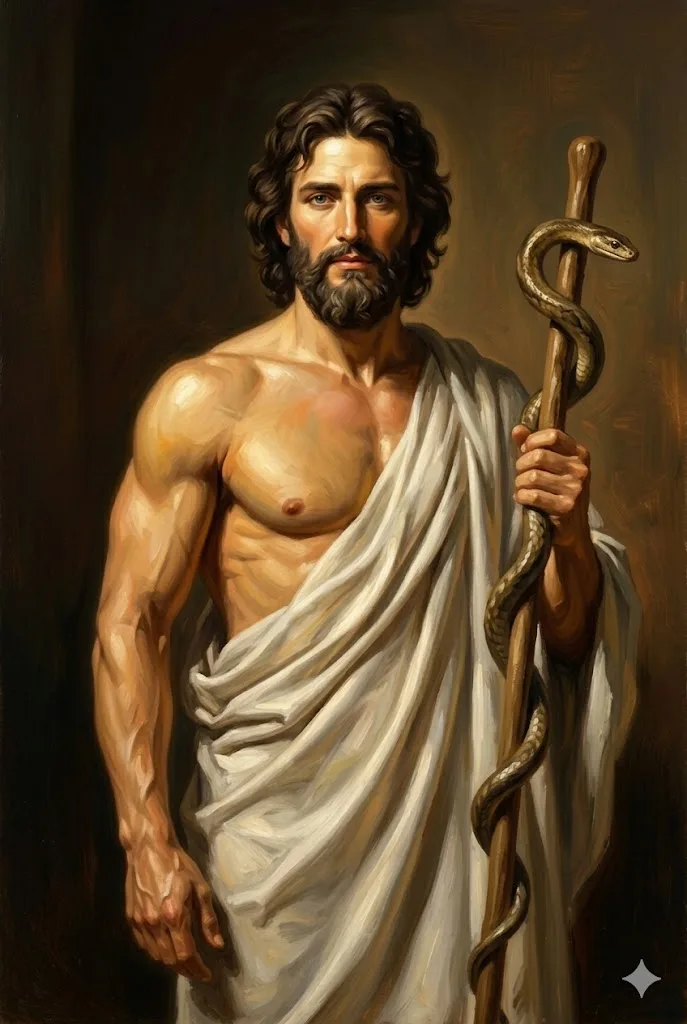
The Divine Physician
Asclepius was the Greek god of medicine, healing, and physicians. Son of Apollo and the mortal princess Coronis, he was raised and educated by the centaur Chiron, the wisest of all beings, who taught him the art of medicine. Asclepius surpassed even his teacher, becoming so skilled that he could not only cure any disease but eventually learned to raise the dead. This ultimate transgression of the natural order led to his destruction by Zeus, but his legacy as the patron of healing endured for millennia.
Birth and Training
Asclepius's birth was marked by tragedy. When Apollo discovered that Coronis had been unfaithful to him, he killed her (or in some versions, his sister Artemis did). But as Coronis lay on her funeral pyre, Apollo rescued the unborn Asclepius from her womb. He entrusted the child to Chiron, the immortal centaur who lived on Mount Pelion and had trained many of the greatest heroes. Under Chiron's tutelage, Asclepius learned the properties of every herb, root, and mineral. He mastered surgery and the use of drugs. Most importantly, he learned the sacred art of healing that combined physical treatment with spiritual and psychological care.
The Rod of Asclepius
The symbol of Asclepius, a single serpent coiled around a staff, remains the universal symbol of medicine to this day. It appears on ambulances, hospitals, medical organizations, and the logos of the World Health Organization and most medical associations worldwide. The serpent represented renewal and regeneration because snakes shed their skin, appearing to be reborn. The staff represented the physician's authority and the support offered to the sick. This symbol is frequently confused with the Caduceus (two snakes around a winged staff), which is actually the symbol of Hermes and has no medical association in ancient sources.
Death and Apotheosis
Asclepius's downfall came when he achieved what no mortal or god had done before: he raised the dead. When Hippolytus, son of Theseus, was killed in a chariot accident, Asclepius restored him to life. Hades, lord of the dead, complained to Zeus that Asclepius was robbing him of his subjects and threatening the natural order. Zeus agreed and struck Asclepius dead with a thunderbolt. Apollo, grieving for his son, killed the Cyclopes who had forged Zeus's thunderbolts. Zeus, in turn, nearly cast Apollo into Tartarus but instead sentenced him to a year of servitude among mortals. Eventually, Zeus recognized Asclepius's value and placed him among the stars as a god, making him the divine patron of physicians for all time.
Healing Temples
The cult of Asclepius was centred on temples called Asclepieia, the most famous of which was at Epidaurus in the Peloponnese. Patients would undergo a ritual called incubation: after purification and sacrifice, they would sleep in the temple overnight. Asclepius was believed to visit them in their dreams, either healing them directly or prescribing treatments. The priests would interpret the dreams and apply the recommended cures. Archaeological evidence from Epidaurus includes inscriptions recording miraculous cures: the blind made to see, the lame made to walk, the sick restored to health. The Asclepieia functioned as the hospitals of the ancient world and represent one of the earliest forms of organized medical practice.
Classical Sources
- 📜 Homer, Iliad & Odyssey (c. 750 BC)
- 📜 Hesiod, Theogony (c. 700 BC)
- 📜 Apollodorus, Bibliotheca (c. 1st-2nd century AD)
- 📜 Ovid, Metamorphoses (8 AD)
Cross-referenced with multiple classical sources for accuracy.
Explore More
Apollo · Achilles · Zeus · Delphi · Home
Competing Birth Stories
The ancient accounts of Asclepius' birth differ more than most retellings let on.
- The Thessalian version (Hesiodic poetry and Pindar). Coronis, daughter of Phlegyas, was carrying Apollo's child when she took a mortal lover, Ischys son of Elatus. In the Hesiodic tradition a raven brought Apollo the news, and Ovid later adds that the god turned the bird from white to black. In Pindar's third Pythian Ode, Apollo learns the truth through his own all-knowing mind, Artemis kills Coronis, and Apollo snatches the baby from the pyre.
- The Epidaurian version. Pausanias reports the local story: Phlegyas came to the Peloponnese with his daughter, who secretly gave birth and exposed the child on a mountain near Epidaurus. A goat suckled the baby and a dog guarded him. When the goatherd Aresthanas found him, a flash of light shone from the child, and the herdsman backed away in awe. The mountain was later called Titthion ("the Nipple").
- The Messenian version. Another tradition, also known to Pausanias and found in the Hesiodic Catalogue, made his mother Arsinoe, daughter of Leucippus. The Delphic oracle reportedly settled the dispute in favour of Epidaurus.
Whom He Raised, and How
The page above names Hippolytus, but ancient authors offer a whole list of people Asclepius raised from the dead. Apollodorus credits various sources with Capaneus, Lycurgus, Glaucus son of Minos, Tyndareus and Hymenaeus, as well as Theseus's son Hippolytus. Apollodorus also explains the method: Athena gave him blood from the veins of the Gorgon Medusa. Blood from the left side was a deadly poison and blood from the right could restore life. Euripides' Ion also mentions two drops of Gorgon blood, one deadly and one healing.
Pindar gives the episode a moral edge. He says Asclepius was "bound by gain" and raised a man for a large fee in gold, and that Zeus's thunderbolt was the punishment for that greed. Pindar uses the story to warn mortals not to reach beyond their limits.
Homer's Mortal Physician and His Family
In the Iliad Asclepius is not a god but a famous human healer, "the blameless physician", who learned remedies from Chiron. His sons Machaon and Podalirius lead the contingent from Tricca in Thessaly and serve as the Greek army's doctors. Machaon treats Menelaus's arrow wound in Book 4. Tricca kept a claim to the oldest Asclepian sanctuary.
Later tradition gave him a whole family of personified healing powers. His wife was Epione ("Soothing"), and their daughters included Hygieia (Health), Panacea (All-Healing), Iaso (Cure), Aceso (Remedy) and Aegle (Radiance). A hooded child-god, Telesphorus, often stands beside him in Roman-era statues. The Hippocratic Oath opens by swearing by "Apollo the Physician, and Asclepius, and Hygieia and Panacea, and all the gods and goddesses".
The Spread of His Cult
Epidaurus was the great centre, and Pausanias describes the chryselephantine (gold-and-ivory) cult statue made by Thrasymedes of Paros, showing the god seated, holding a staff, with a dog lying beside him. The god came to Athens in 420 BC. Ancient tradition says the playwright Sophocles hosted the sacred snake in his home until a sanctuary was ready on the south slope of the Acropolis, and after death Sophocles was honoured as a hero under the name Dexion ("Receiver").
Rome sent an embassy to Epidaurus during a plague in 293 BC. According to Livy and Ovid, a serpent sacred to the god boarded the Roman ship and slipped ashore at the Tiber Island, where a temple to Aesculapius was built. Medical care continued on that island into modern times. At Pergamon, the Asclepieion was where Galen began his career and where the orator Aelius Aristides spent years in incubation, recording his dreams in the Sacred Tales.
Socrates' last words in Plato's Phaedo, "Crito, we owe a cock to Asclepius", show how ordinary thank-offerings to the god were. The words have often been read as an offering for being cured of life.
Asclepius was not lost when Zeus struck him down. As well as being made a god, he was placed in the sky as the constellation Ophiuchus, the Serpent-Bearer (see constellation myths). In the story of his father's revenge, Apollo killed the Cyclopes who forged the thunderbolt.
Ancient sources
- Homer, Iliad Books 2, 4 and 11: Asclepius as a mortal "blameless physician" whose sons Machaon and Podalirius lead men from Tricca and heal the wounded.
- Pindar, Pythian 3: Coronis's infidelity with Ischys, her death by Artemis, the rescue from the pyre, Chiron's training, and the thunderbolt as punishment for taking gold to raise the dead.
- Apollodorus, Bibliotheca 3.10: Gorgon blood from Athena, the list of those he raised, and Apollo's revenge on the Cyclopes.
- Pausanias, Description of Greece Book 2: the Epidaurian birth legend, the sanctuary, Thrasymedes' statue, and the stelae recording cures.
- Livy, History of Rome Book 10 and Ovid, Metamorphoses Book 15: the god's serpent brought from Epidaurus to Rome's Tiber Island.
- Plato, Phaedo: Socrates' final request to offer a cock to Asclepius.
Frequently asked questions
Was Asclepius a god or a mortal?
Both, depending on the source. Homer treats him as a mortal physician. Later myth and cult made him a full god, worshipped across the Greek and Roman world.
Who were the children of Asclepius?
His sons Machaon and Podalirius were Homeric doctors at Troy. His daughters, personifications of healing, included Hygieia, Panacea, Iaso, Aceso and Aegle, and Telesphorus is often shown as a child companion.
How did Asclepius bring people back to life?
Apollodorus says Athena gave him blood from Medusa's veins, and the blood from her right side could restore the dead. Pindar instead focuses on the bribe of gold that tempted him to try.
What is the difference between the Rod of Asclepius and the caduceus?
The Rod of Asclepius is a single snake on a plain staff and is the true ancient symbol of medicine. The caduceus has two snakes and often wings, and it belongs to Hermes.
Books to read next
- Stephen Fry, Mythos
- Edith Hamilton, Mythology
- Hesiod, Theogony and Works and Days (Oxford World's Classics)
Links go to Bookshop.org, which supports independent bookstores. We earn a small commission if you buy, at no extra cost to you.