I. Why the Labours?
The Twelve Labours of Heracles (known as Hercules in Roman mythology) are the most famous series of adventures in all of Greek mythology. They were imposed as penance after Hera, queen of the gods, drove Heracles temporarily insane, causing him to kill his own wife Megara and their children. Consumed by guilt, Heracles consulted the Oracle at Delphi, which commanded him to serve King Eurystheus of Tiryns for twelve years and perform whatever tasks were demanded of him. Only then would he be purified of his crime.
Eurystheus — a weak, cowardly king who ruled only because Hera had manipulated Zeus's oath — designed each labour to be impossible. He sent Heracles against invulnerable beasts, demanded treasures guarded by dragons, and ultimately sent him into the underworld itself. Yet Heracles completed every task through a combination of superhuman strength, divine assistance, and cunning intelligence — earning his place as the greatest hero of the Greek world.
II. The Twelve Labours in Order
Labour 1: The Nemean Lion
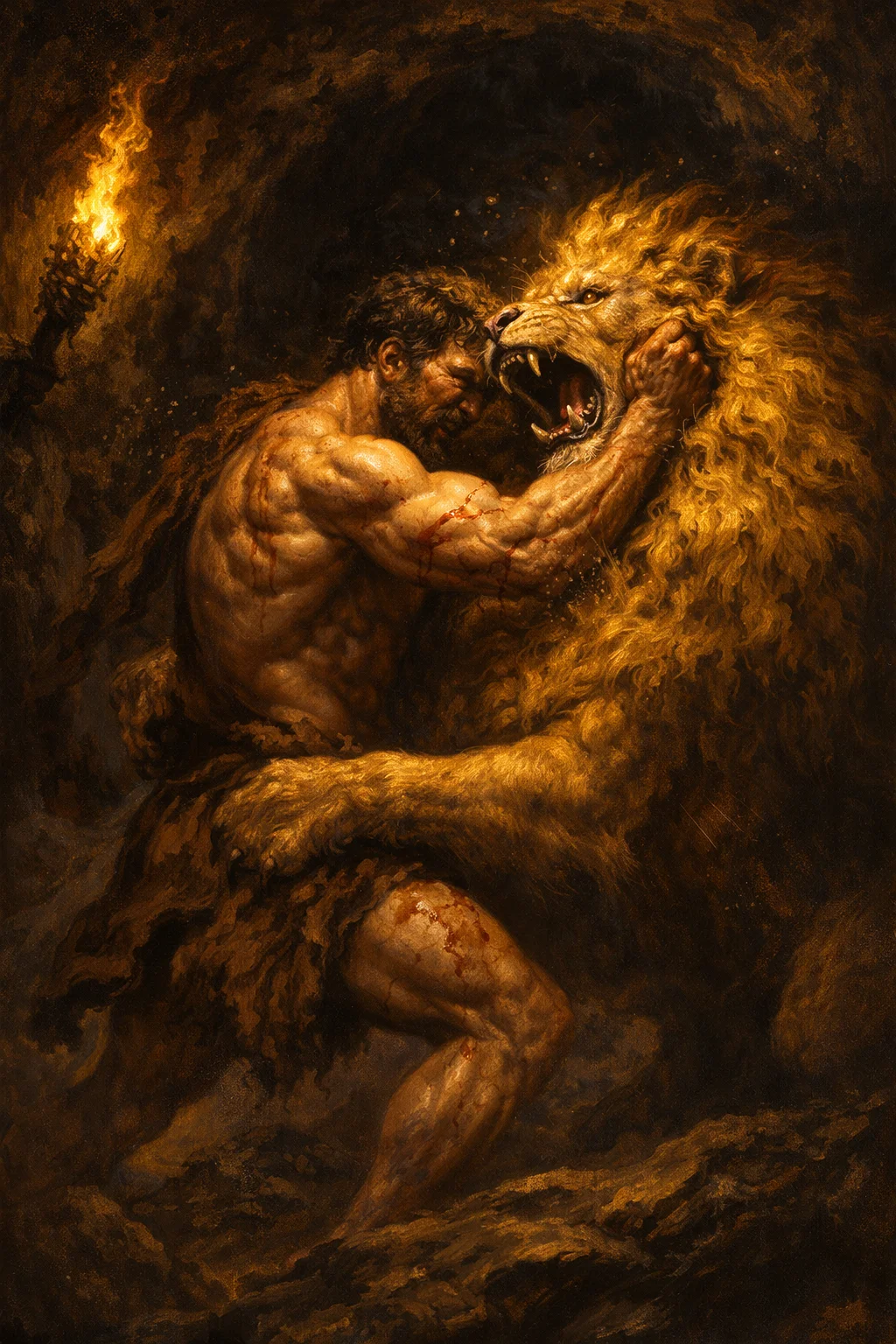
Heracles was sent to slay the Nemean Lion, a monstrous beast whose golden fur was impervious to all weapons. Arrows bounced off its hide, and swords shattered on contact. Heracles cornered the lion in its cave, blocked one entrance, and wrestled the beast to death with his bare hands, strangling it. He then used the lion's own razor-sharp claws to skin it, and wore the impenetrable hide as armor for the rest of his life.
Labour 2: The Lernaean Hydra
The Hydra was a serpentine water monster with nine heads, living in the swamps of Lerna. When one head was cut off, two more grew in its place. Heracles enlisted his nephew Iolaus as an assistant: as Heracles severed each head, Iolaus cauterized the stump with a burning torch to prevent regrowth. The final head was immortal, so Heracles buried it under a massive boulder. He dipped his arrows in the Hydra's venomous blood, making them lethal for the rest of his adventures.
Labour 3: The Ceryneian Hind
Heracles was tasked with capturing the Ceryneian Hind — a sacred deer with golden antlers and bronze hooves, consecrated to the goddess Artemis. Since killing it would invite divine wrath, Heracles pursued the deer for an entire year across Greece, finally catching it while it slept (or, in some versions, wounding it with an arrow as it crossed a river). He apologized to Artemis, explained his penance, and promised to return the animal unharmed.
Labour 4: The Erymanthian Boar
Heracles captured alive an enormous wild boar that terrorized the slopes of Mount Erymanthos. He chased the boar through deep snow until it was exhausted, then bound it in chains and carried it back to Eurystheus, who was so terrified he hid inside a large bronze storage jar — a scene frequently depicted in ancient art.
Labour 5: The Augean Stables
King Augeas owned the largest cattle herd in Greece, and his stables had not been cleaned in thirty years. Eurystheus ordered Heracles to clean them in a single day — an intentionally humiliating task for the greatest hero alive. Heracles solved the problem with engineering rather than brute force: he diverted the courses of two rivers, the Alpheus and the Peneus, channeling them through the stables to wash away decades of filth in hours.
Labour 6: The Stymphalian Birds
A flock of man-eating birds with bronze beaks, metallic feathers they could launch like arrows, and toxic droppings infested the marshes of Lake Stymphalia. Athena gave Heracles a pair of bronze castanets (or a rattle) forged by Hephaestus. The noise startled the birds into flight, and Heracles shot them down with his Hydra-venom arrows.
Labour 7: The Cretan Bull
Heracles traveled to Crete to capture the magnificent bull that Poseidon had sent from the sea — the same bull whose union with Queen Pasiphaë produced the Minotaur. Heracles wrestled the bull into submission and brought it back to the mainland alive, where Eurystheus released it (it eventually wandered to Marathon, where Theseus later captured it again).
Labour 8: The Mares of Diomedes
King Diomedes of Thrace fed his four horses on human flesh, making them savage and uncontrollable. Heracles subdued Diomedes, fed the wicked king to his own mares, and once the horses were calm from feeding, he muzzled them and drove them back to Eurystheus.
Labour 9: The Girdle of Hippolyta
Eurystheus's daughter Admete desired the golden war girdle of Hippolyta, queen of the Amazons. Hippolyta initially agreed to give it willingly, but Hera, disguised as an Amazon warrior, spread a rumor that Heracles planned to kidnap the queen. The Amazons attacked, and in the ensuing battle, Heracles killed Hippolyta and took the girdle by force.
Labour 10: The Cattle of Geryon
Heracles journeyed to the western edge of the world to steal the red cattle of Geryon, a three-bodied giant who lived on the island of Erytheia. To reach it, Heracles erected the Pillars of Hercules (the Strait of Gibraltar), splitting a mountain in two. He killed Geryon with his arrows, slew the two-headed guard dog Orthrus, and drove the cattle all the way back across Europe to Greece.
Labour 11: The Golden Apples of the Hesperides
The golden apples of immortality grew in a divine garden at the edge of the world, guarded by the hundred-headed dragon Ladon and tended by the Hesperides, daughters of Atlas. Heracles persuaded Atlas to retrieve the apples by offering to hold up the sky in his place. When Atlas returned and tried to leave Heracles holding the heavens permanently, the hero tricked him into taking the burden back by asking him to hold it "just for a moment" while he adjusted a pad on his shoulders — then walked away with the apples.
Labour 12: The Capture of Cerberus
The final and most dangerous labour sent Heracles into the underworld itself to capture Cerberus, the three-headed hound of Hades. Heracles descended through the entrance at Taenarum, crossed the Styx, and sought permission from Hades and Persephone. Hades agreed — on the condition that Heracles use no weapons. The hero wrestled the monstrous dog into submission with his bare hands, dragged it to the surface, showed it to the terrified Eurystheus, and returned it safely to the underworld.
III. After the Labours
With the twelve labours complete, Heracles was freed from servitude and his crimes were considered atoned. But his adventures continued — he sailed with the Argonauts, sacked Troy, and fought in the Gigantomachy alongside the Olympians. His death came from the poisoned shirt of Nessus, which burned his flesh with the Hydra's venom. In agony, he built his own funeral pyre on Mount Oeta. As the flames consumed his mortal body, Zeus raised his divine essence to Olympus, where Heracles was granted full immortality — the only mortal ever to become a true Olympian god.
Classical Sources
This myth is recorded in multiple ancient sources:
- 📜 Homer, Iliad & Odyssey (c. 750 BC)
- 📜 Hesiod, Theogony & Works and Days (c. 700 BC)
- 📜 Apollodorus, Bibliotheca (c. 1st–2nd century AD)
- 📜 Ovid, Metamorphoses (8 AD)
- 📜 Greek Tragedians — Aeschylus, Sophocles, Euripides (5th century BC)
Cross-referenced with multiple classical sources for accuracy.
Why ten labours became twelve
In the most detailed ancient account, the mythographer Apollodorus says Eurystheus first set ten labours, not twelve. He then refused to count two of them. The Hydra did not count because Heracles' nephew Iolaus had helped him, and the Augean Stables did not count because Heracles had made a deal with Augeas for payment, a tenth of his cattle. Two more labours were added, the apples of the Hesperides and Cerberus, which is why they come last in Apollodorus.
The number twelve and the list itself were not fixed early. Homer knows Heracles laboured for Eurystheus and mentions the fetching of Cerberus, but gives no list. The earliest firm evidence for the canonical twelve is visual: the twelve sculpted metopes over the porches of the Temple of Zeus at Olympia, carved around 460 BC and described by Pausanias. The order also varies between writers such as Diodorus and Apollodorus.
The side stories behind each labour
Almost every labour came with side adventures that ancient audiences knew as well as the tasks themselves.
- Nemea. On his way to the lion Heracles stayed with a poor labourer named Molorchus, who was about to sacrifice his only ram. Heracles asked him to wait thirty days: if he came back, they would sacrifice to Zeus the Saviour, and if not, Molorchus should make offerings to him as a dead hero.
- The Hydra. Hera sent a giant crab to bite Heracles' foot during the fight. He crushed it, and Hera placed it in the sky as the constellation Cancer. More on the monster is on the Hydra page.
- The Ceryneian Hind. Pindar's Olympian 3 has Heracles chase the golden-horned hind all the way to the land of the Hyperboreans in the far north, where he first saw the olive trees he later brought to Olympia.
- The Erymanthian Boar. On the way Heracles was entertained by the centaur Pholus, who opened a jar of wine belonging to all the centaurs. The smell drew the others, a fight broke out, and in the confusion one of Heracles' Hydra-poisoned arrows struck the immortal Chiron. The wound could not heal, and Chiron eventually gave up his immortality to escape the pain.
- Augeas. When Augeas refused to pay, Heracles later made war on Elis and killed him. Pindar's Olympian 10 makes this victory the occasion on which Heracles founded the Olympic Games.
- The Mares of Diomedes. Heracles left the horses in the care of his young companion Abderus, and they tore him apart. Heracles founded the city of Abdera at his tomb. Euripides' Alcestis catches Heracles on his way to this labour: he stops at the palace of Admetus and wrestles Death (Thanatos) to bring back Admetus' wife.
- Hippolyta's belt. On the way home Heracles reached Troy, where King Laomedon had chained his daughter Hesione out as an offering to a sea monster. Heracles killed the monster, but Laomedon cheated him of the promised horses, and Heracles later came back and sacked Troy, a generation before the Trojan War.
- Geryon. To cross the river Ocean, Heracles threatened Helios with his bow, and the sun god lent him the golden cup in which he sailed back east each night. The archaic poet Stesichorus wrote a whole poem, the Geryoneis, that treats the three-bodied Geryon with real sympathy. Fragments of it survive on papyrus.
- The Hesperides. Heracles did not know where the garden was. He caught the shape-shifting sea-god Nereus, who told him. On the way he wrestled Antaeus in Libya, a giant who was invincible while he touched the earth, and freed Prometheus by shooting the eagle that ate his liver. The trick on Atlas is only one version. Others have Heracles kill the serpent Ladon and pick the apples himself.
- Cerberus. Before going down, Heracles was initiated into the Eleusinian Mysteries. In the underworld he freed Theseus from the Chair of Forgetfulness but could not free Pirithous. He also met the ghost of Meleager, who asked him to marry his sister Deianira. That marriage would lead to Heracles' own death.
A major variant: when did the madness happen?
The page above follows the common order: madness, then the murder of Megara and the children, then the labours as penance. Euripides reverses it. In his Heracles, the hero has already finished the labours and comes back from Hades just in time to save his family from the tyrant Lycus. Then Hera sends Madness (Lyssa) and he kills them. This makes the labours a heroic achievement and not an atonement, and turns the murder into the tragedy that wrecks a finished life. Other sources say Heracles served Eurystheus because Hera had tricked Zeus over the birth: Zeus swore that a descendant of his born that day would rule, and Hera held back Heracles' birth while hurrying Eurystheus'. That trick is told in Iliad 19.
Labours in art
The labours were among the most popular subjects in Greek art. Black-figure vases from the 6th century BC show Heracles wrestling the lion in many variations, and the scene of Eurystheus cowering in a storage jar while Heracles holds the boar over him was a comic favourite. The Olympia metopes (some now in the site museum, others in the Louvre) show Heracles ageing across the series, beardless and tired at the start, mature by the end.
Ancient sources
- Apollodorus, Library 2.5.1–12: the fullest single account of all twelve labours and their side episodes, including why Eurystheus discounted two of them.
- Diodorus Siculus, Library of History Book 4: a continuous narrative of the labours, sometimes in a different order and with rationalising touches.
- Hesiod, Theogony: describes the births of the Nemean Lion, the Hydra, Geryon and Orthus and says Heracles killed them.
- Euripides, Heracles and Alcestis: the madness placed after the labours, and Heracles' detour on the way to the Mares of Diomedes.
- Pindar, Olympian 3 and 10: the hind and the Hyperborean olive, and the founding of the Olympic Games after the defeat of Augeas.
- Pausanias, Description of Greece Book 5: describes the twelve labour metopes on the Temple of Zeus at Olympia.
Frequently asked questions
What was the hardest of the twelve labours?
Ancient sources treat the capture of Cerberus as the climax, since it meant going into the land of the dead and returning alive. The Augean Stables were designed to be the most humiliating, not the hardest.
Why did Hercules have to do twelve labours?
In the usual version, the Delphic oracle ordered him to serve Eurystheus as atonement for killing his children in a madness sent by Hera. Apollodorus says ten labours were set first and two more added when Eurystheus refused to count the Hydra and the Stables.
Did Hercules do the labours alone?
Not always. Iolaus helped with the Hydra, Athena gave him the rattle for the Stymphalian birds, Helios lent him his cup, Hermes and Athena guided him in the underworld, and Atlas fetched the apples in one version. That help is exactly why Eurystheus disqualified the Hydra.
Is "Hercules" or "Heracles" correct?
Both. Heracles (Herakles) is the Greek name, meaning "glory of Hera," and Hercules is the Latin form the Romans used. The Heracles page covers his whole life.
Explore More Mythology
Get weekly deep dives into the gods, heroes, and myths of ancient Greece.