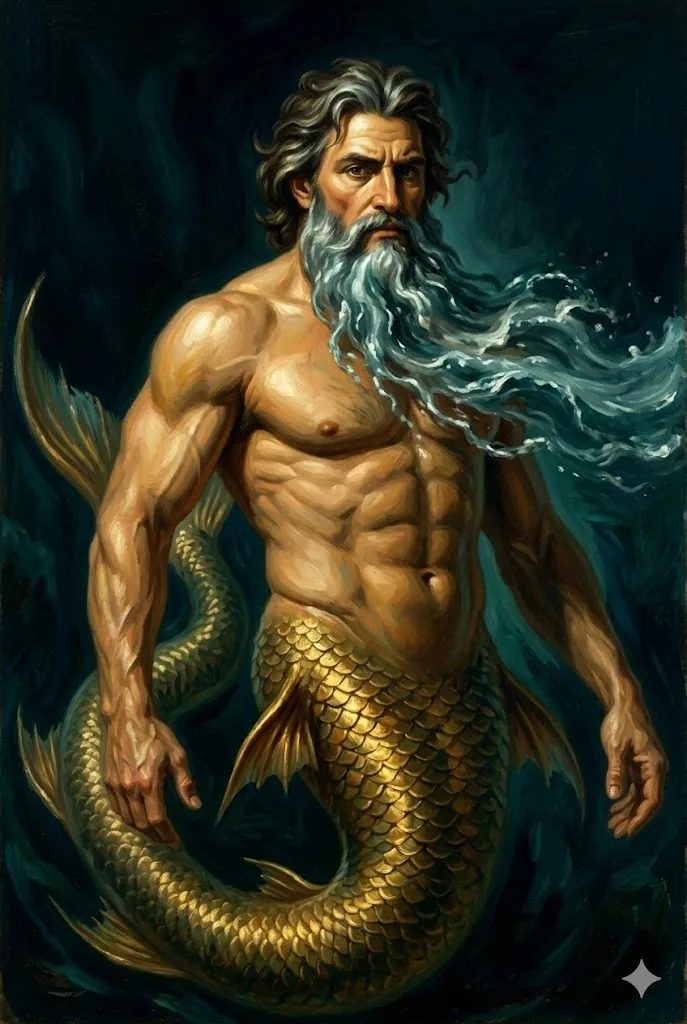
I. Who Was Oceanus?
Oceanus was the eldest of the Titans and the god of the great earth-encircling river Okeanos, a massive freshwater stream that the ancient Greeks believed flowed around the flat disc of the earth. He was not a god of the salt sea (that was Poseidon's domain) but rather the cosmic river from which all the world's rivers, springs, fountains, and rain clouds drew their water.
With his sister-wife Tethys, Oceanus fathered the three thousand river gods (Potamoi) and three thousand ocean nymphs (Oceanids) — making him the ancestor of virtually every freshwater deity in Greek mythology. Famous Oceanids include Metis (Zeus's first wife and mother of Athena), Styx (the river of the underworld), Calypso (who detained Odysseus), and Clymene (mother of Prometheus).
Uniquely among the Titans, Oceanus did not participate in the castration of Uranus, and during the Titanomachy he remained neutral rather than fighting against the Olympians. For this reason, he was not imprisoned in Tartarus with his brothers and was allowed to continue flowing around the edges of the world undisturbed. Homer portrays him as the origin of all things — even the gods themselves.
Classical Sources
The mythology of Oceanus is preserved in:
- 📜 Hesiod, Theogony (c. 700 BC) — The primary source for Titan mythology, genealogy, and the Titanomachy.
- 📜 Apollodorus, Bibliotheca (c. 1st–2nd century AD) — Comprehensive handbook of Titan genealogies and myths.
- 📜 Aeschylus, Prometheus Bound (c. 5th century BC) — Dramatic portrayal of Titan defiance against Olympian authority.
- 📜 Ovid, Metamorphoses (8 AD) — Roman accounts of Titan mythology and transformations.
Cross-referenced with multiple classical sources for accuracy.
Oceanus in Homer: the origin of the gods
Homer gives Oceanus a status that Hesiod does not. In the Iliad, Hera, setting up her seduction of Zeus, says she is going to visit "Oceanus, origin of the gods, and mother Tethys." She claims the couple raised her in their house while Zeus was locking Cronus beneath the earth. A few lines later, Sleep calls Oceanus the origin "of all." Ancient readers, Plato among them, took these lines to mean that some early tradition made water the first principle of the world. Modern scholars often compare this with Near Eastern creation stories that begin with primeval waters.
Homer also shows his limits. In Book 21, Achilles boasts that even Oceanus, "from whom all rivers and all the sea, all springs and deep wells flow," is afraid of Zeus's lightning. In Book 20, when Zeus summons every river and nymph to an assembly on Olympus, Oceanus is the only one who does not come. The poet seems to picture him as too vast, and too far away at the edge of the world, to leave his bed. When Achilles' new shield is made in Book 18, Hephaestus runs the stream of Ocean around its outer rim, a model of the world in bronze.
The edge of the world
For early Greek geography, Oceanus was the boundary of everything. The sun, moon and stars rise from his stream and sink back into it. In some accounts Helios sails back east each night in a golden cup. Beyond or beside his waters lay the places that ordinary travellers could not reach: the Aethiopians, the garden of the Hesperides, the Gorgons, the island of Geryon and the entrance to the realm of the dead. In the Odyssey, Odysseus sails across Ocean to reach the land of the dead.
That edge also appears in the labours of Heracles. To reach Geryon's cattle he borrowed the cup of the Sun. In a version attributed to the early mythographer Pherecydes, Oceanus tested the hero by tossing the cup on high waves until Heracles aimed an arrow at him, and the Titan calmed the water. Herodotus, writing in the fifth century BC, was already sceptical. He said he knew of no river Ocean and suspected Homer or an earlier poet had invented the name. He also laughed at mapmakers who drew the earth as a perfect circle with Ocean flowing around it.
Family and politics
Hesiod makes Oceanus the eldest son of Gaia and Uranus. His list of the children of Oceanus and Tethys names about two dozen rivers, including the Nile, Alpheus, Achelous and Scamander, and some forty Oceanids, before saying that there are three thousand of each. The most politically important daughter is Styx. When Zeus called on the immortals to join him against the Titans, Styx came first, bringing her children Zelus, Nike, Kratos and Bia, on her father's advice. As a reward her waters became the great oath of the gods. Another daughter, Metis, became Zeus's first wife. So Oceanus's family stood behind the Olympian victory, even if Oceanus himself did not fight.
In Aeschylus's Prometheus Bound, Oceanus appears in person, riding a winged four-legged creature. He offers to plead with Zeus for Prometheus and advises him to "know yourself" and soften his tongue. Prometheus politely sends him away, warning him not to get into trouble on his behalf. The chorus of the play is made up of Oceanus's daughters, the Oceanid nymphs. Plato's Timaeus gives yet another family arrangement, in which Oceanus and Tethys are the parents of Cronus and Rhea, not their siblings.
How he was pictured
Archaic Athenian painters included Oceanus among the guests at the wedding of Peleus and Thetis. On the Sophilos dinos in the British Museum he appears with bull's horns and the body of a fish below the waist, with Tethys beside him. Bull horns were a normal way of showing river gods. In the Roman period he became one of the most popular figures in mosaics and silver: a huge bearded face with crab claws or lobster legs sprouting from his hair and dolphins swimming in his beard. The central mask of the Great Dish from the Mildenhall Treasure is the best-known example. The large central statue of the Trevi Fountain in Rome, by Pietro Bracci, is also Oceanus, not Poseidon or Neptune as visitors often assume.
Ancient sources
- Homer, Iliad 14.200–204 and 14.246: Hera calls Oceanus the origin of the gods and says he and Tethys raised her, and Sleep calls him the origin of all.
- Homer, Iliad 18, 20 and 21: Ocean on the rim of Achilles' shield, Oceanus's absence from Zeus's assembly, and Oceanus as the source of all waters who still fears Zeus.
- Hesiod, Theogony 133 and 337–370: Oceanus as eldest Titan, and the catalogue of the rivers and Oceanids, three thousand of each. See also 383–403 for Styx joining Zeus on his advice.
- Aeschylus, Prometheus Bound: Oceanus visits the chained Prometheus and urges him to submit, and his daughters form the chorus.
- Herodotus, Histories 2.23 and 4.36: scepticism about the river Ocean and mockery of circular world maps.
- Plato, Timaeus 40e: Oceanus and Tethys as children of Earth and Heaven and parents of Cronus and Rhea.
Frequently asked questions
Is Oceanus the same as Poseidon?
No. Poseidon rules the salt sea, especially the Mediterranean. Oceanus is the freshwater river that encircles the whole earth and feeds all rivers and springs.
Did Oceanus fight in the Titanomachy?
No ancient source shows him fighting. Homer has him sheltering Hera during the war, and Hesiod has his daughter Styx join Zeus on his advice, which suggests he leaned toward the Olympians.
Is the word "ocean" from Oceanus?
Yes. Greek Ōkeanos passed through Latin oceanus into English, with the meaning shifting from a world-river to the great seas beyond the Mediterranean.
Who is the statue in the Trevi Fountain?
The central figure is Oceanus, standing in a shell-shaped chariot pulled by sea-horses and tritons.
Explore More Mythology
Get weekly deep dives into the gods, heroes, and myths of ancient Greece.