Daughter of the Sun
Circe was a goddess and sorceress of extraordinary power, the daughter of the sun god Helios and the Oceanid Perse. She lived alone on the island of Aeaea, surrounded by wolves, lions, and other wild animals that had once been men. She was the aunt of the equally dangerous sorceress Medea, and together they represent the most powerful practitioners of magic in Greek mythology.
Odysseus on Aeaea
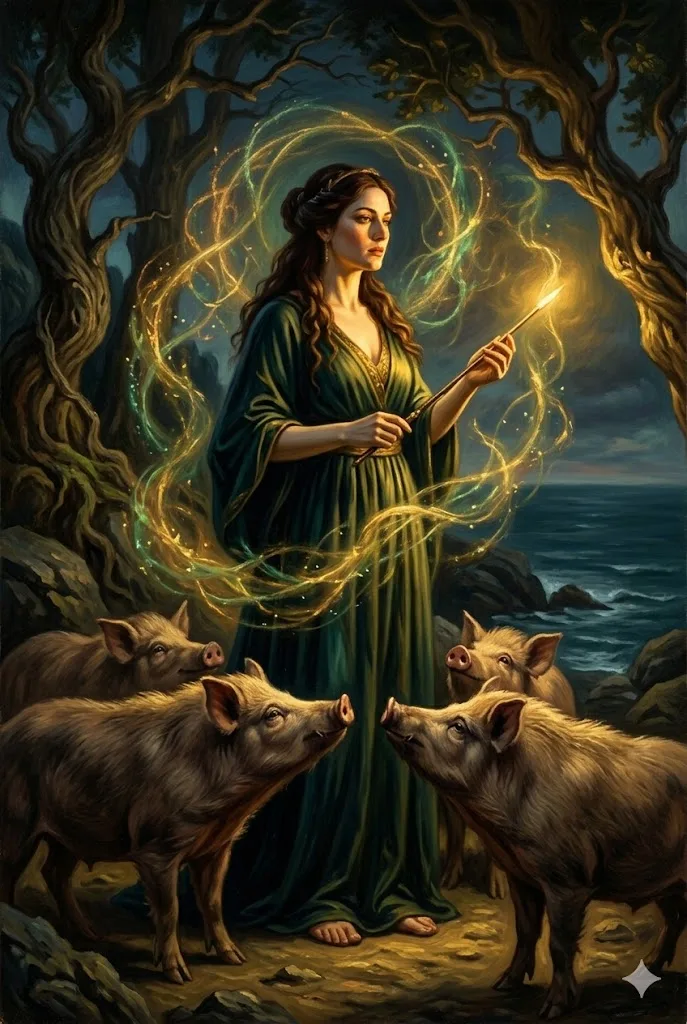
Circe's most famous appearance is in Homer's Odyssey. When Odysseus's crew landed on Aeaea during their long journey home from Troy, Circe invited them to a feast. She mixed a potion into their food and, when they drank it, transformed them into pigs. They retained their human minds but were trapped in animal bodies, fully aware of what had happened to them.
Odysseus, warned by Hermes and protected by the herb moly, was immune to her magic. When Circe's spell failed on him, she was genuinely astonished. No man had ever resisted her. Odysseus drew his sword, and Circe, recognizing his identity (she had been told by Hermes that Odysseus would come), submitted and agreed to restore his men. She then became Odysseus's lover and host for an entire year, during which she proved a generous and knowledgeable ally.
More Than a Villain
Circe is often reduced to the role of villainess or temptress, but Homer presents her as far more complex. After the initial confrontation, she becomes one of the most helpful figures in the Odyssey. She advises Odysseus to visit the Underworld to consult the prophet Tiresias. She warns him about the Sirens, Scylla and Charybdis, and the cattle of Helios. She prepares his crew for the dangers ahead. Without Circe's guidance, Odysseus would never have reached Ithaca.
Modern Revival
Madeline Miller's novel Circe (2018) transformed public understanding of this character. Miller reimagined Circe's story from her own perspective: a goddess born without divine powers who discovers witchcraft as a form of self-determination in a world ruled by male gods. The novel portrays her transformation of men into pigs not as random cruelty but as self-defence against sailors who came to her island to rape and plunder. Miller's Circe became a feminist icon and a bestseller, proving that characters dismissed as minor villains for centuries can become protagonists when someone bothers to tell their side of the story.
Classical Sources
- 📜 Homer, Iliad & Odyssey (c. 750 BC)
- 📜 Hesiod, Theogony (c. 700 BC)
- 📜 Apollodorus, Bibliotheca (c. 1st-2nd century AD)
- 📜 Ovid, Metamorphoses (8 AD)
Cross-referenced with multiple classical sources for accuracy.
Explore More
Odysseus · The Odyssey · Helios · Hermes · Home
Family, Home and Homer's Details
Homer names Circe's mother as Perse, a daughter of Oceanus, and makes her the full sister of Aeetes, the king of Colchis who guarded the Golden Fleece. Later writers fill out the family: Apollodorus counts Pasiphae, the wife of Minos and mother of the Minotaur, as another child of Helios and Perse, so Circe's relatives include the Cretan royal house as well as Medea, her niece. Homer's own epithets for her are worth knowing: she is deinē theos audēessa, "a dread goddess who speaks with human voice," and euplokamos, "of the lovely braids." The word "goddess" matters. Circe is never a mortal witch in Greek sources but an immortal daughter of the Sun.
Odyssey Book 10 has more texture than the summary versions suggest. Her house stands in a clearing of stone, and the wolves and mountain lions around it fawn on the visitors like dogs greeting a master. Circe sits at a great loom singing, and her potion is mixed into a drink of cheese, barley and honey in Pramnian wine. One man, Eurylochus, suspects a trap and stays outside, which is how Odysseus learns what happened. Hermes describes moly as having a black root and a milk-white flower, hard for mortals to dig up. Before Odysseus goes to her bed, he makes Circe swear the great oath of the gods that she will not harm him. When she restores the crew, they come back younger, taller and handsomer than before. After a full year, it is the crew, not Odysseus, who remind him that it is time to go home. The stay also has a sad footnote: the young sailor Elpenor, sleeping off his wine on her roof, falls to his death as they leave. His ghost is the first one Odysseus meets in the Underworld.
Circe Beyond the Odyssey
Circe turns up in several other stories that rarely get told alongside the pig episode:
- The Argonauts. In Apollonius of Rhodes' Argonautica (Book 4), Jason and Medea come to Aeaea after murdering Medea's brother Apsyrtus. Circe performs a purification rite with the blood of a piglet. When she learns who Medea is and what she has done, she sends her away without offering hospitality.
- Glaucus and Scylla. In Ovid's Metamorphoses (Book 14), the sea-god Glaucus asks Circe for a love charm to win the nymph Scylla. Circe wants Glaucus for herself, and when he refuses her she poisons the pool where Scylla bathes, turning the girl's lower body into a ring of barking dogs. This is the origin Ovid gives for the monster Scylla, who later eats six of Odysseus's men.
- Picus. Also in Ovid, the Latin king Picus turns her down because he loves his wife Canens, and Circe changes him into a woodpecker (picus in Latin).
- The Telegony. The lost epic Telegony, known from a later prose summary, gives Circe and Odysseus a son, Telegonus. Grown up, he sails to Ithaca looking for his father and kills him without knowing who he is, using a spear tipped with a stingray spine. Then comes a strange double marriage: Telegonus marries Penelope, and Telemachus marries Circe. Hesiod's Theogony names other sons of Circe and Odysseus, Agrius and Latinus, who rule over the Tyrrhenians, though scholars suspect those closing lines were added later.
Where Was Aeaea?
Homer puts Aeaea in the far east, where Dawn has her dwelling and Helios rises, which suits a daughter of the Sun. Italian tradition moved her west. The headland of Monte Circeo on the coast of Lazio was identified with her island, and Roman authors note that it once stood surrounded by water and marshes. The town of Circeii claimed to show Elpenor's tomb. Virgil has Aeneas sail past Circe's shore at night and hear the growling of her captive beasts. The Latin genealogies through Latinus helped tie her to the origins of Rome.
Circe in Art
Vase painters liked the transformation scene. A well-known Attic black-figure cup in Boston shows Circe stirring her bowl while the crewmen around her sprout boar, ram and other animal heads, and Odysseus comes in with his sword drawn. Boeotian cups from the sanctuary of the Kabeiroi near Thebes turn the meeting into broad comedy, with big-bellied caricatures. In modern painting, John William Waterhouse painted her twice: Circe Offering the Cup to Ulysses (1891) and Circe Invidiosa (1892), which shows her pouring poison into Scylla's water. People often blur Circe with Calypso, but they are different. Calypso keeps Odysseus against his will for seven years. Circe hosts him for one year and then helps him leave.
Ancient sources
- Homer, Odyssey 10–12: the main account. The transformation of the crew, Hermes and moly, the year on Aeaea, the journey to the dead, and her instructions about the Sirens, Scylla, Charybdis and the cattle of the Sun.
- Hesiod, Theogony: lists Circe as a daughter of Helios and Perse, and in its closing catalogue names her sons by Odysseus.
- Apollonius of Rhodes, Argonautica 4: Circe purifies Jason and Medea for the killing of Apsyrtus and recognises her niece.
- Ovid, Metamorphoses 14: the stories of Glaucus and Scylla, Picus, and Macareus's retelling of the Aeaea episode.
- Proclus' summary of the Telegony: Telegonus, son of Circe, kills Odysseus. The surviving family then intermarries.
- Virgil, Aeneid 7: the Trojans sail past Circe's coast in Italy and hear the animals she has transformed.
Frequently asked questions
Why did Circe turn Odysseus's men into pigs?
Homer never gives her a motive. He simply shows it as what she does to visitors, and her house is already surrounded by other bewitched creatures. The idea that she was defending herself from violent sailors comes from modern retellings, especially Madeline Miller's novel, not from ancient texts.
Did Circe and Odysseus have children?
Not in the Odyssey. Later tradition gives them a son, Telegonus, who accidentally kills Odysseus. Hesiod's Theogony also names Agrius and Latinus as their sons.
What is moly?
Moly is the protective herb that Hermes gives Odysseus. Homer describes it as having a black root and a white flower, and says it is hard for mortals to dig up. Ancient and modern writers have tried to identify it with a real plant, garlic or snowdrop among them, but Homer presents it as a plant known to the gods.
Is Circe a goddess or a witch?
She is both. She is an immortal goddess, the daughter of Helios, and her power works through drugs (pharmaka), potions and a wand. That is why later writers treat her, along with Medea, as the model sorceress.
Books to read next
- Homer, The Odyssey (trans. Emily Wilson)
- Homer, The Odyssey (trans. Robert Fagles)
- Madeline Miller, Circe
Links go to Bookshop.org, which supports independent bookstores. We earn a small commission if you buy, at no extra cost to you.