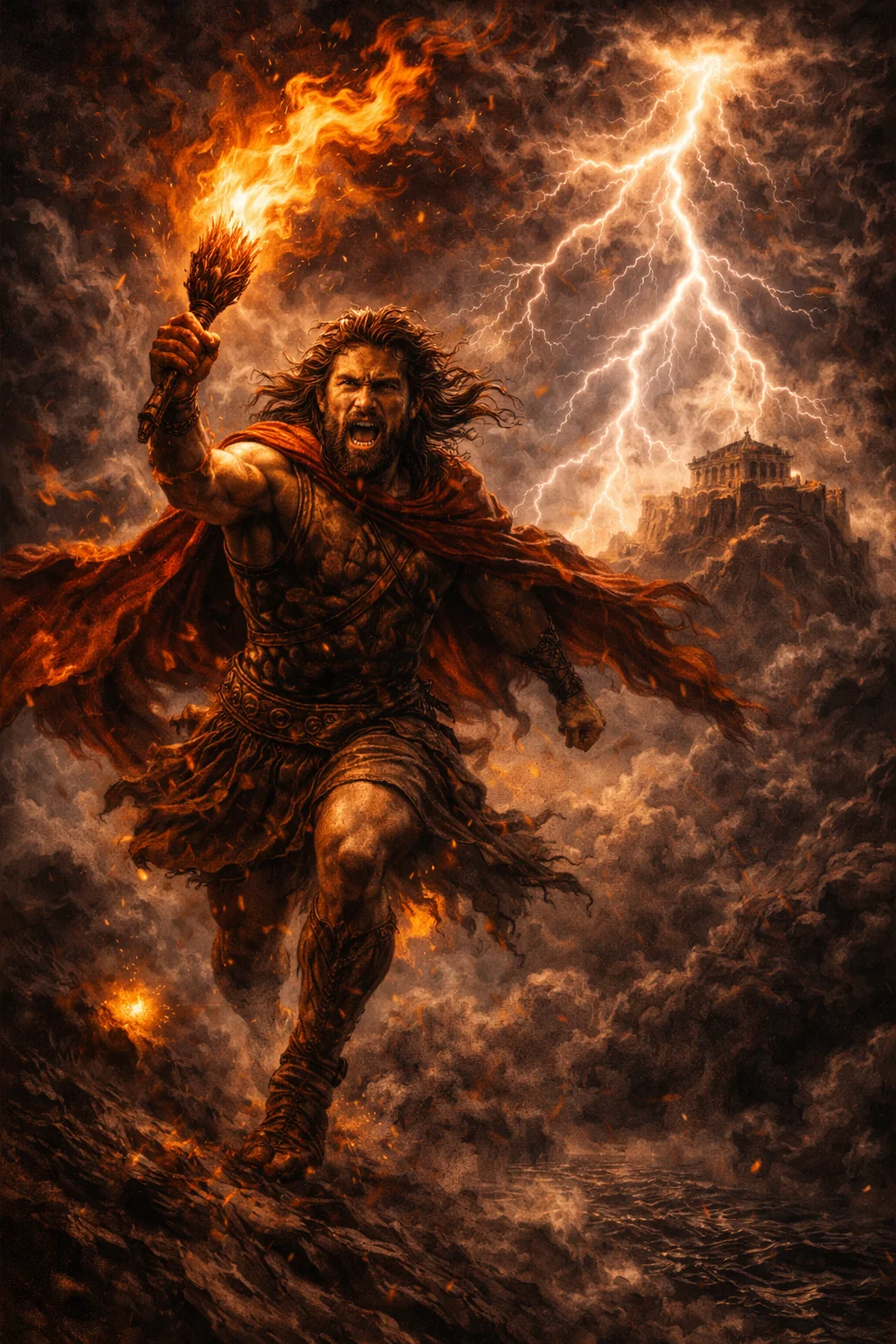
The Great Theft
Of all the myths in the Greek tradition, none has resonated more deeply across the centuries than the story of Prometheus, the Titan who stole fire from the gods and gave it to humanity. This single act of rebellion — born from compassion for mortals and defiance of divine authority — transformed the human condition forever and earned Prometheus an eternity of unimaginable suffering. It is a story about knowledge, power, sacrifice, and the terrible price of progress.
Before Prometheus's intervention, mortals lived in darkness and ignorance, barely distinguishable from animals. They ate raw food, cowered in caves, and had no art, no craft, and no technology. They were playthings of the gods — creatures made from clay who existed at the whim of higher powers. Prometheus, whose name means 'Forethought,' saw their misery and resolved to change their fate.
Why Prometheus Acted
Prometheus had a special bond with humanity. In some traditions, he was their creator — the Titan who shaped the first humans from clay and water, modelling them in the image of the gods. Whether or not he made them, Prometheus loved mortals in a way that no other god did. He saw their potential — their capacity for thought, creativity, and wonder — and believed they deserved more than the wretched existence the Olympians had allotted them.
Zeus, however, had little affection for mortals. After a dispute with Prometheus over sacrificial offerings — in which the crafty Titan tricked Zeus into choosing the worst portion of a sacrificed ox — Zeus punished humanity by withholding fire. Without fire, humans could not cook, forge metal, see in the darkness, or warm themselves against the cold. Zeus intended to keep mortals weak and dependent.
The Theft
Defying the king of the gods, Prometheus ascended to Mount Olympus — or, in some versions, to the forge of Hephaestus, or to the chariot of Helios the Sun — and stole a spark of divine fire. He concealed the ember inside a hollow fennel stalk and carried it down to earth, where he presented it to humanity. In an instant, the world changed. Mortals could now cook their food, light their homes, smelt metals, fire pottery, and begin the long march toward civilization.
Fire was more than a practical tool — it was a symbol of divine knowledge and creative power. With fire came technology, art, medicine, mathematics, navigation, and ultimately philosophy. Prometheus had not merely given humanity warmth; he had given them the spark of civilization itself.
Zeus's Punishment
Zeus was furious. He devised two punishments — one for Prometheus and one for the mortals who had received his gift. For humanity, Zeus ordered Hephaestus to create Pandora, the first woman, who was given a jar (often mistranslated as a 'box') containing all the evils and sorrows of the world. When Pandora opened the jar, disease, suffering, old age, and death escaped into the world — the price humanity would pay for the fire Prometheus had stolen on their behalf.
For Prometheus himself, the punishment was far more personal and brutal. Zeus had the Titan chained to a rock in the Caucasus Mountains, where each day a great eagle descended and devoured his liver. Each night, because Prometheus was immortal, his liver regenerated — only to be torn out again the following day. This cycle of agony was intended to continue for all eternity. Yet Prometheus endured, unbroken and unrepentant, knowing that his suffering had purchased humanity's freedom.
Liberation
Prometheus's torment eventually ended when the hero Heracles, during his famous labours, came upon the bound Titan and shot the eagle with his bow. With Zeus's reluctant permission — for Prometheus possessed knowledge of a prophecy that Zeus needed — Heracles broke the chains and freed the Titan. In exchange, Prometheus revealed the secret: that if Zeus married the sea nymph Thetis, her son would be greater than his father and could overthrow him. Zeus avoided the marriage, and the prophecy was ultimately fulfilled through Thetis's mortal husband Peleus, whose son Achilles became the greatest warrior of the Trojan War.
Why This Myth Matters
The myth of Prometheus has been retold, reinterpreted, and reimagined more than perhaps any other Greek myth. It speaks to the fundamental human experience of striving for knowledge at great cost. Mary Shelley subtitled her novel Frankenstein 'The Modern Prometheus,' drawing a direct line between the ancient Titan's creation of humanity and Dr. Frankenstein's creation of life. The myth raises questions that remain urgently relevant: What is the cost of progress? Should knowledge be withheld to prevent suffering? Is defiance of authority justified when it serves the greater good?
Classical Sources
This myth is recorded in multiple ancient sources:
- 📜 Homer, Iliad & Odyssey (c. 750 BC)
- 📜 Hesiod, Theogony & Works and Days (c. 700 BC)
- 📜 Apollodorus, Bibliotheca (c. 1st–2nd century AD)
- 📜 Ovid, Metamorphoses (8 AD)
- 📜 Greek Tragedians — Aeschylus, Sophocles, Euripides (5th century BC)
Cross-referenced with multiple classical sources for accuracy.
Explore More
Prometheus · Zeus · Heracles · Pandora · Home