I. Who Was Apollo?
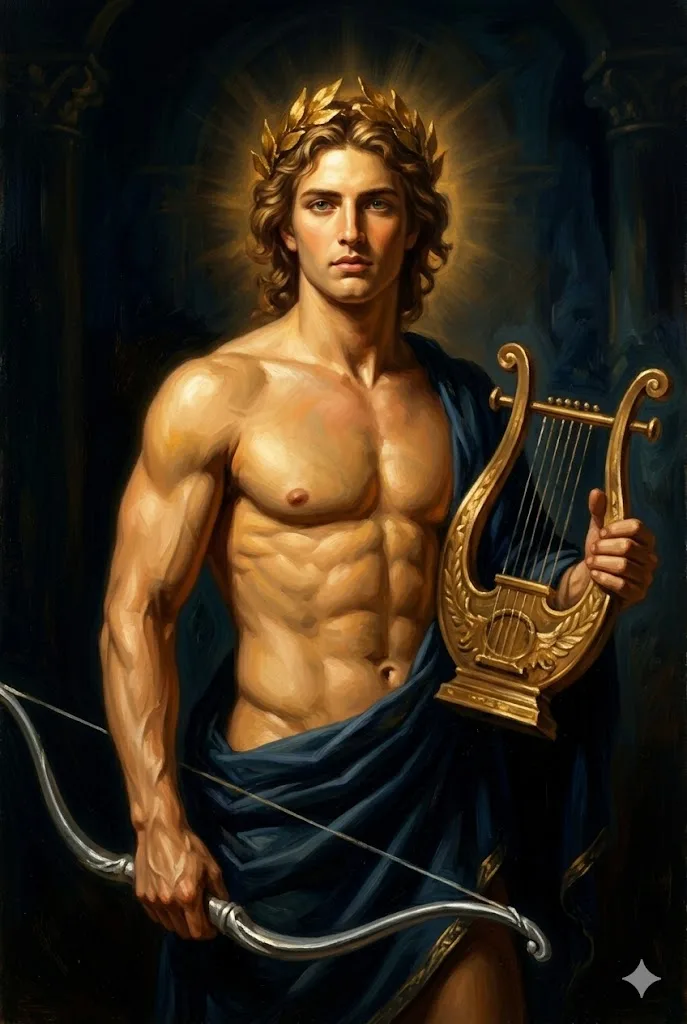
Apollo was perhaps the most multifaceted of all the Olympian gods. He embodied the ideal of the perfect Greek man: beautiful, athletic, artistic, and wise. As god of the sun, he drove his golden chariot across the sky each day, bringing light to the world. As god of music, he led the nine Muses and played the lyre with unmatched skill. As god of prophecy, he spoke through his famous Oracle at Delphi, guiding kings and commoners alike with cryptic but fateful revelations.
Yet Apollo was also the god of plague and pestilence. His silver bow could send arrows of disease raining down upon entire armies, as he did at the start of Homer's Iliad when he punished the Greeks for dishonoring his priest. This duality — light and darkness, healing and destruction, beauty and terror — made Apollo one of the most complex and deeply revered deities in the Greek pantheon.
Remarkably, Apollo was one of the few Greek gods whose name was not changed by the Romans. Both cultures called him Apollo, a testament to his universal appeal and the way his worship transcended cultural boundaries. His influence extended into philosophy, medicine, poetry, and law — the inscription at his temple at Delphi, "Know Thyself," became one of the foundational maxims of Western thought.
II. Birth on Delos
Apollo was the son of Zeus and the Titaness Leto. When Hera discovered that Leto was pregnant with Zeus's children, she was consumed with jealousy and forbade any land on earth from giving Leto shelter to give birth. Leto wandered from place to place, rejected everywhere, until she reached the tiny, barren island of Delos — a floating island that was technically not fixed to the earth and therefore not bound by Hera's curse.
On Delos, Leto gave birth to twins. Artemis, the goddess of the hunt, was born first and immediately helped her mother deliver her brother Apollo. The birth took nine days of labor, and when Apollo finally emerged, the island was bathed in golden light. Delos became one of the most sacred sites in the Greek world, home to a magnificent sanctuary that drew pilgrims from across the Mediterranean for centuries.
III. Powers & Domains
Apollo's domains were extraordinarily broad. In music, he was supreme — his lyre performances could move gods and mortals to tears, and he presided over the Muses who inspired all forms of art. In archery, he was second only to his sister Artemis, and his silver bow was a weapon of both precision and mass destruction. In healing, he was the father of Asclepius, the god of medicine, and the patron of physicians.
His prophetic powers centered on the Oracle at Delphi, but he also spoke through numerous other oracles throughout the Greek world. He was associated with rational thought, order, and civilization — the very opposite of his half-brother Dionysus, who represented ecstasy, chaos, and the untamed wild. The Greeks saw these two gods as complementary forces, necessary for a balanced life.
IV. The Oracle at Delphi
The Oracle at Delphi was the most important religious institution in the ancient Greek world. Located on the slopes of Mount Parnassus, the sanctuary was believed to be the center of the world — the spot where two eagles sent by Zeus from opposite ends of the earth had met. A stone called the Omphalos (navel) marked this sacred center.
Apollo claimed the site by slaying Python, a monstrous serpent (or dragon) that guarded the location. The Pythia, a priestess who served as Apollo's mouthpiece, would enter a trance — possibly induced by gases rising from a fissure in the earth — and deliver prophecies in cryptic verses. Kings, generals, and colonists all consulted the Oracle before making major decisions, and her pronouncements shaped the course of Greek history for centuries.
V. Famous Myths
Apollo and Daphne
After mocking Eros's archery skills, the love god retaliated by shooting Apollo with a golden arrow of desire and the nymph Daphne with a lead arrow of repulsion. Apollo became obsessed with Daphne, pursuing her relentlessly through the forests. Just as he was about to catch her, Daphne cried out to her father, the river god Peneus, who transformed her into a laurel tree. Heartbroken, Apollo made the laurel his sacred plant, wearing a wreath of its leaves as a crown forever after.
Apollo and Marsyas
The satyr Marsyas found a flute discarded by Athena and became so skilled that he challenged Apollo to a musical contest. The Muses judged, and Apollo won — then punished Marsyas's hubris by flaying him alive. The story served as a warning about the dangers of challenging the gods, a theme central to Greek moral thinking.
The Death of Hyacinthus
Apollo's beloved companion Hyacinthus was killed when a discus thrown by Apollo was blown off course by the jealous West Wind, Zephyrus. The discus struck Hyacinthus in the head and killed him. From his blood, Apollo caused the hyacinth flower to grow, inscribing its petals with the Greek letters "AI AI" — a cry of grief that echoes through eternity.
"Know thyself." — Inscription at the Temple of Apollo, Delphi
VI. Quick Facts
Primary Classical Sources
The mythology of Apollo is preserved in numerous ancient texts, including:
- 📜 Homer, Iliad & Odyssey (c. 750 BC) — The foundational texts of Greek literature, containing extensive references to the gods and their interventions in mortal affairs.
- 📜 Hesiod, Theogony (c. 700 BC) — The primary source for the genealogy and origins of the Greek gods, including the succession myths and the rise of the Olympians.
- 📜 Homeric Hymns (c. 7th–6th century BC) — A collection of hymns to individual deities providing detailed mythological narratives not found elsewhere.
- 📜 Apollodorus, Bibliotheca (c. 1st–2nd century AD) — The most comprehensive ancient handbook of Greek mythology, systematically cataloguing myths and genealogies.
- 📜 Ovid, Metamorphoses (8 AD) — The Roman poet's masterwork retelling Greek myths with a focus on transformation, preserving many stories that would otherwise be lost.
- 📜 Pausanias, Description of Greece (c. 150 AD) — A detailed travelogue recording temples, cult sites, and local mythological traditions across the Greek world.
All content on this page has been cross-referenced with multiple classical sources and modern scholarly works to ensure accuracy.
Explore More Mythology
Get weekly deep dives into the gods, heroes, and myths of ancient Greece.