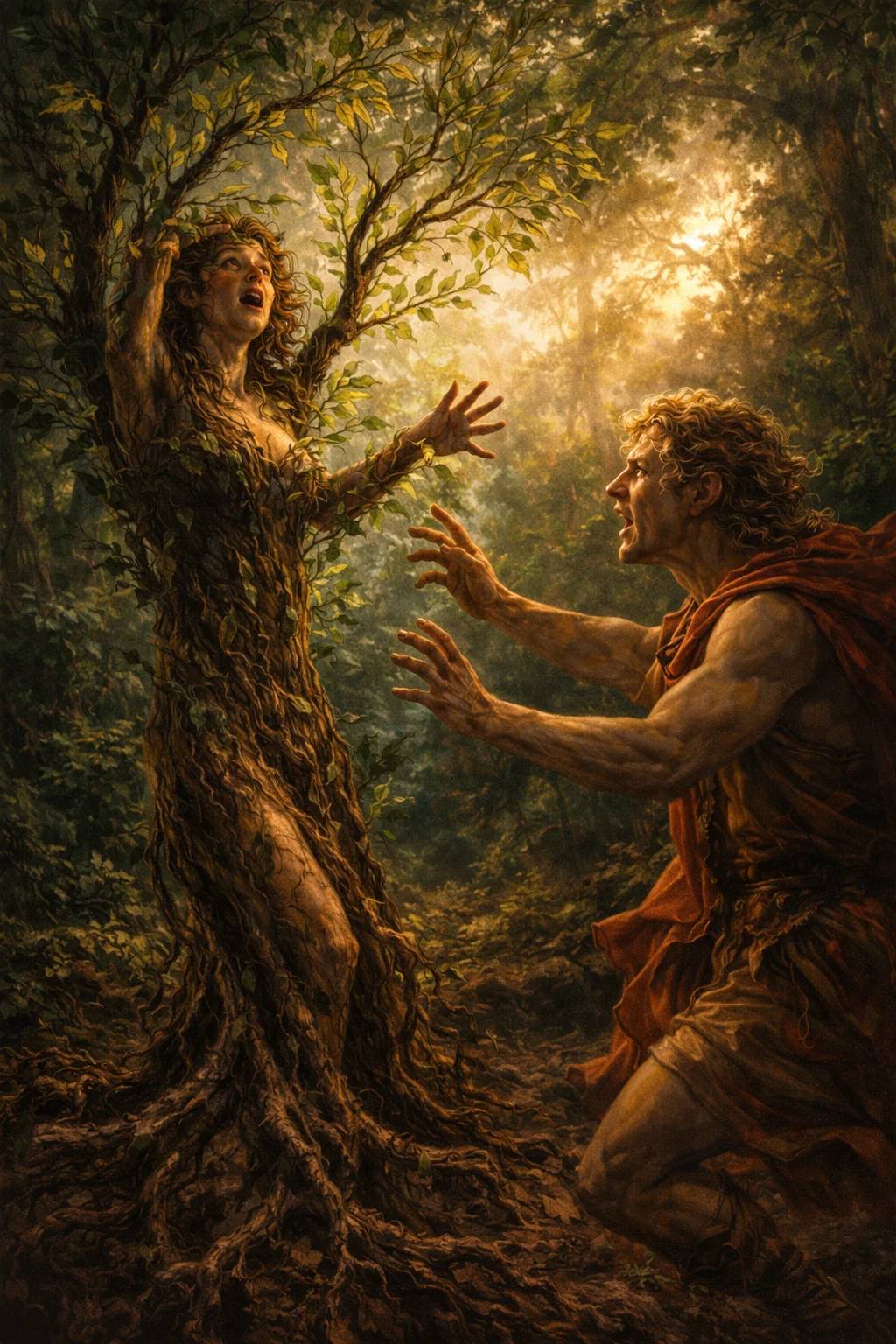
Eros's Revenge
The myth begins with Apollo mocking Eros. Fresh from slaying the great serpent Python, Apollo was boasting about his prowess with the bow when he saw the young love god and laughed at him. What could a child with a toy bow know about real archery? Eros, insulted, decided to teach Apollo a lesson about the power of love. He fired two arrows: one gold-tipped, which caused irresistible desire, and one lead-tipped, which caused utter repulsion. The gold arrow struck Apollo. The lead arrow struck the nymph Daphne.
The Chase
Apollo was instantly consumed with desire for Daphne. Daphne was instantly consumed with revulsion for Apollo. He pursued her through forests and meadows, calling out promises of love, listing his accomplishments, telling her he was the god of prophecy, medicine, and music. Daphne ran. She did not care that he was a god. She did not care about his temples or his powers. She wanted nothing to do with him or any man. She was a devotee of Artemis who had sworn to remain a virgin, and Apollo's pursuit was a violation of everything she valued.
The Transformation
As Apollo gained on her, Daphne cried out to her father, the river god Peneus, begging him to destroy her beauty or transform her so that Apollo could not have her. The moment Apollo's fingers touched her skin, bark began to cover her body. Her feet became roots sinking into the earth. Her arms became branches reaching toward the sky. Her hair became leaves. In seconds, the running girl was gone. In her place stood a laurel tree.
Apollo, reaching the tree, pressed his hand against the bark and felt her heart still beating inside the trunk. He wept. He declared that since he could not have Daphne as his lover, the laurel would be his sacred tree forever. He would wear a crown of laurel leaves, and laurel wreaths would be awarded to victors in athletic games, poets, and military commanders. To this day, the laurel wreath remains a symbol of achievement, and the word 'laureate' (as in Nobel Laureate or Poet Laureate) derives directly from this myth.
What the Myth Really Says
Modern readers often note the disturbing dynamics of this story. A woman says no, a powerful male refuses to accept it, and the only escape available to her is to stop being human entirely. Daphne would literally rather become a tree than be with Apollo. And even after her transformation, Apollo claims ownership of the laurel, turning her rejection into his symbol. The myth can be read as a story about the impossibility of escape from power, or as a critique of male entitlement that the ancient authors embedded in a seemingly romantic narrative. The laurel wreath on every graduate's cap carries this uncomfortable history within it.
Classical Sources
- 📜 Homer, Iliad & Odyssey (c. 750 BC)
- 📜 Hesiod, Theogony (c. 700 BC)
- 📜 Apollodorus, Bibliotheca (c. 1st-2nd century AD)
- 📜 Ovid, Metamorphoses (8 AD)
Cross-referenced with multiple classical sources for accuracy.
Explore More
Apollo · Eros · Artemis · Home
Ovid's "First Love of Phoebus"
The version almost everyone knows comes from Ovid's Metamorphoses (1.452–567). Ovid introduces it as "the first love of Phoebus" and places it right after Apollo kills the Python, so the god at his proudest is brought down by a child's arrow. A few details are easy to miss. Daphne was already refusing marriage before any arrow was shot. She lived in the woods as a rival of Diana (Artemis), and her father had begged her for grandchildren. Ovid also gives Apollo a comic speech as he runs. He tells her to slow down so she won't scratch her legs on the brambles and promises to run more slowly himself. He lists his oracles at Delphi, Claros, Tenedos and Patara, and then complains that his medicine has no cure for love.
The prayer at the climax is a textual problem. In most editions Daphne calls on her father, the river Peneus in Thessaly. Some manuscripts include a line addressed to Tellus, the Earth, and editors still argue over which reading Ovid wrote. Near the end Ovid adds a Roman touch that has nothing to do with Greece. Apollo announces that the laurel will guard the doorposts of Augustus, which refers to the laurel trees that really did flank the emperor's door on the Palatine.
The Older Greek Version: Leucippus
Greek writers told a different story with a different father. Pausanias (Book 8), describing Arcadia, and Parthenius (Love Stories 15) make Daphne the daughter of the Arcadian river Ladon or of King Amyclas. In their accounts she has a mortal suitor, Leucippus, son of Oenomaus. He grew his hair long and dressed as a girl to join her band of huntresses, and won her friendship. Apollo was jealous and put it into the girls' heads to bathe in a spring. When Leucippus refused to undress, they stripped him, discovered the trick and killed him with their spears. Only after that did Apollo pursue Daphne, and she was turned into the laurel. This version is less about Eros's revenge and more about rival lovers. The Ladon-Peneus difference also shows that Arcadia and Thessaly both claimed the story.
A third claim came much later. The famous suburb of Daphne outside Antioch in Syria had a grove and temple of Apollo, and local tradition said the transformation happened there.
Laurel in Apollo's Cult
The myth explains a sacred plant that was everywhere in Apollo's worship. Laurel (daphne in Greek) decorated the temple at Delphi. It was used for purification and associated with the Pythia's prophecy. Victors at the Pythian Games received a laurel crown. That was a Delphic custom, unlike the olive at Olympia or the wild celery at Nemea. Every eight years the Delphic Septerion festival ended with a procession that brought laurel back from the Vale of Tempe in Thessaly, through which the Peneus flows. This helps explain why Ovid set the story there. At Thebes the Daphnephoria ("laurel-bearing") honoured Apollo Ismenios with a procession led by a boy carrying a decorated laurel branch. Pindar composed songs for it.
Many readers assume the myth came first and the custom grew from it. It may well have been the other way round. A god so closely tied to one plant invites a story about how the plant became his. The same logic works with Hyacinthus and the hyacinth.
Daphne in Art and Later Culture
Roman wall paintings at Pompeii show Apollo reaching for the nymph. The subject became hugely popular in the Renaissance because Ovid was read everywhere. Antonio del Pollaiuolo's small panel in the National Gallery, London, shows Daphne's arms already sprouting into leafy branches. Gian Lorenzo Bernini's marble group in the Galleria Borghese, Rome (1622–25), captures the exact moment bark closes over her body. Its base carries a moralising couplet by Cardinal Maffeo Barberini, the future Pope Urban VIII. Petrarch built his poems to Laura around a pun on lauro, laurel. The story also gave its name to some of the earliest operas: Peri's Dafne (1598) is generally counted as the first opera, and Richard Strauss later wrote Daphne (1938).
For other figures in the same cycle, see Lovers of Apollo and Transformation Myths.
Ancient sources
- Ovid, Metamorphoses 1.452–567: the canonical version, with Cupid's two arrows, the chase, the prayer to Peneus and Apollo's dedication of the laurel.
- Parthenius, Love Stories (Erotika Pathemata) 15: the Leucippus story, with Daphne as daughter of Amyclas.
- Pausanias, Description of Greece, Book 8: gives the Arcadian version, with Daphne as daughter of the Ladon and Leucippus disguised among her companions.
- Hyginus, Fabulae: a short Latin summary in which Daphne, chased by Apollo, begs Earth for help and becomes the laurel.
Frequently asked questions
Who was Daphne's father?
In Ovid it is the Thessalian river-god Peneus. In Greek versions recorded by Pausanias it is the Arcadian river Ladon, and Parthenius makes her the daughter of King Amyclas.
Did Apollo love Daphne or was it just the arrow?
In Ovid the desire is caused by Cupid's golden arrow, which Cupid shot to punish Apollo for mocking him. Earlier Greek versions do not mention the arrows and present Apollo simply as a rival of the mortal Leucippus.
Why is the laurel sacred to Apollo?
The myth says Apollo adopted the tree in Daphne's memory. In practice laurel was central to his cult: it was used for purification at Delphi and for the victors' crowns at the Pythian Games.
Where is the Bernini sculpture of Apollo and Daphne?
It is in the Galleria Borghese in Rome. Bernini carved it in the early 1620s for Cardinal Scipione Borghese.
Books to read next
Links go to Bookshop.org, which supports independent bookstores. We earn a small commission if you buy, at no extra cost to you.