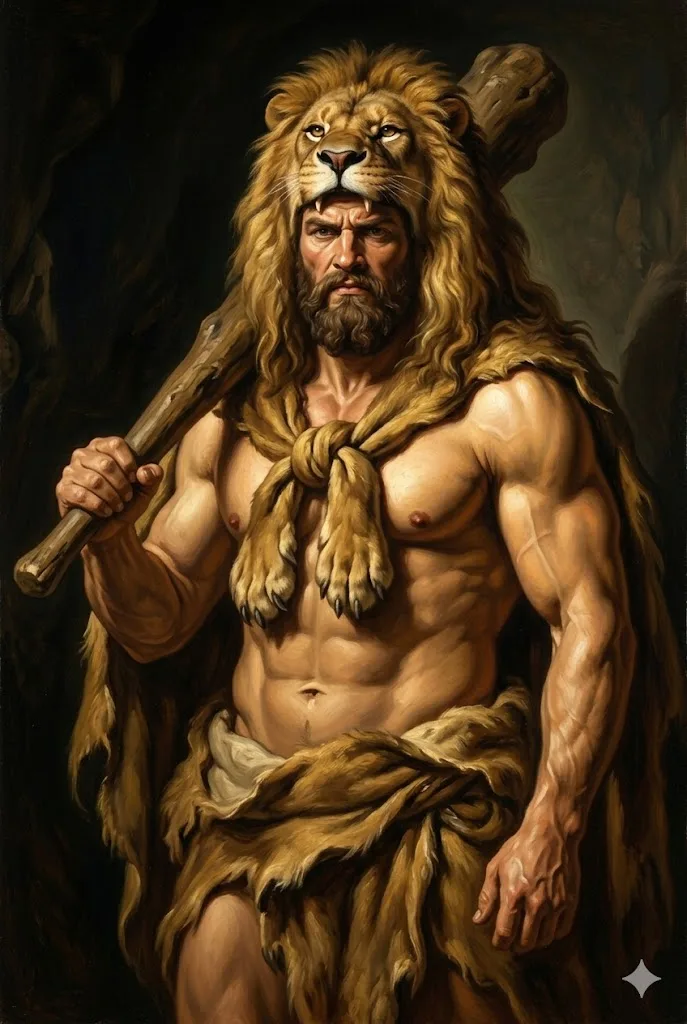
I. Who Was Heracles?
Heracles — known to the Romans as Hercules — was the greatest hero of Greek mythology and the strongest mortal who ever lived. He was the son of Zeus and the mortal woman Alcmene, and his life was defined by two opposing forces: the divine power inherited from his father and the relentless persecution of Hera, who despised him as living proof of Zeus's infidelity. His very name, meaning "Glory of Hera," was a bitter irony — for it was Hera's hatred that drove him to accomplish the feats that made him immortal.
As an infant, Hera sent two enormous serpents to kill him in his cradle. The baby Heracles strangled them with his bare hands — the first demonstration of the superhuman strength that would define his legend. He grew into a man of extraordinary physical prowess, equally skilled with the club, the bow, and in wrestling. But his life was marked by terrible suffering: Hera drove him temporarily mad, causing him to kill his own wife and children. To atone for this crime, the Oracle at Delphi commanded him to serve King Eurystheus of Tiryns and perform whatever labours were demanded of him.
The Twelve Labours — In Detail
The Twelve Labours of Heracles form the core of his mythology — twelve seemingly impossible tasks assigned by King Eurystheus as penance for killing his own wife and children in a fit of madness sent by Hera. Each labour took the hero further from civilization and deeper into the realms of the impossible, testing not only his strength but his ingenuity, endurance, and courage.
The first six labours took place in the Peloponnese: slaying the invulnerable Nemean Lion (whose skin became his iconic cloak), killing the nine-headed Lernaean Hydra (which grew two heads for every one cut off), capturing the sacred Ceryneian Hind (a deer with golden antlers sacred to Artemis), capturing the monstrous Erymanthian Boar alive, cleaning the Augean Stables in a single day (by diverting two rivers through them), and driving away the bronze-beaked Stymphalian Birds.
The final six labours sent Heracles progressively further from the known world: capturing the Cretan Bull, stealing the man-eating Mares of Diomedes, obtaining the girdle of Hippolyta the Amazon queen, stealing the cattle of the three-bodied giant Geryon from the western edge of the world, retrieving the golden apples of the Hesperides from the garden at the end of the earth, and finally descending to the Underworld itself to capture Cerberus, the three-headed hound of Hades. This final labour — bringing death's guardian into the realm of the living — was the ultimate demonstration of Heracles' power over every boundary, physical and metaphysical.
Heracles as Cultural Hero
Beyond his famous labours, Heracles was credited with countless other deeds that shaped the mythological world. He participated in the voyage of the Argonauts, fought alongside the gods in the Gigantomachy (war against the Giants), sacked the city of Troy a generation before the Trojan War, freed Prometheus from his chains in the Caucasus, and wrestled Death itself (Thanatos) to save the life of Queen Alcestis. He was the quintessential culture hero — a figure who used his extraordinary abilities to make the world safer for ordinary mortals by eliminating monsters, tyrants, and threats to civilized life.
The Greeks established hero cults in Heracles' honour at sites across the Mediterranean. Unlike most heroes, who received offerings at their tombs, Heracles was often worshipped with the full honours of a god — a unique status that reflected his mythological apotheosis. After his agonizing death (caused by the poisoned robe of Nessus), Heracles was carried to Mount Olympus, granted immortality by Zeus, reconciled with Hera, and married her daughter Hebe (Youth). He was the only Greek hero to achieve true godhood — the mortal who became immortal through sheer force of will and labour.
Roman Hercules and Beyond
The Romans adopted Heracles as Hercules, and he became one of the most popular deities in the Roman world. Roman generals and emperors claimed descent from Hercules or modelled themselves on his image. The Emperor Commodus infamously appeared in public dressed as Hercules, wearing a lion skin and carrying a club — a spectacle that horrified the Roman Senate but delighted the common people.
Heracles/Hercules has remained the most recognizable hero of Greek mythology in modern culture. From the Disney animated film to the Marvel Comics character to Kevin Sorbo's television series to Dwayne Johnson's 2014 film, Heracles continues to embody the ideal of strength in service of others. His story resonates because it addresses a universal human fantasy: the idea that one person, through sheer determination and courage, can overcome any obstacle and make the world a better place.
II. The Twelve Labours
The Twelve Labours of Heracles are among the most famous adventures in all of mythology. They were designed to be impossible — yet Heracles completed them all through a combination of superhuman strength, cunning, and divine assistance. The labours were: (1) slaying the Nemean Lion, (2) slaying the nine-headed Lernaean Hydra, (3) capturing the Ceryneian Hind, (4) capturing the Erymanthian Boar, (5) cleaning the Augean Stables, (6) slaying the Stymphalian Birds, (7) capturing the Cretan Bull, (8) stealing the Mares of Diomedes, (9) obtaining the Girdle of Hippolyta, (10) capturing the Cattle of Geryon, (11) stealing the Golden Apples of the Hesperides, and (12) capturing Cerberus from the Underworld.
Each labour took Heracles further from the known world — to the ends of the earth, beneath the ocean, and even into the realm of the dead. Along the way, he founded cities, liberated the enslaved, and set the boundaries of the known world at the Pillars of Hercules (the Strait of Gibraltar). Upon completing the labours, he was freed from servitude, but his adventures continued until his death — after which Zeus raised him to Olympus as a full god, the only mortal ever to achieve true divine immortality.
A Birth Hera Tried to Stop
The trouble began before Heracles was born. Zeus took the shape of Amphitryon, Alcmene's husband, while the real Amphitryon was away at war, and later writers say he made that night last three times its normal length. Amphitryon came home the next day, so Alcmene gave birth to twins: Heracles, son of Zeus, and Iphicles, son of Amphitryon. In Iliad 19, Agamemnon tells how Zeus boasted on the day of the birth that a descendant of his born that day would rule over all those around him. Hera made him swear to it. Then she held back Eileithyia, the goddess of childbirth, to delay Alcmene's labour, and hurried along the premature birth of Eurystheus, another descendant of Zeus through Perseus. That is why Heracles had to serve a weaker cousin. Ovid adds that Alcmene's servant Galanthis broke the spell by lying that the baby had already been born. Eileithyia turned her into a weasel for it.
Diodorus says the hero was first called Alcaeus or Alcides, after his grandfather Alcaeus. The name Heracles came later. Another well-known story says Hera was tricked into nursing the baby and pushed him away when he sucked too hard, and the spilled milk became the Milky Way. That story comes from later writers, not Homer or Hesiod.
The Choice, the Madness and Omphale
Xenophon preserves a parable by the sophist Prodicus, "Heracles at the Crossroads." As a young man, Heracles meets two women. Vice offers him an easy road of pleasure, and Virtue offers a hard road of toil that leads to lasting fame. He chooses Virtue. Ancient moralists, and later Renaissance painters, made this the key to his character.
Not every source places his madness in the same part of his life. Apollodorus puts the killing of his wife Megara and their children before the labours, as their cause. Euripides' Heracles reverses the order. The hero comes back from fetching Cerberus just in time to save his family from a usurper, and only then does Hera send Madness to make him kill them. Theseus leads him, broken, to Athens. Later he murdered his guest Iphitus in another fit, and as punishment he was sold for a year to Omphale, queen of Lydia. Later Greek and Roman writers liked to imagine him in women's clothes spinning wool while Omphale wore his lion skin.
Deianira, Nessus and Mount Oeta
To win his second wife, Deianira of Calydon, Heracles wrestled the river-god Achelous and broke off one of his horns. As the couple crossed the river Evenus, the centaur Nessus tried to rape her, and Heracles shot him with an arrow dipped in the Hydra's poison. As Nessus died, he told Deianira to keep his blood as a love charm (see centaurs). Years later, when Heracles brought home the captured princess Iole, Deianira soaked a robe in the blood, hoping to win him back. In Sophocles' Women of Trachis, the poison eats into his flesh. Deianira kills herself, and Heracles has himself carried to a pyre on Mount Oeta. The young Philoctetes, or his father Poeas, agreed to light it and was given the hero's bow. That bow was later needed to take Troy. Heracles also sacked an earlier Troy and returned from that expedition only to be caught in a storm Hera sent against him, which Zeus punished by hanging her from Olympus by her wrists.
God and Hero: How the Greeks Honoured Him
Ancient Greeks wrestled with the question of whether Heracles was a god or a hero. The Odyssey's own answer is mixed. In Book 11, Odysseus meets Heracles' phantom in the Underworld, glaring with a drawn bow, but lines that ancient critics already suspected as a later addition add that "he himself" feasts with the immortals and is married to Hebe. Herodotus approved of Greeks who kept two kinds of shrine to him, sacrificing to him as an Olympian immortal at one and offering to him as a hero at the other. At Athens he had the gymnasium of Kynosarges and the epithet Alexikakos, "averter of evil." The common prayer against misfortune was Herakles kallinikos, "Heracles of glorious victory." The kings of Sparta, and later the Macedonian royal house, claimed descent from him through the Heraclidae, his sons and their descendants who "returned" to the Peloponnese.
The fixed list of twelve labours seems to have taken shape quite late. The twelve metopes of the Temple of Zeus at Olympia (about 460 BC) are the first surviving complete set, and earlier poets refer to the labours more loosely. The famous Farnese Hercules in Naples, the weary, bearded hero leaning on his club with the Hesperides' apples hidden behind his back, is a Roman copy after a work by the fourth-century sculptor Lysippus.
Ancient sources
- Homer, Iliad 14, 15 and 19: Hera's trick at his birth, the storm she sent against him after Troy, and her punishment.
- Homer, Odyssey 11: Odysseus meets Heracles' phantom among the dead, while "he himself" lives with Hebe among the gods.
- Hesiod, Theogony and the Shield of Heracles: his killing of monsters, his marriage to Hebe, and his duel with Cycnus.
- Sophocles, Women of Trachis: Deianira, the poisoned robe and the order to burn him on Oeta.
- Euripides, Heracles: the madness after the labours, and Theseus' rescue of the ruined hero.
- Xenophon, Memorabilia 2.1: Prodicus' fable of Heracles' choice between Virtue and Vice.
Frequently asked questions
Was Heracles Hera's son?
No. That is an invention of Disney's Hercules. His mother was the mortal Alcmene, and Hera was his persecutor. The two were reconciled only after his death, when she accepted him on Olympus as her son-in-law.
Did Heracles have a twin?
Yes, Iphicles, born of Amphitryon on the same night. When Hera's serpents attacked, Iphicles screamed while baby Heracles strangled them, which was said to reveal which twin was the son of Zeus.
How did Heracles die?
Deianira gave him a robe soaked in the centaur Nessus' blood, poisoned by the Hydra. She believed it was a love charm. In agony, Heracles had himself burned on a pyre on Mount Oeta, and he was then taken up to Olympus.
Is Heracles a god or a hero?
The Greeks treated him as both. He was the rare mortal who became a full god after death, so he received both Olympian sacrifice and hero offerings. Herodotus approved of that double practice. See the Twelve Labours of Hercules for the individual tasks.
Explore More Mythology
Get weekly deep dives into the gods, heroes, and myths of ancient Greece.