Hector — Prince of Troy and the Noblest Warrior o
⚡ Quick Facts
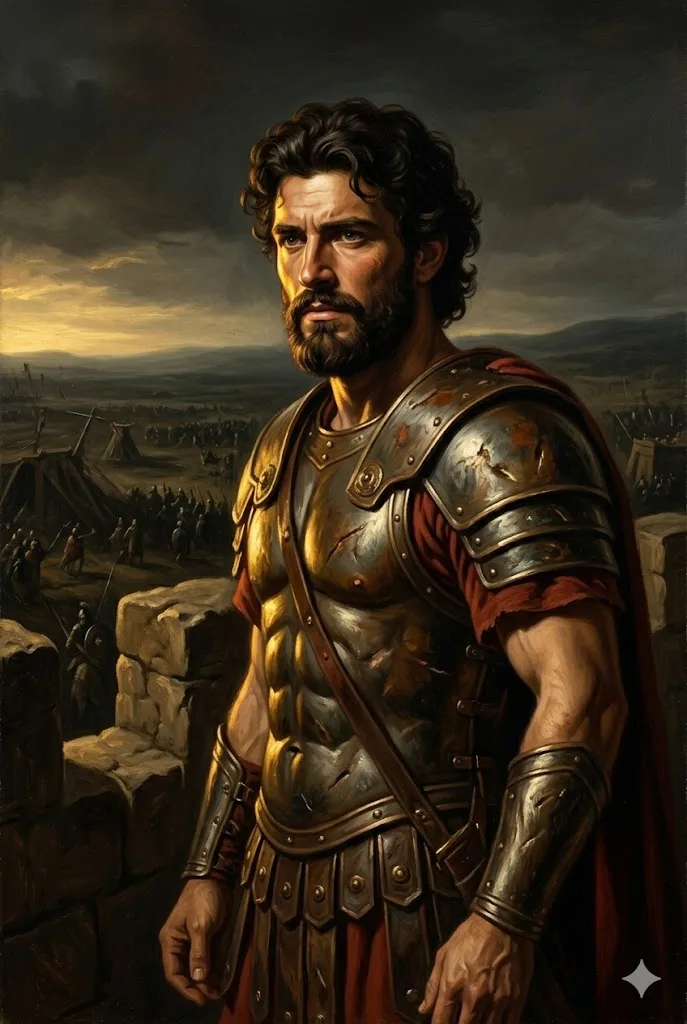
The Defender of Troy
Hector stands apart in Greek mythology as a hero defined not by divine blood or supernatural gifts, but by duty, courage, and love for his family. As the eldest son of King Priam and Queen Hecuba, he bore the weight of Troy's defense against the greatest army the Greek world had ever assembled.
Unlike his brother Paris, who started the war by abducting Helen, Hector fought not for glory or passion but because his city needed him. Homer portrays him as the most complete human being in the Iliad — a devoted husband, a loving father, a respected leader, and a fierce warrior who nonetheless knew fear and doubt.
Hector and Andromache
The scene between Hector and his wife Andromache at Troy's gates is one of the most moving passages in all of Western literature. Andromache begs him not to return to battle, reminding him that Achilles has already killed her father and seven brothers. She tells him he is her father, mother, brother, and husband all in one.
Hector reaches for his infant son Astyanax, but the child screams in terror at his father's war helmet with its horsehair plume. Both parents laugh through their tears. Hector removes the helmet, kisses his son, and prays that the boy will grow to be even greater than his father. Then he returns to war, knowing he will likely die.
The Duel with Achilles
After killing Patroclus, Hector knew Achilles would come for him. When that moment arrived, Hector's courage briefly failed — he ran three times around Troy's walls with Achilles pursuing. Only when Athena appeared disguised as his brother Deiphobus did Hector stop and face his fate.
The duel was brief and brutal. Hector threw his spear and missed. He turned to Deiphobus for another weapon, but the phantom had vanished. In that moment, Hector understood: the gods had abandoned him. He drew his sword and charged anyway, choosing to die fighting rather than flee.
Achilles drove his spear through the gap in Hector's armor at the throat. Dying, Hector begged for his body to be returned to his family. Achilles refused, dragging the corpse behind his chariot in one of mythology's most disturbing acts of vengeance.
The Ransom
The Iliad ends not with Greek triumph but with an act of compassion. Old King Priam, guided by Hermes, crossed enemy lines alone to kneel before Achilles and beg for his son's body. He asked Achilles to think of his own father, Peleus, who would never see his son return.
Achilles wept. For a moment, the two enemies — the father who had lost everything and the warrior who would soon die himself — shared their grief. Achilles returned Hector's body, and Troy mourned its champion for nine days. The poem ends with Hector's funeral, not with victory.
Hector's Battles Before the Final Duel
Hector's best-known scenes are with Andromache and at the end, but the Iliad shows him fighting all through the poem, with his successes and his mistakes.
- The duel with Ajax (Book 7). Hector challenges any Greek champion to single combat, and the lot falls to Telamonian Ajax. They fight until heralds stop them at nightfall and then exchange gifts: Hector gives a silver-studded sword and Ajax a purple belt. Later poets gave the gifts a grim afterlife. In Sophocles' Ajax, Ajax kills himself on Hector's sword, and Teucer notes that Achilles dragged Hector's body by the very belt Ajax had given him.
- Storming the wall (Books 12–15). Hector breaks the gate of the Greek camp with a huge stone that two ordinary men could barely lift, and leaps through with flashing eyes. In Book 15 he reaches the ships and grabs the stern of Protesilaus' vessel, calling for fire. This crisis is why Achilles lets Patroclus go into battle.
- Wearing Achilles' armour (Book 17). After killing Patroclus, Hector strips him of the armour Achilles had lent him and puts it on. Zeus, watching, pities him, because he is wearing the armour of a better man and will not return from battle for Andromache to take it from him.
The Mistake That Doomed Him
Homer gives Hector a real flaw. His adviser Polydamas, born the same night as Hector, warns him twice to be careful: once before the wall in Book 12, and again in Book 18, when he urges the Trojans to withdraw inside the city now that Achilles has returned. Hector rejects him angrily both times, and the Trojans cheer Hector, because, Homer says, Athena had taken away their wits. In Book 22, alone outside the Scaean Gate, Hector remembers this. He cannot go back inside, he says, because Polydamas would be the first to blame him, and he cannot face the Trojan men and women after destroying his people through his own recklessness. Just before this, Priam has begged him from the walls to come in, and Hecuba has bared her breast to him, pleading by the breast that nursed him. Hector's decision to stand and fight is courage, but it is also his shame at having been wrong.
The gods' part is spelled out as well. Zeus lifts his golden scales, Hector's fate sinks toward Hades, and Apollo leaves him. Even after death the gods protect his body. Aphrodite anoints it with ambrosial oil of roses, and Apollo covers it with a dark cloud so the sun will not dry it out. For twelve days of dragging, the corpse stays unharmed.
The Three Laments and Epithets
The Iliad closes with three women mourning him in turn. Andromache foresees slavery for herself and death for their son Astyanax. Hecuba remembers how Achilles dragged him around Patroclus' tomb but could not bring him back to life. Helen speaks last, and her lament may be the most moving tribute of all: in twenty years Hector never spoke a single harsh word to her, and he would stop others from abusing her. The final line names him with his traditional epithet: "So they performed the funeral of Hector, tamer of horses." Homer also often calls him koruthaiolos, "of the gleaming helmet," and androphonos, "man-slaying." His name is connected to echein, "to hold," which fits the man who held Troy together.
After the Iliad: Family, Bones and Cult
Andromache's prediction came true in the later epics and tragedies. When Troy fell, the baby Astyanax was thrown from the walls. The Little Iliad blames Neoptolemus, while Euripides' Trojan Women makes it a decision of the Greek council urged by Odysseus. Andromache herself became the war prize of Neoptolemus, son of Achilles. Hector was honoured as a hero in more than one place. Pausanias saw his grave at Thebes beside the spring of Oedipus. He reports that the Thebans had brought the bones from Troy because an oracle promised prosperity if they did. In the Troad, people still made offerings to him in Roman times. Medieval Europe made him one of the Nine Worthies, the model knights of history.
Two famous artworks show how early he was depicted. A Rhodian plate of about 600 BC in the British Museum, the "Euphorbos plate," shows Hector and Menelaus fighting over the body of Euphorbus, with all three names painted on. A red-figure amphora by Euthymides in Munich (about 510 BC) shows Hector putting on his armour between Priam and Hecuba.
Ancient sources
- Homer, Iliad 6, 7, 12, 15–18, 22 and 24: his farewell to Andromache, the duel with Ajax, the attack on the ships, the quarrel with Polydamas, his death, and the laments and funeral.
- Sophocles, Ajax: the exchanged sword and belt become instruments of death for both heroes.
- Euripides, Trojan Women and Andromache: the killing of Astyanax and Andromache's later life as a captive.
- Pausanias, Description of Greece 9.18: Hector's tomb at Thebes and the oracle that brought his bones from Troy.
- Virgil, Aeneid 2: Hector's mangled ghost appears to Aeneas in a dream and tells him to flee the burning city.
Frequently asked questions
Why did Hector run from Achilles?
Homer says fear seized him when he saw Achilles shining like the rising sun. He had just been weighing whether to surrender, offer back Helen and the treasure, or fight. He ran three times around the walls before Athena, disguised as Deiphobus, tricked him into standing his ground.
How long did Achilles keep Hector's body?
Twelve days pass from Hector's death before the gods intervene and Priam comes to ransom him. Achilles then grants a truce of eleven days: nine for mourning, the tenth for the funeral and the eleventh for the burial mound.
What happened to Hector's son?
Astyanax, whom the Trojans also called Scamandrius, was thrown from the walls of Troy after the city fell. Sources differ over whether Neoptolemus or a decision urged by Odysseus was responsible.
Was Hector a demigod?
No. Both his parents, Priam and Hecuba, were mortal, although a few late sources claim Apollo was his father. In the Iliad, Apollo is his protector, not his parent.