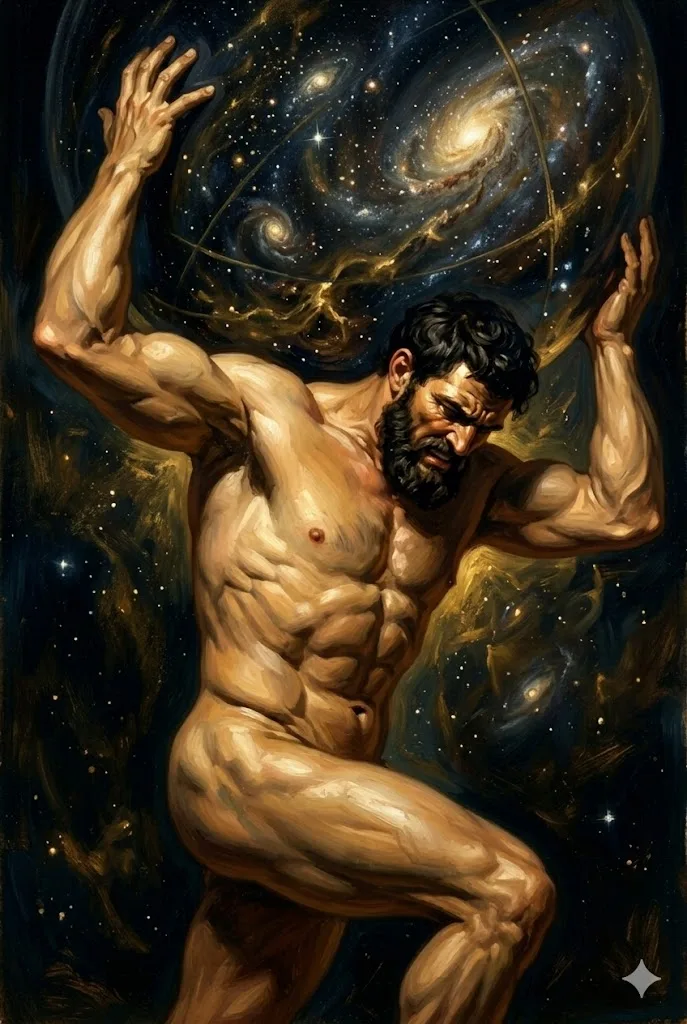
I. Who Was Atlas?
Atlas was a second-generation Titan — son of Iapetus and brother of Prometheus, Epimetheus, and Menoetius. After the Titanomachy, when the Olympian gods defeated the Titans, Zeus singled Atlas out for a special punishment: he was condemned to stand at the western edge of the world (later identified with the Atlas Mountains of North Africa) and hold the celestial spheres upon his shoulders for all eternity. It was Atlas who kept the sky from crashing down upon the earth — a burden no other being, mortal or immortal, could bear.
Despite his punishment, Atlas appeared in several important myths. When Heracles came seeking the Golden Apples of the Hesperides (Atlas's own daughters), he offered to hold the sky temporarily while Atlas fetched the apples. Atlas, delighted to be free of his burden, retrieved the apples but then refused to take the sky back. Heracles outwitted him by asking Atlas to hold the heavens "just for a moment" while he adjusted a pad on his shoulders — then walked away with the apples.
In another tradition, Perseus turned Atlas to stone by showing him the head of Medusa, transforming the Titan into the Atlas Mountains. Atlas was also the father of the Pleiades (the seven sisters who became a star cluster), the Hyades, and the Hesperides (guardians of the golden apples). Our word "atlas" — meaning a book of maps — derives from his name, after a 16th-century collection of maps depicted him holding not the sky but a globe of the earth.
Classical Sources
The mythology of Atlas is preserved in:
- 📜 Hesiod, Theogony (c. 700 BC) — The primary source for Titan mythology, genealogy, and the Titanomachy.
- 📜 Apollodorus, Bibliotheca (c. 1st–2nd century AD) — Comprehensive handbook of Titan genealogies and myths.
- 📜 Aeschylus, Prometheus Bound (c. 5th century BC) — Dramatic portrayal of Titan defiance against Olympian authority.
- 📜 Ovid, Metamorphoses (8 AD) — Roman accounts of Titan mythology and transformations.
Cross-referenced with multiple classical sources for accuracy.
Explore More Mythology
Get weekly deep dives into the gods, heroes, and myths of ancient Greece.